
Home / Laundry Room
Room guide
Laundry room organization
Laundry room organization for small rooms and laundry closets: shelving, sorting and space-saving storage.
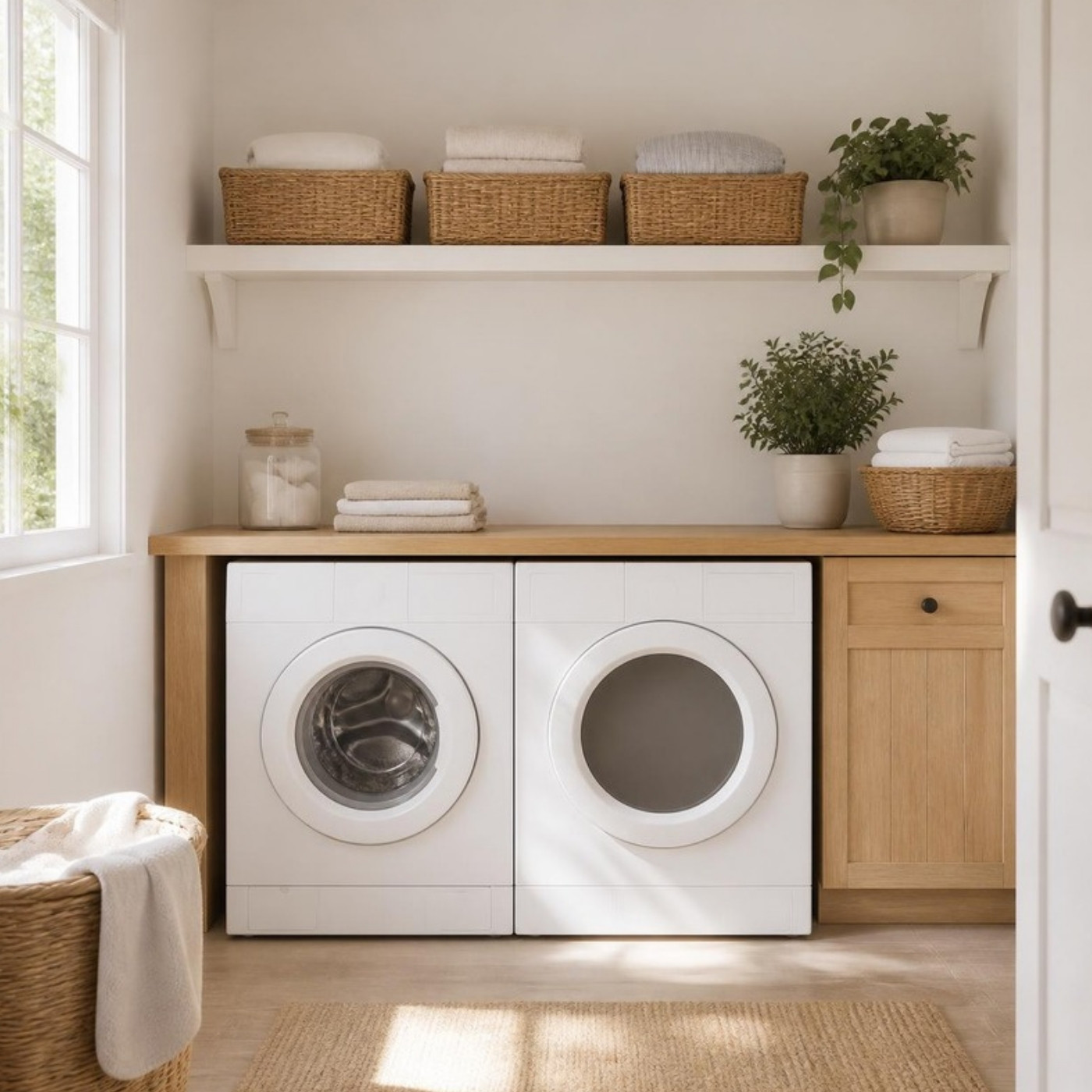
The floor is taken. The walls are not.
A laundry room is usually a corridor with two machines in it. Every fix starts from the same place: the floor is spoken for, so the storage goes up.
One shelf above the machines. It holds the detergent and everything that currently sits on top of the washer, which is where things slide down the back and stay. If your machines are stacked, measure the clearance above the top one before you buy any shelf.
Sort before, not after. Two or three baskets where clothes actually come off, rather than one basket by the machine, means the sorting already happened by the time you get there.
Plan the drying space. It is the thing most laundry layouts forget, and it is why wet clothes end up on the backs of chairs. A wall-mounted rack that folds flat costs nothing in floor space when it is closed.
Some wall fittings print a weight limit on the packaging, and some print none at all. Look for it before you load anything, because a rail full of wet towels is heavier than it looks.
Best-of guide
Our side-by-side comparisons start from the measurement that rules a product out, not from a star rating. How we compare
Free printables
Printable checklists for every room
Sorting is the hamper's real job
One hamper means you sort on the floor on wash day. That is the actual cost of a single laundry basket, and it is paid every week.
Sorting at the point where clothes come off is what removes that step. Two sections covers most households, lights and everything else. Three if someone's work clothes need their own wash. In a family, one laundry hamper per person works better than one per color, because then the folding comes out sorted too.
A laundry hamper with a lid keeps the smell in and the sight of it out. It also hides the fact that it is full, which is how a lidded hamper ends up with a pile beside it. If that is your house, open is better.
A rolling laundry basket earns its keep when the machines are not on the same floor as the bedrooms, or when carrying a full load is the thing that makes you put it off. Check the wheels against your floor. Hard casters on tile are loud, and small wheels struggle on a door threshold.
A collapsible laundry hamper is for the house where the hamper itself has nowhere to live between loads.
Drying needs more room than washing
Two machines take a fixed footprint you cannot argue with. Drying is the part that spreads, and in a small laundry room it is the thing with no home.
A foldable laundry drying rack is the usual answer because it is only in the way while it is in use. Measure the clear floor in front of the machines before you buy one. A rack needs that floor when it is open, and if it blocks the machine doors it will end up living in the hall.
Where there is no floor at all, drying goes on the wall. A wall mounted rack that folds flat, a retractable line, or a rod across the room above the machines all do the same job without claiming floor. A rod's own instructions name what it has to be fixed to, and that is the line to read before you drill. If the listing does not give it, ask the seller in writing and keep the reply.
Whatever you hang on, leave air around the clothes. Where two items overlap they cover each other's surface, and covered fabric dries slowly.
The space above the machines
This is the biggest unused surface in most laundry rooms, and the choice is open shelving or laundry room cabinets.
Open shelving is cheaper, easier to put up, and shows every bottle, so it suits a room where the things on it are things you actually use. Cabinets hide the clutter and cost more. In a room you walk through rather than sit in, open usually wins.
One measurement decides the height either way. With a top loading washer, the lowest shelf has to clear the lid at full open, not the lid closed, so measure with the lid up. On a front loader you can come much lower, and the useful rule is to leave enough room to lift a full basket onto the machine.
Weight matters on a shelf above head height. Detergent is heavy, and a full jug is one of the heaviest things in the room. Keep it at or below waist height and put the light, bulky things up high.
If your laundry is a closet
A laundry closet is its own problem: bifold or sliding doors, no counter, and a doorway narrower than the space behind it.
Measure the door opening, not the closet. That opening is what rules out most rolling carts and most tall units, and it is the measurement people take last. On bifold doors, also check how far the panels fold back into the opening, because they can cost you a hand's width on each side permanently.
The narrow gap between or beside the machines is the one piece of room a laundry closet usually has spare. A slim rolling cart that fits it holds detergent and pulls out when you need it. Measure that gap at its narrowest point, including any hose or pipe, not at the front.
Questions we get about laundry room organization
Can I put a counter over a top loading washer?
Not a fixed one, because the lid has to open. Either the counter stops at the dryer, or it hinges, or the folding surface goes somewhere else in the room. This is the most common planning mistake in a laundry room, and it only becomes visible once the counter is in.
Where do I fold if there is no counter?
On a wall mounted surface that drops down, on a board laid across the top of a front loader, or in the room the clothes are going to. Folding where the clothes live removes a trip, and it is the option nobody considers because it does not look like a laundry room upgrade.
What about the gap between the washer and dryer?
Socks go down it, so either fill it with a slim cart that matches the gap or close it off. Measure the narrowest point: hoses and the machines' own feet often make the gap tighter at the back than it looks from the front.