
Home / Kids
Room guide
Kids organization
Toy storage, closets and school stuff: simple systems kids can actually put away themselves.
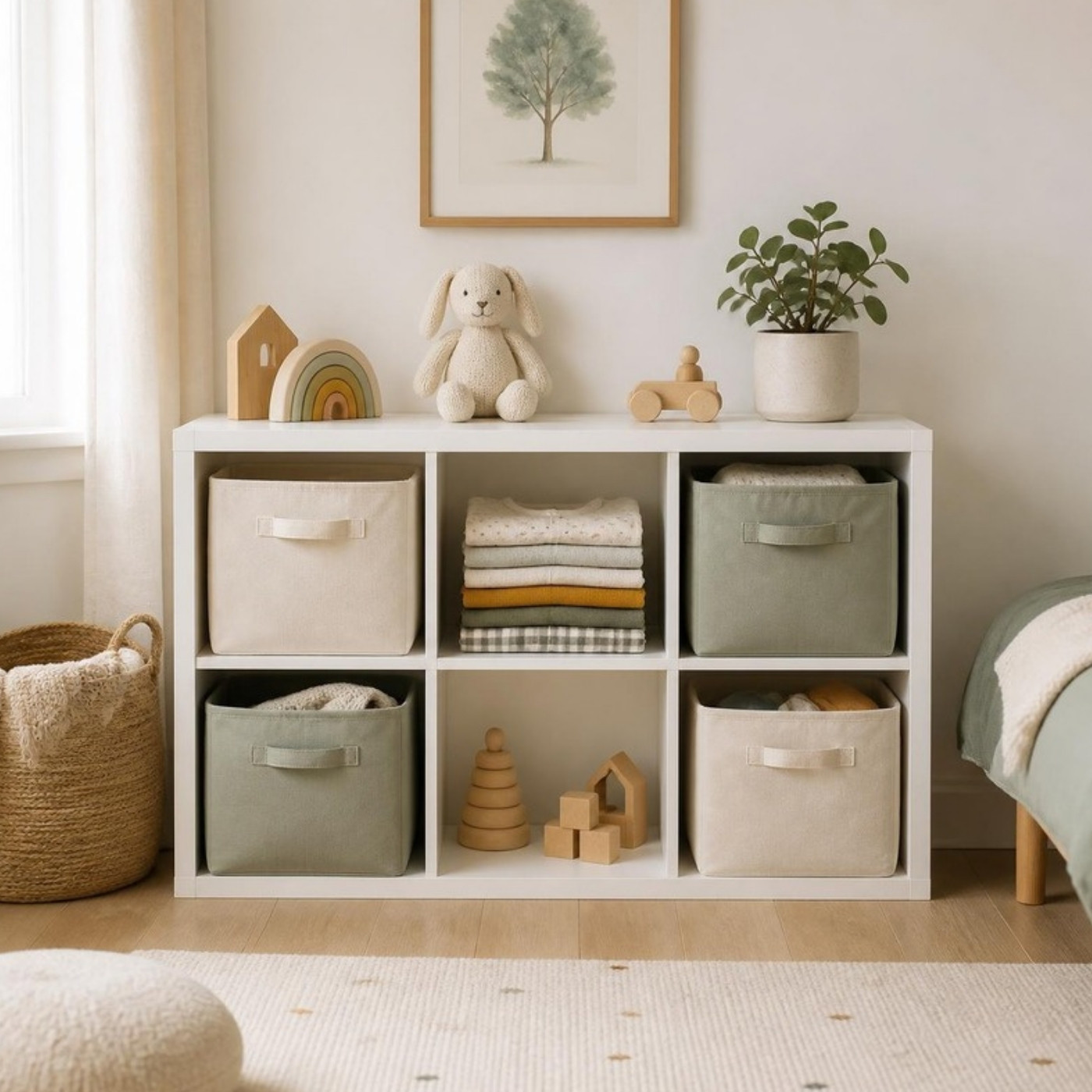
A system a child can use without you
Most kids' storage fails for the same reason: it was designed for an adult to tidy, not for a child to put away.
Open, not closed. A lid is one step too many. Open bins and baskets get used. Boxes with lids end up stacked in a corner, still full from the last cleanup.
At their height. Anything above a child's shoulder belongs to you, not to them. Daily toys go on the bottom two levels. The things you hand out yourself, and the ones with small parts, go up high.
Fewer categories. Three bins a child can name beats twelve carefully labeled ones. Building, cars, soft toys works. Small plastic animals does not.
Clothes follow the same rule. A closet rod low enough to reach turns getting dressed into something they do alone, and a drawer they can open is worth more than a closet they cannot.
Best-of guide
Our side-by-side comparisons start from the measurement that rules a product out, not from a star rating. How we compare
Free printables
Printable checklists for every room
Why a toy box fails and open bins work
A toy box is one deep container with a lid, and that shape has a built in fault. Whatever is on top gets played with, and whatever sank never does. After a month the bottom third is archaeology.
Depth is the problem, and the measurement that matters is your child's arm, not the box. If they cannot reach the bottom without climbing in, they will not put anything back down there either.
Several shallow open bins beat one deep closed box for the same reason a drawer beats a sack. The child can see the contents from standing height, and that is what turns putting things away into a one step job instead of a negotiation.
A lid has one real use: it stops the room looking like a toy room when someone comes over. If that is why you want it, buy the lid and accept the sorting cost, rather than expecting the toy chest to also be the system.
Sort by what the toy does, not by what it is
Adults sort by material and size. Children sort by game. A bin labeled small plastic means nothing to a four year old. A bin that holds everything for the farm game means something immediately.
Watch what comes out together and make that a bin. The cars and the mat they drive on. The dolls and their clothes. Dress up. Everything that belongs to one activity, in one container: that is the whole method.
Use pictures on the labels rather than words for anyone who cannot read yet. A photo of the actual contents is easier to match than a drawing, because there is nothing left to interpret.
Three categories that need their own answer
Stuffed animals. They compress, so they fill whatever container you give them and rarely look tidy in a bin. Stuffed animal storage works better hanging, or in an open net or basket where a loose shape is the point. A tall open basket in a corner is at least honest about what they are.
Lego and other small pieces. A bin mixes them, which is the opposite of what building needs. What works is a flat surface: a shallow tray, or a drawer unit where each drawer holds one kind of piece. Shelves for Lego are for finished builds, which is a display problem rather than a storage one, and they belong somewhere a passing sleeve cannot sweep them off.
Books. Spines mean nothing to a child who cannot read yet. Front facing shelving shows the cover, which is the thing a child recognizes, and it costs nothing more than a different shelf.
Height is what decides whether a child uses it
If a child cannot see into a container without being lifted, it is your storage, not theirs. That is the whole idea behind a low open shelf, the montessori toy shelf included: the toys sit at the height of the person who plays with them.
Which gives a simple split for a shared room. Everything the child is meant to manage goes below their shoulder. Everything you manage, the spare puzzles, the craft supplies that need supervision, the toys being rotated out, goes above their reach. A toy storage bench works because it is seat height, which puts the opening somewhere a small child can reach into from standing.
Rotation is the other half of it. A playroom with every toy out at once does not get tidied, because there is nowhere to put it all. Keeping a share of it boxed and out of sight, and swapping it every few weeks, cuts the volume and makes the old toys new again.
Questions we get about toy storage
At what age can a child tidy up on their own?
Earlier than most systems allow for, as long as the system has no steps. One bin, one kind of thing, no lid, within reach, picture on the front. Every extra step you add, a lid to lift, a drawer to pull, a word to read, is a reason to give up.
How many bins do I need?
Count the games your child actually plays, not the toys they own. That count, not the toy count, is the number of bins. More bins than games means toys get split across containers and nothing ends up with a home.
Open shelves or a cube unit?
A cube unit with removable fabric bins is the common choice because the bin comes out onto the floor, which is where the game happens. Open shelves are better for anything on display or in progress. Most rooms end up wanting some of each, with the cubes low and the shelves high.