Entryway Closet: The Two Depths People Keep Confusing
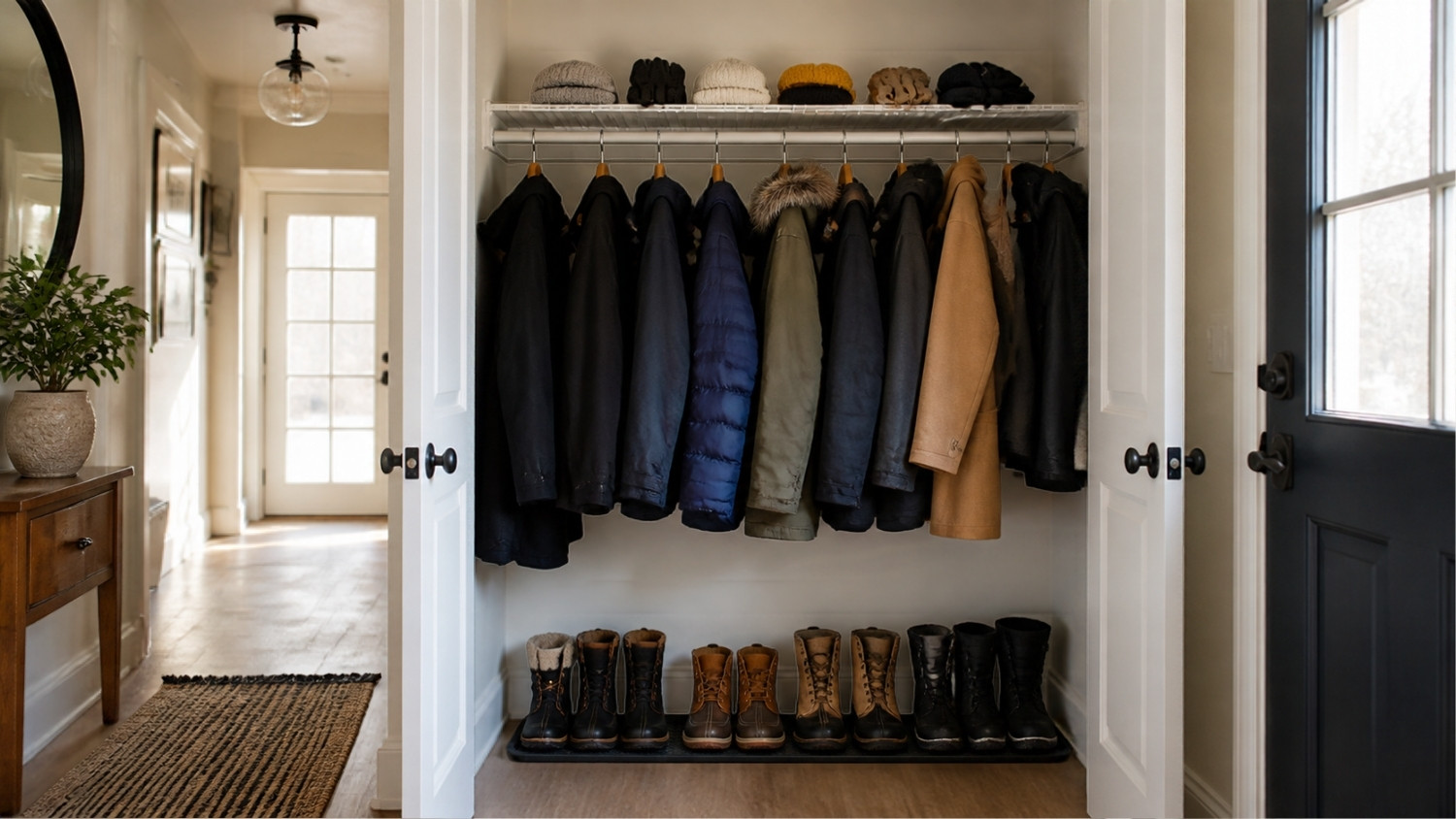
In an entryway closet, the word depth covers two different measurements, and they do not have the same limit.
There is the depth of the closet itself, from the back wall to the inside of the closed door. And there is the depth of the shelf you screw to the wall inside it. Hunker puts the standard minimum depth of a reach-in closet at 24 inches, and writes that a closet intended to store coats or other bulky hanging items may need to be as deep as 28. A kit’s shelf can be 12. Take your own number before you buy anything.
- 24 inHunker’s standard minimum for the room
- 28 inWhat Hunker says coats or bulky items may need
- 12 inThe shelf depth the ClosetMaid SuperSlide kit publishes
- 16 inThe least Hunker says a shelf should be for large items
The listing publishes two different figures and does not reconcile them. The ClosetMaid SuperSlide listing gives a Total Weight Capacity of 60 lbs. in its details table. In the questions section of that same listing, ClosetMaid answers that the hang rod is designed for a functional load of 15 lbs per linear foot, and that the shelf is designed for the same. A second seller answer, from AMES Companies, says the shelving and rod will hold up to 15 lbs per linear foot when properly installed. One is a total for the whole kit, the other is a rate per linear foot. The page does not say which one applies to a run of this length. Ask the seller to confirm in writing which figure covers your length before you hang the family’s winter coats on it.
And it conditions its own figure without ever defining the condition. ClosetMaid publishes that the shelving and rod will hold up to 15 lbs per linear foot when properly installed. On the parts of that page I could read, the product header and the features list, there is no installation requirement at all: nothing on what the shelf and rod are fixed into, and nothing on which fasteners come in the box. I could not open its product details or its questions and answers section, so I am not speaking for those. Ask ClosetMaid what properly installed means for your length before you drill. Meanwhile, spread the coats along the rod rather than letting them bunch at one end, because the figure the two seller answers give is a rate per foot.
And one rule in plain words. Anything tall that stands on the closet floor gets fixed to the wall. That applies whatever it weighs and whoever lives in the house. The Anchor It campaign from the Consumer Product Safety Commission is where to read what their own pages publish about it.
Two depths, one sheet. Our free Entryway Fit Planner takes the depth of the passage on page 2 and the clear run of wall on page 3. Take those before you price a kit, and the shelf depth stops being a guess. Get the planner
Entryway closet depth, and the shelf depth that lives inside it
24 and 12
Twelve inches sounds shallow next to the 24 inches Hunker calls a standard minimum. The 24 is the room. The 12 is the board. The shelf sits against the back wall, the coats hang underneath it and come forward toward the door, and that forward reach is what the door has to close on.
Before you buy a kit for this closet
Step 1
Take the measurement, your own way
I found no measuring method published with the Hunker figures, so here is how I take mine, and it is the one this article uses. Open the closet. Put the tape on the back wall and run it forward to the inside face of the closed door. Write that number down before you look at a single product.
Step 2
Do not buy on width alone
The 72 in kit needs a closet wide enough for it. Take your closet depth as well, since the coats hang in front of the shelf. Hunker says a closet less than 22 inches deep isn’t deep enough to allow hanging clothes.
Step 3
Do not count on the top shelf for large items
The kit gives 12 in of shelf depth, and Hunker puts 16 inches as the least a shelf should be for them. Hats and gloves go up there. Our guide to closet shelf depth has the figures for the deeper boards.
Step 4
Get the weight figure first
Find what the seller publishes on that page and ask which of its two figures applies to your length, rather than loading the rod on a guess. The warning above has both figures and what is missing from them.
Taking the tape to the closet this weekend? Print the Entryway Fit Planner and fill it in at the door. Four steps, five pages, and every published figure on it carries its source. Send it to me
What an entryway closet is asked to holdand why it fills faster than a bedroom one
A bedroom closet holds clothes that hang still for months. An entryway closet holds the coat that came in wet an hour ago, the bag that gets dropped, and the boots of whoever walks through.
It also tends to be small.
So it fills, and then the door stops closing.
Here is the confusion, in one example. On its Home Depot listing, the ClosetMaid SuperSlide kit is 72 in wide, and the specification table gives a shelf depth of 12 in. Twelve inches sounds shallow next to the 24 inches Hunker calls a standard minimum. The 24 is the room. The 12 is the board.
Hunker also says a shelf should be at least 16 inches deep to allow for storage of large items. The 12 in board is below that figure.
What I could not verifytwo things, said plainly
Both come from the single product listing I read in full for this article.
The length of the hang rod is not in that listing’s dimensions table. It appears in the highlights, as 6 ft. of hang space, which is not a table row.
And I found no figure on that page for how many coats the rod holds. Your own coats would decide it. Weigh one on a kitchen scale if you want a number to plan with.
Questions people ask3 questions
How deep should an entryway closet be?
Hunker gives 24 inches as the standard minimum for a reach-in closet, and writes that a closet for coats or other bulky hanging items may need to be as deep as 28 inches. It also says a closet less than 22 inches deep isn’t deep enough to allow hanging clothes. Measure from the back wall to the inside of the closed door. I found no measuring method published with those figures, so use them as a guide rather than an exact match.
Why does my closet door not close any more?
The usual cause is what hangs inside coming forward past the door line. Take the coats out, measure the empty closet from the back wall to the inside of the closed door, and put back what fits inside that number.
Is a 12 inch shelf too shallow for a coat closet?
For large items, yes: Hunker puts 16 inches as the least a shelf should be to hold them, and the ClosetMaid SuperSlide kit publishes 12 in. Small things go up there instead. And whatever sits on that shelf, anything tall standing on the closet floor is a tip-over question, and the Anchor It campaign from the Consumer Product Safety Commission is where to read what their pages publish about it.
Take the tape to the door
The free Entryway Fit Planner takes the depth of the passage on page 2 and the clear run of wall on page 3. Four steps, five pages, and every published figure on it carries its source.
Saved in this browser, on this device. No account, nothing sent to us, and it goes if you clear your browsing data. See what you saved