Entryway Shoe Storage: What Two IKEA Cabinets Publish About Depth
When you buy through a link on Cozy & Tidy, we may earn a commission. It does not change the price you pay, and it does not decide what we recommend. How it works
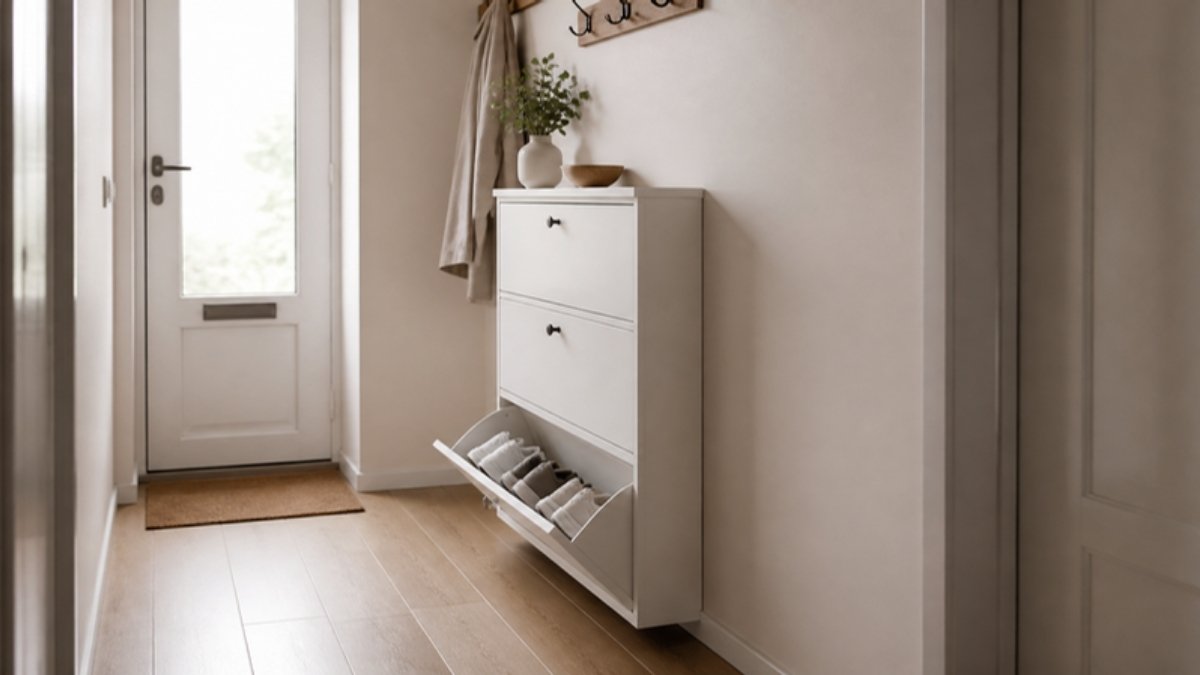
Entryway shoe storage has to fit your hallway, not just your shoes.
On the two IKEA cabinets I read, the depth is published plainly: 11 inches on the BISSA, and 7 1/8 inches on the TRONES. That depth comes out of the space you walk through, so the figure to take first is your own passage, wall to wall, at the spot where the cabinet would stand.
IKEA writes on the BISSA page: This cabinet must be fastened to the wall; the back panel has predrilled holes to make it easier. And on the TRONES page: These shoe cabinets must be secured to the wall. The TRONES is 15 3/8 ” high and the BISSA is 53 1/8 ” high. Both pages say must.
Both pages also carry this line: Different wall materials require different types of fasteners. Use fasteners suitable for the walls in your home.
If you do not know what your walls are made of, find out before you drill, or have that part done by someone who does.
The free Entryway Fit Planner. Page 2 is the depth you can give up where you actually walk, and page 4 counts the pairs that really live at the door. Five printable pages, with the IKEA depth figures on the same page as the box you write yours in. Send it to me
What entryway shoe storage publishes about depth
- 11 “The depth the BISSA page prints, in its Measurements section.
- 7 1/8 “The depth the TRONES page prints, same section, same label.
- ShutBoth of those are the cabinet closed. Neither page publishes how far a door or a drawer swings out.
- MustBoth pages require the cabinet to be fastened to the wall. Neither leaves it optional.
Yours
Take it at the spot where the cabinet would go, not at the widest part of the hall. Then take the published depth off it and picture yourself walking through what is left, with a drawer open.
Four shapes of entryway shoe storage, and what each one costs you
Every one of these takes something out of the hallway. What changes is what it takes, and what question decides it. The only published figures below are the two IKEA depths, because those are the two pages I read.
The slim shoe cabinet. This is what the two pages above describe. It stands flat against the wall and takes its published depth out of your passage: 11 inches on the BISSA, 7 1/8 inches on the TRONES, both under the label Depth in the Measurements section. What decides it is your wall to wall figure, and one thing that has nothing to do with measuring: both pages say the cabinet must be fixed to the wall, so you need to be allowed to drill and to know what your walls are made of.
The open rack. Nothing is fixed to anything, which is what makes it the easiest to undo. It still takes depth out of the passage, and there is a catch the photos hide: a rack is measured empty, and a shoe pointing outwards sticks out past the frame. Measure the rack, then put your own largest shoe on the floor and measure that too. The bigger of the two numbers is what the hallway actually loses.
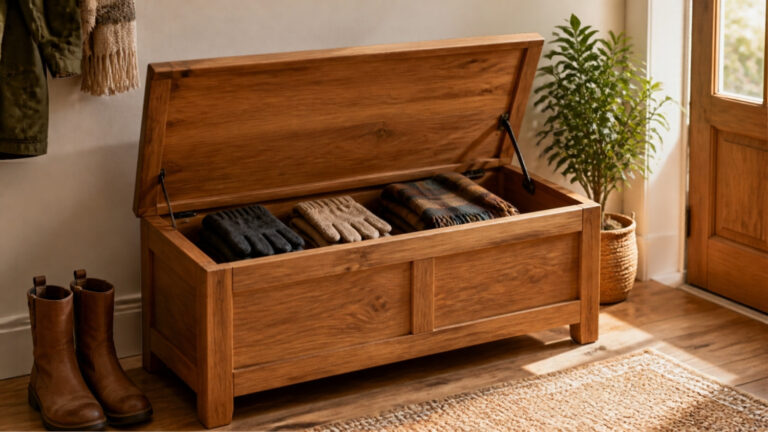
The storage bench. It does two jobs, which is why people want one, and it is used sitting down, which is why the depth on the page is not the whole story. You need room in front of it to sit and to stand up again, and that room is yours to measure, not the listing’s to publish. Our mudroom bench guide takes the depth, the load and the seat height one at a time.
Over the door. The only one of the four that takes no floor at all, which makes it the answer when the passage has nothing left to give. Two things decide it: whether the door still closes with it hanging there, and what it is rated to carry. Read what the listing says about the second, because a loaded organizer on a door is weight that swings.
The tape test, in three steps
Step 1
Measure your passage first
Wall to wall, in inches, where the cabinet would stand. Do this before you compare anything else and before you fall in love with a photo.
Step 2
Hold a tape out from the wall
Stand where you walk and have someone hold a tape against the wall at the depth the listing publishes. Then open an imaginary drawer. Five seconds and you will know.
Step 3
Count what lives by that door
Whole pairs, counted on a bad day, not your whole collection. Compare that with the pairs figure on the page, and measure your tallest boot while you are there.
How narrow your hallway gets once the cabinet is in
Your hallway against the two published depths. It runs in your browser, and nothing leaves this page.
Wall to wall, at the spot where the cabinet would stand.
Whole pairs, counted on a bad day, not your whole collection. Optional.
The figures here are the ones the two IKEA listings print, and I name the section each one sits in. The pages are the BISSA shoe cabinet with 3 compartments, 105.302.59, and the TRONES shoe/storage cabinet, 003.973.07.
If you rent, or cannot drill
Start with the part that is not negotiable. Both of the cabinets on this page say, on their own pages, that they must be fixed to the wall. The BISSA page prints: This cabinet must be fastened to the wall; the back panel has predrilled holes to make it easier. The TRONES page prints: These shoe cabinets must be secured to the wall. If drilling is not available to you, those two are out, whatever your hallway measures.
So the question becomes a different one. Instead of asking how deep a piece is, ask what its own listing says about how it stands. A listing that states the piece stands on its own tells you something. A listing that says nothing either way tells you nothing, and that is a question to put to the seller before you order rather than something to assume. We are not going to tell you a piece is safe standing loose when its own maker has not said so.
Check your lease before you answer any of this, because the rule you are working to is in there, not here.
Ordered by what costs least to undo when you leave. Over the door takes no floor and no fixing, so it is the first thing to try when the passage has nothing to give. A tray or an open rack comes next: nothing is attached, and a boot tray is the smallest depth of anything here. A freestanding piece follows, on the condition above. And last comes anything that goes into the wall to carry weight, where the instructions in the box are what to follow rather than anything we could tell you.
That order is about what you can reverse, not about what is safe. Nothing on this list is safe to overload, and a piece that was never meant to stand loose does not become safe because it is convenient.
Every figure these two pages publishdepth, width, height, and the pairs count that says approx
Both IKEA pages put the depth in the Measurements section, under the same label.
The BISSA shoe cabinet with 3 compartments publishes Depth: 11 “. It also publishes Width: 19 1/4 ” and Height: 53 1/8 “.
The TRONES shoe cabinet publishes Depth: 7 1/8 “. Its other figures are Width: 20 1/2 ” and Height: 15 3/8 “, and the same section publishes Package quantity: 2 pack.
Those are the two numbers to hold against your own passage. Take yours first, then read the listing. Flat against the wall, one drawer open: the depth is the line both of these pages put in the Measurements section.
The pairs count is published too, and it says approx
IKEA publishes a shoe count in the Good to know section on both pages.
For the BISSA: Holds approx. 12 pairs of shoes. For the TRONES: Holds approx. 4 pairs of shoes.
The word approx. is IKEA’s, not mine.
And here is something the TRONES page leaves open, which I would rather tell you than paper over. It publishes Holds approx. 4 pairs of shoes in one place and Package quantity: 2 pack in another, and I did not find a sentence on that page saying which of the two the count belongs to. So I am not going to decide it for you. If that number is the one your plan rests on, ask IKEA before you order.
Count what actually piles up by your door, and hold your own number against the one on the page.
What that depth takes from your hallwaythe tape test, and why the sum is not the answer
A cabinet in a hallway takes its depth out of the space you walk through. So the thing to picture is not how slim it looks in a photo. It is how much of your passage is left once it is against the wall.
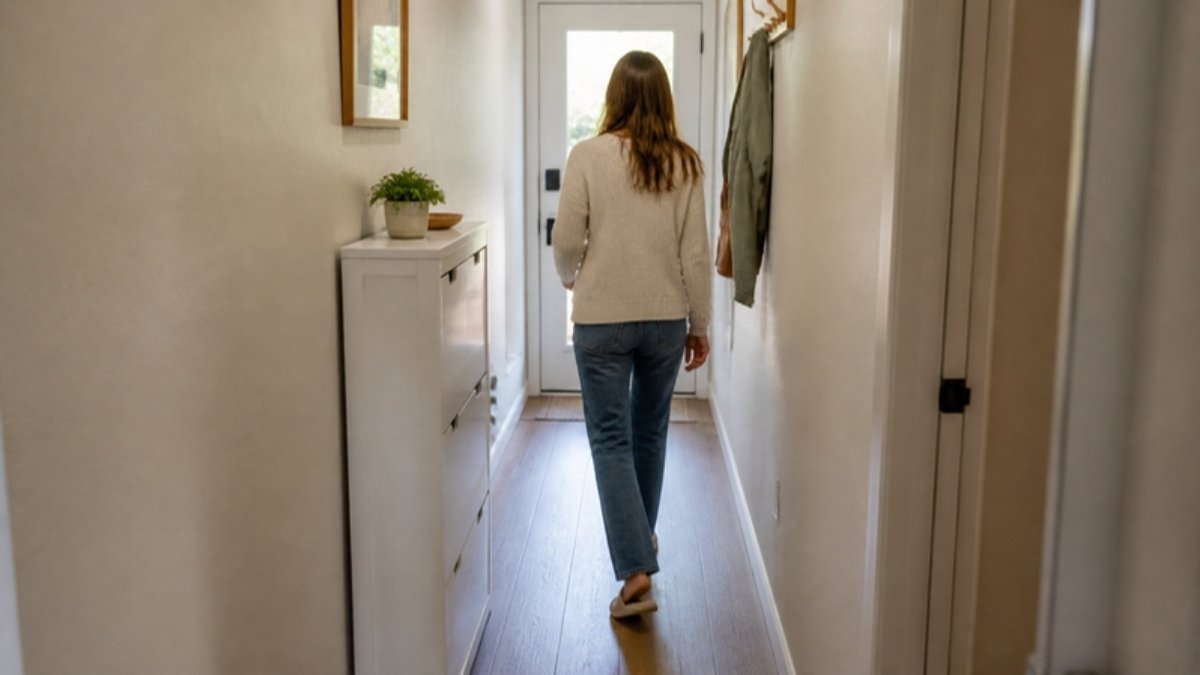
Our mudroom storage solutions guide has a tape test for exactly this. Stand where you walk, have someone hold a tape against the wall at the depth the listing publishes, and you will feel right away whether the passage still works.
Do that before you fall in love with anything.
Four things to check before you order
- Measure your passage first. Run the tape test at the depth the listing publishes, before you compare anything else.
- Count what lives by your door. Compare that number with the pairs figure on the page, not with your whole shoe collection.
- Find out what your walls are made of. Both of these pages say the cabinet must be fixed to the wall, and both say to use fasteners suitable for the walls in your home.
- Measure your tallest boot. Neither of these pages publishes a maximum shoe size, so take that number with you rather than hoping.
What I could not verifythree gaps, said plainly
Three things, said plainly, and that is the whole of what these two entryway shoe storage pages publish and leave out.
In the Measurements, Good to know and Safety and compliance sections of both pages, I found no maximum load, no interior or compartment dimensions and no maximum shoe size. If one tall boot has to fit, measure the boot and ask IKEA before you order. Neither page carries a questions and answers section.
And both of these are IKEA. Two pages from one maker is not the market. Two cabinets from one maker is a thin slice of what is sold. Read this as a record of two listings.
If your entryway also has a closet, our guide to entryway closet organization takes the two depths that get confused in there.
Questions people ask2 questions
How deep is a shoe cabinet for an entryway?
On the two IKEA cabinets I read, the published depths are 11 inches for the BISSA shoe cabinet with 3 compartments and 7 1/8 inches for the TRONES, both under the label Depth in the Measurements section. Measure your own passage before you compare them. Stand where you walk, have someone hold a tape against the wall at the published depth, and see whether you still pass comfortably.
Does a shoe cabinet really need to be attached to the wall?
On both IKEA pages I read, yes, and the maker says so itself. The BISSA page says the cabinet must be fastened to the wall and that the back panel has predrilled holes to make it easier. The TRONES page says these shoe cabinets must be secured to the wall, and the TRONES is 15 3/8 inches high. Both pages add this line: Different wall materials require different types of fasteners. Use fasteners suitable for the walls in your home. If you do not know what your walls are made of, have that part done by someone who does.
Taking the tape to the front door this weekend? The Entryway Fit Planner carries the IKEA depth figures on the same page as the box you write yours in. Five printable pages. Download the planner
Saved in this browser, on this device. No account, nothing sent to us, and it goes if you clear your browsing data. See what you saved