Kitchen Cabinet Organization: What Goes Where, and What Actually Fits
When you buy through a link on Cozy & Tidy, we may earn a commission. It does not change the price you pay, and it does not decide what we recommend. How it works
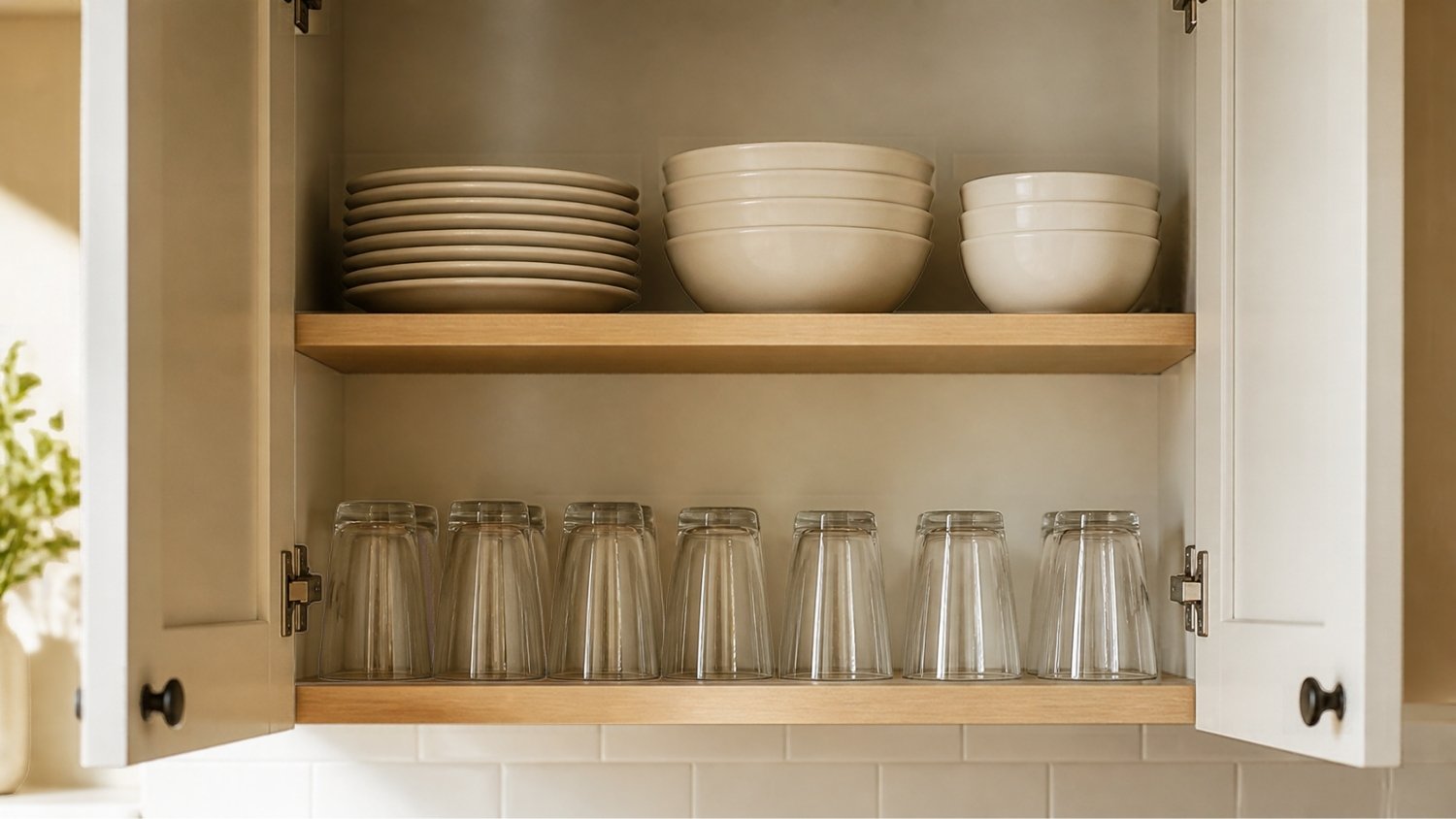
Kitchen cabinet organizers are sized to the cabinet opening, which on face frame cabinetry runs about three inches narrower than the width printed on the box.
And the most useful rule on this page is not about organizers at all. It is a placement rule, it comes from a public health source, and almost nobody repeats it. Ohio State University Extension: the cabinets above the range, beside the dishwasher and next to the refrigerator exhaust run warm, and those are good places for dishes, pots and pans but too warm to keep food at its best. Kitchen zones, by contrast, are not defined by any standards body I could find.
- 3 inHow much narrower the opening is than the name on the box, on face frame
- 11 inUsable shelf depth in a 12 in wall cabinet, once the back and the door are counted
- 54 inWhere wall cabinets start off the floor. Shoulder height before you fill them
- 15 lb/sq ftWhat the certification tests a shelf to survive, held for seven days
Over the range. The residential code sets no cabinet size anywhere, but it does set one thing that matters here. The IRC requires at least 30 inches of clearance between a cooking surface and an unprotected combustible surface above it. That is why the cabinet over your range sits higher than the ones beside it, and a listed range hood is what changes the arithmetic.
Hanging a wall cabinet. How a wall cabinet is mounted is tested, and what yours is rated for sits on its maker’s own page. The installation guides I read are specific about how that load gets carried, and they do not all say the same thing, so the one that governs is the guide that came with your cabinet. Lowe’s calls for number 10 by two and a half inch wood screws. Schrock specifies the same gauge with a washer head, and puts two screws in a 30 inch cabinet and three in a 36 or a 42. Schuler calls for number 8 by three inch screws through the top and bottom hanging rails, driven about an inch and three quarters into the stud. What all three agree on is the part that matters: into the center of a stud, and never nails or drywall screws. The Lowe’s guide does explicitly allow a toggle bolt where the cabinet lands away from a stud, and a good toggle is published at 238 pounds ultimate in half inch drywall, but what drywall cannot give you is redundancy, which is why every guide treats the stud as the rule and the toggle as the exception. Never hang a whole run on them.
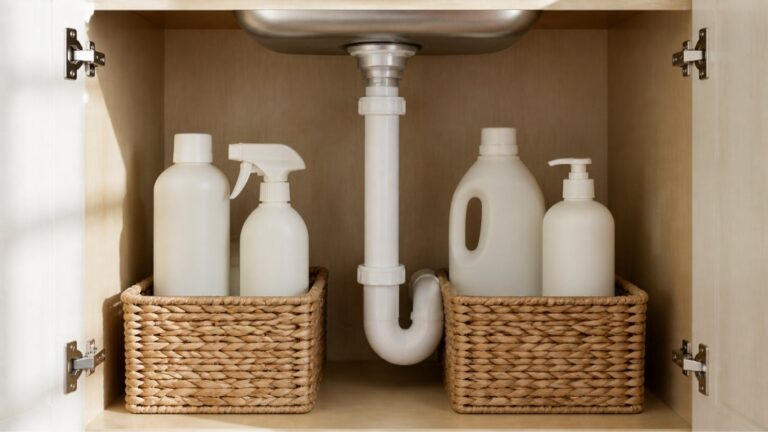
Cleaning supplies, if there are small children in the house. Two sources point opposite ways and both are satisfied by the same fix. The EPA and the Consumer Product Safety Commission both want household chemicals either up high or behind a safety latch, and always in their original labeled containers. The food code wants them low so they cannot drip onto food. Latch the cabinet and you satisfy both.
Want the cabinet numbers on paper? The free Kitchen Fit Planner has the six openings to measure, what your cabinets really give you once the door is counted, and a shopping checklist. Four steps, five printable pages. Send it to me
Kitchen cabinet organizers are sized to the opening, not to the box
About 3 in less
On face frame cabinetry the stiles take about an inch and a half each, so an 18 inch cabinet gives you something like 14.5 to 15 inches of opening. A unit asking for 15 inches is marginal there, not a comfortable yes. This is the single measurement that sends organizers back, and nobody in the store will volunteer it.
Measure three things before you buy anything
Step 1
The clear opening
Of the cabinet you want to fix, not its nominal width. On face frame cabinetry that is roughly three inches narrower than the name on the box.
Step 2
The usable depth behind the door
A 12 inch wall cabinet gives you roughly 11 inches once the back panel and the door are accounted for. A dinner plate runs 10 to 11 inches across, so a 12 or 13 inch charger is not going in at all. I could not find a manufacturer that publishes interior depth anywhere, which means the tape measure is the only way to know.
Step 3
The shelf to shelf height
Write all three in your phone. Those three numbers turn every product listing from a guess into a yes or a no.
Then do the swap that costs nothing. Take the things you reach for daily out of the upper cabinets and put them in a base cabinet or a drawer, and send the once a month pieces upstairs in their place. You will feel it the first morning.
Six openings, one page. Print the Kitchen Fit Planner, take it round the kitchen with a tape, and shop from your own numbers instead of from the name on the box. Get the free planner
The numbers your kitchen was built aroundeight conventions, and not one of them is law
There is a particular kind of frustration in a kitchen that is technically organized. Everything has a place. You still get on a step stool for the vanilla, and the skillet you use every single night lives behind three you do not. That is not a discipline problem, and no amount of matching containers will fix it. Your kitchen was built to a set of numbers, and almost none of them were chosen with your arms in mind.
First, something that surprises most people: there is no US building code that sets a single kitchen cabinet dimension. The residential code asks for a sink, hot and cold water, drainage and a seven foot ceiling, and it sets no cabinet size anywhere. The main American cabinet standard, ANSI/KCMA A161.1, is a performance standard. It tests how much weight a shelf carries and how many times a door can swing, not how big anything is.
So every figure below is manufacturing convention rather than law, which is exactly why it is so consistent and also why nobody in the store will ever volunteer it.
| Part of the kitchen | Standard figure | Worth knowing |
|---|---|---|
| Base cabinet height | 34.5 in, 36 in with the countertop | Assumes a 1.5 in top |
| Base cabinet depth | 24 in | 12 in and 27 in are also made |
| Wall cabinet depth | 12 in | IKEA’s SEKTION system is 14.75 in, which changes every organizer you buy |
| Wall cabinet heights | 12, 15, 18, 21, 24, 27, 30, 36, 39 and 42 in | 30 in is the most common. The 39 in is the one that closes the gap on an 8 ft ceiling with no soffit |
| Widths | Base 6 to 42 in, wall 6 to 48 in, in 3 in steps | Semi custom lines will go to 1 in increments on order |
| Bottom of the wall cabinets | About 54 in off the floor | 36 in of counter plus the 18 in gap |
| Gap above the countertop | 18 in | Not a rule anyone published, just what the 54 in hang line produces |
| Tall pantry cabinet | 84, 90, 93 or 96 in | Depths of 12 or 24 in |
| Shelf | 0.75 in engineered wood | Pin holes usually 32 mm apart, about 1.25 in, a cabinetmaking convention rather than a standard |
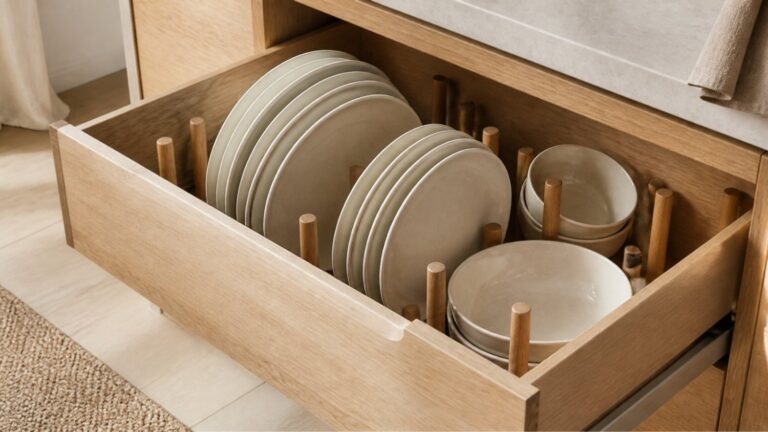
One number that is not on any spec sheet decides more than all of them. A 12 inch wall cabinet gives you roughly 11 inches of usable shelf depth once the back panel and the door are accounted for. A dinner plate runs 10 to 11 inches across. So a 10 inch plate sits comfortably, an 11 inch plate is tight against the door, and a 12 or 13 inch charger is not going in at all. I could not find a manufacturer that publishes interior depth anywhere, which means the tape measure is the only way to know.
How high is too high, and who actually decidedthe 48 inch figure is an accessibility standard, not an ergonomic one
Here is where the organizing internet quotes a number at you, and where it is worth knowing exactly what that number is before you rearrange your whole kitchen around it.
- The 48 inch figure everybody quotes is an accessibility standard, not an ergonomic one. The ADA puts unobstructed reach at a maximum of 48 inches and a minimum of 15, dropping to 44 over a counter deeper than 20 inches. Those numbers were written for people using wheelchairs. They are not a measurement of what a standing adult can reach, and nobody has published a good one for a home kitchen.
- The National Kitchen and Bath Association uses the same window, and it is worth noticing where. Plan storage of frequently used items 15 to 48 inches above the floor sits under its universal design recommendations, not its general guidelines. The ordinary planning guidelines treat the 54 to 84 inch band as perfectly real storage and count it toward your totals.
- Above 84 inches the same guidelines change their mind and file that storage under miscellaneous, with a cap on how much of your total it is allowed to contribute. It still counts. It just counts less, which is the profession quietly admitting that above seven feet, storage gets awkward.
- For an accessible kitchen, the ADA requires that at least 50 percent of shelf space fall inside the 15 to 48 inch range. The ADA does not govern private homes, but if someone in your household uses a wheelchair it is the only worked out guidance anyone has written, and by it every upper cabinet in a standard kitchen is out of range.
Now put those against the installation line. Wall cabinets begin at 54 inches, so the floor of the cabinet is already at about shoulder height before you put anything in it. A 30 inch cabinet tops out around 84 inches, a 36 inch one around 90, and a 42 inch one at 96. The top shelf of your upper cabinets is step stool territory by the profession’s own reckoning, and no amount of pretty labeling changes that.
And that is all the height guidance anybody can point to. Nobody has measured the kitchen you are standing in, which is oddly freeing.
So the useful question is not how to organize your uppers. It is what earns a place on that top shelf, and the honest answer is: the things you take down once a year. The roasting pan, the punch bowl, the second waffle iron. Everything you use weekly wants to be on the lowest shelf you have or, better still, in a base cabinet or a deep drawer, because a drawer brings its contents out to you instead of asking you to reach past the front row.
The lower shelf of an upper cabinet is the one you will actually use. Whatever goes above it is a decision you make once and then live with.
What goes where, and the one rule with a source behind itwarm cabinets, cool cabinets, under the sink, spices, glasses
Almost everything written about kitchen zones is somebody’s preference dressed up as a system. The one placement rule I could find that comes from a public health source happens to be the most useful thing on this page, and Ohio State University Extension puts it in a single sentence: cabinets tend to be warmer above the range, near the dishwasher, or next to the refrigerator exhaust, and those are good places to store dishes, pots and pans, but too warm for keeping food safe and at top nutritional quality.
That one distinction does more work than any zone chart. Here is how it plays out, with what the other sources add.
- The warm cabinets get the hardware. Above the range, beside the dishwasher, next to the refrigerator: dishes, pots, pans, mixing bowls, sheet pans. Dry heat does nothing to them. Cast iron is the one thing worth a second thought there. The storage condition it actually needs is dry, and a cabinet directly above a range without a vented hood catches a lot of cooking steam.
- The coolest cabinet you have gets the food. Texas A&M AgriLife says to use the cabinets furthest from the range, oven, water heater, dishwasher and any hot pipes. Extension services put the quality target at 50 to 70 degrees Fahrenheit. The USDA’s line is different and lower stakes: below 85 degrees is best, and above 100 actively damages canned goods.
- Under the sink is for cleaning supplies, full stop. The USDA names it outright as a place not to keep shelf stable food. Texas A&M adds that it is a bad spot for potatoes and onions specifically. The reasoning is the one the commercial food code gives for professional kitchens: you do not store clean things underneath water supply lines and a drain trap. If there are small children in the house, add the other half of the answer, which is in the panel at the top of this page.
- Spices go in a closed cabinet or a drawer, away from the stove. This one is unusually well supported. Texas A&M AgriLife gives the full list, not above the dishwasher, microwave, stove or refrigerator, and not near the sink or a heating vent. McCormick says repeated heat is the enemy and names that little ledge at the top of the stove specifically. Penn State agrees in more general terms, airtight containers in dry places away from sunlight and heat. Three sources, one of them the manufacturer, and they all land in the same place: the pretty rack on the wall beside the range is the worst spot in the room.
- Glasses go rim down. There is no home rule about this, so anyone who states one is guessing. What exists is the professional standard: the FDA Food Code requires clean items to be stored covered or inverted, in a self draining position, away from splash and dust. A closed cabinet handles the dust. Inverting handles the rest.
On humidity, a small correction to something that circulates constantly. I could not find a single source that publishes a relative humidity target for a home pantry. Everything written for households is qualitative and always lands on the same three words: dry, cool, dark. There is a 50 to 70 percent figure in circulation, and I could not trace it to anything written about a home kitchen. Notice that it is the same pair of numbers as the 50 to 70 degree temperature target above, which may well be all it ever was.
Two warnings from a cabinet maker’s own care guide that are worth more than they sound. KraftMaid recommends a heat shield on the side panels of an oven cabinet, and on adjacent cabinets where the door style is thermofoil or laminate. And it states plainly that a damp towel draped over the door of a sink base cabinet causes permanent water damage over time. The second one has probably already happened in your kitchen.
How much a kitchen shelf actually holdsarithmetic on the standard, and why that is not a promise
Here is where the numbers get uncomfortable, and where you should watch me closely, because the arithmetic below is mine rather than anybody’s published rating. Shelf ratings come out of a certification test, and the only figure you can act on is the one the maker publishes for the cabinet in front of you. That is a pass threshold, not a capacity: a certified shelf has to survive it, and plenty of shelves will carry more. It is also the only per shelf figure the industry publishes anywhere, so converting it is the closest anyone can get to an answer.
The table below takes the full nominal cabinet width, with a usable depth of 11 inches for wall shelves and 22 for base shelves. A real shelf spans the inside of the box rather than the opening, so take off about an inch and a half for the two side panels and shade each figure down accordingly. Treat them as ceilings rather than allowances.
| Shelf | Weight the shelf is tested to survive, at nominal width |
|---|---|
| 12 in wall cabinet | About 14 lb |
| 24 in wall cabinet | About 28 lb |
| 30 in wall cabinet | About 34 lb |
| 36 in wall cabinet | About 41 lb |
| 24 in base cabinet | About 55 lb |
| 30 in base cabinet | About 69 lb |
| 36 in base cabinet | About 83 lb |
Be clear about what that table is. It is arithmetic on the standard, not a manufacturer promise. I could not find a per shelf pound rating on a product page from KraftMaid, Hampton Bay, Home Decorators or IKEA. The only manufacturer statement I did find was Shenandoah’s, which says its shelves meet the 15 pound per square foot standard and leaves the conversion to you.
And now the number worth carrying away. A 30 inch upper shelf is tested to survive roughly 34 pounds. A dozen stoneware dinner plates run somewhere around 18 to 26 pounds depending on the pattern, so one stack is most of that, and two stacks plus the bowls is past it, sitting there day after day for years. Nobody has published what that actually does to a shelf over time, and I am not going to invent it. But if a shelf in your kitchen has a gentle curve in the middle, you now know roughly how much is standing on it.
The cabinet box itself is a different story and much stronger, and how it is hung is covered in the panel at the top of this page.
One useful consequence. The pull out shelves sold at the big box stores carry a rated capacity of 100 pounds. That is a rating rather than a pass threshold, so it is not directly comparable to the table above, but it does tell you the slide is unlikely to be your weak point. If what you are relying on is the cabinet bottom the pull out screws into, that is a question for the maker rather than for me.
Five organizers, and the dimension that sends each one backpull outs, door racks, turntables, risers, wood organizers
Every one of these fails for a different reason, and in every case it is one dimension that does it. Check that dimension and the return trip disappears.
| Organizer | What is actually sold | The dimension that fails |
|---|---|---|
| Pull out shelves and wire baskets | Specified by minimum cabinet opening: 11.5, 15, 20.5 and 24 in | The opening, not the cabinet name. Face frame stiles take about 1.5 in each, so an 18 in cabinet gives roughly 14.5 to 15 in of opening. A unit asking for 15 in is marginal there, not a comfortable yes |
| Door mounted racks | Around 13.75 in wide, needing about 4.375 in of clear depth | That clear depth in front of the shelves. Wall cabinets commonly ship with full depth shelves, so on those the rack does not fit until you cut them back |
| Turntables | Sold at 9, 9.25, 10.6 and 12 in diameters | Diameter against roughly 11 in of usable depth. A 12 in turntable does not fit a 12 in wall cabinet, and many listings never publish the diameter at all |
| Expandable shelf risers | 7.9 in and 11 in deep, expanding 14 to 26 in wide | The collapsed width, not the depth. A 14 in minimum needs an 18 in cabinet by the opening rule above, so a 12 or a 15 in is out |
| Pull out wood organizers | Need close to the full depth of a standard 24 in base cabinet | Depth. A 12 in deep base cabinet cannot take one, and the shallower boxes some kitchens use are marginal |
One load figure worth carrying with you, and one absence. Expandable risers are rated at 22 pounds for the shallow ones and 55 for the 11 inch deep ones, which is a good deal less than a riser full of canned goods. And several major retailers publish neither dimensions nor capacity for their two tier cabinet shelves, so on those you are buying blind and measuring afterwards.
On price, one honest note instead of a table. This category is discounted so constantly that any figure printed here would be wrong within two weeks, and the spread inside a single category is wider than the gap between categories. A plastic turntable and a soft close wood pull out are two orders of magnitude apart, and everything in between is really a judgment about how long you plan to stay in this kitchen. Measure first, then look at what is actually in stock this week.
Six things you will read everywhere that are not truewhat happens when you go looking for the source
Every one of these gets repeated confidently, in article after article. Here is what happens when you go looking for where it came from.
- “Keep dishes within 18 inches of the dishwasher.” No such figure exists in the NKBA guidelines, the accessibility standards or the food code. NKBA’s real numbers are different ones entirely: the dishwasher edge within 36 inches of the nearest sink edge, and a quantity of storage frontage within 72 inches of the sink centerline.
- “Organize your kitchen in zones.” No standards body I could find defines kitchen zones. The work triangle is real and documented, the NKBA puts the three legs at no more than 26 feet in total with no single leg under 4 feet or over 9, but it is a layout guideline about where the sink, range and refrigerator sit. It says nothing whatsoever about which cabinet anything goes in.
- “Shelf liner protects your cabinets.” KraftMaid’s care guide covers heat shields and moisture damage in detail and does not mention liner once, in either direction. I could find no cabinet maker that recommends it and none that forbids it. One detail worth knowing, because it is usually cited the wrong way round: the certification’s 24 hour chemical and stain test covers exterior surfaces, doors, drawer fronts and end panels. It does not cover the inside of your cabinet, so the finish on a shelf is not the tested one. Liner is a cleanup convenience, which is a perfectly good reason to use it. Just know that warranties exclude alteration in general terms, so an adhesive one is at your own risk.
- “A turntable doubles your cabinet space.” A turntable cannot add volume. It inscribes a circle inside a rectangle, gives up the four corners, and costs you its own base height on top. What you are buying is reach and visibility, which is worth the money. I could not find a manufacturer or a study publishing a capacity gain anywhere, which is unsurprising, since there is not one to publish.
- “80 percent of your kitchen things never get used.” I went looking for the study and there is not one. It is the Pareto principle borrowed from economics and asserted about kitchens, repeated until it starts to sound measured. The nearest real data is a 2023 YouGov survey of a thousand US adults, and it counts which utensils people own, not which ones they use.
- “Decanting into containers keeps food fresher.” Partly true, for reasons nobody gives. Airtight containers really do beat bags and boxes against pantry pests, and that is the documented benefit nobody leads with. On freshness, the nearest thing to evidence is a Utah State study in which nonfat dry milk kept in thin plastic bags, and the source is specific that these were not the Mylar type, tasted measurably worse after four years than the same milk in cans. Four years, not four weeks, and rigid airtight canisters were not what was tested. Over a normal six to twelve month pantry cycle nothing documents a freshness gain at all, and the aesthetic version costs you two things extension services specifically ask for, the date on the package and darkness.
Frequently asked questionsfive, including why your organizer does not fit
What should go in upper kitchen cabinets?
Things you take down once a week or less, and on the top shelf, things you take down once a year. Standard wall cabinets start at 54 inches off the floor, so even the lowest shelf is above shoulder height. The top of a 36 or 42 inch cabinet is at 90 to 96 inches, which is a step stool every time. The NKBA files storage above 84 inches under miscellaneous and caps how much of your total it may contribute, which is the profession’s way of saying it counts for less. Serving pieces, spare glassware and seasonal appliances belong up there. Your daily plates are better off in a base cabinet or a deep drawer.
How much weight can a kitchen cabinet shelf hold?
The certification standard tests shelves at 15 pounds per square foot held for seven days. Converted at nominal width, that is roughly 34 pounds on a 30 inch wall cabinet shelf and roughly 69 pounds on a 30 inch base cabinet shelf. Two caveats matter. That is a pass threshold rather than a rated capacity, so a shelf that survives it may well carry more. And I could not find a major manufacturer publishing a per shelf pound rating at all, so those numbers are arithmetic on the standard, not a guarantee. For scale, a dozen stoneware dinner plates run somewhere around 18 to 26 pounds.
What should not be stored under the kitchen sink?
Food. The USDA names under the sink as a place not to keep shelf stable products, and Texas A&M AgriLife singles out potatoes and onions. The reason is the one the commercial food code gives: clean and edible items do not belong underneath water supply lines and a drain trap. Cleaning supplies, trash bags and dish soap are what that cabinet is for.
Should glasses be stored rim up or rim down?
Rim down, if you want to follow the only written standard that exists. There is no rule for home kitchens, but the FDA Food Code requires clean items in commercial kitchens to be stored covered or inverted, in a self draining position, protected from splash and dust. A closed cabinet already handles the dust. Inverting handles the rest.
Why does my cabinet organizer not fit?
Almost always because the product is specified by the cabinet opening and you measured the cabinet width. On face frame cabinetry the stiles take about an inch and a half each, so the clear opening is roughly three inches narrower than the name on the box. An 18 inch cabinet gives you something like 14.5 to 15 inches of opening, which makes a unit asking for 15 inches marginal rather than a safe bet. The other two classic misses are turntable diameter against a 12 inch upper’s 11 inches of usable depth, and the collapsed width of an expandable riser, which usually starts at 14 inches.
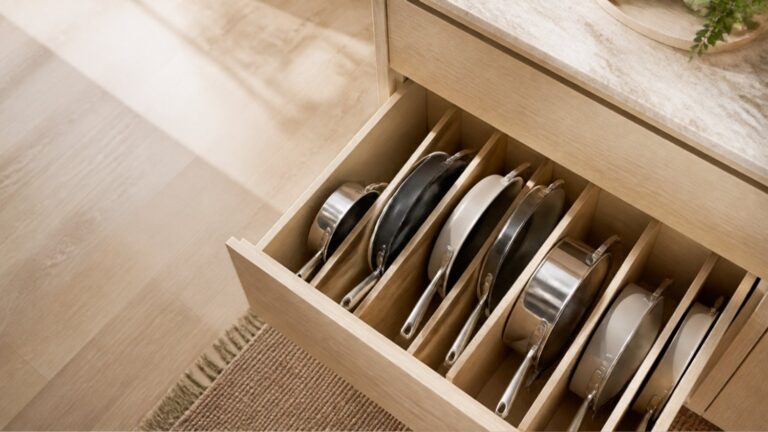
The same measuring logic applied to the drawers below is in kitchen drawer organization, the heavy awkward things are in pot and pan storage, the cabinet everyone avoids is in under sink organization, and what to do about all those jars is in food storage containers. More kitchen guides are in our kitchen organization guide.
The cabinet numbers, on five printable pages
The free Kitchen Fit Planner has the six openings to measure, what your cabinets really give you once the door is counted, and a shopping checklist that tells you which dimension to verify for each item before you order it.
Dimensions checked on September 26, 2026 against published specifications, care guides and installation instructions from KraftMaid, Shenandoah, Fabuwood, Schrock, Schuler, IKEA, Home Depot and Lowe’s. Load figures come from the ANSI/KCMA A161.1 standard, reach figures from the 2010 ADA Standards and the NKBA Kitchen Planning Guidelines, and food storage guidance from the FDA Food Code, the USDA Food Safety and Inspection Service and the Ohio State, Texas A&M AgriLife, Utah State and Penn State extension services. Chemical storage guidance comes from the EPA and the Consumer Product Safety Commission, spice guidance additionally from McCormick, and the utensil ownership figures from a 2023 YouGov survey. Where a figure is my own arithmetic rather than a published rating, the article says so. Organizer dimensions are taken from current retail listings and vary by model, so check the listing for the exact unit you are buying before you order.
Saved in this browser, on this device. No account, nothing sent to us, and it goes if you clear your browsing data. See what you saved