Kitchen Drawer Organization: The Width Nobody Measures
When you buy through a link on Cozy & Tidy, we may earn a commission. It does not change the price you pay, and it does not decide what we recommend. How it works
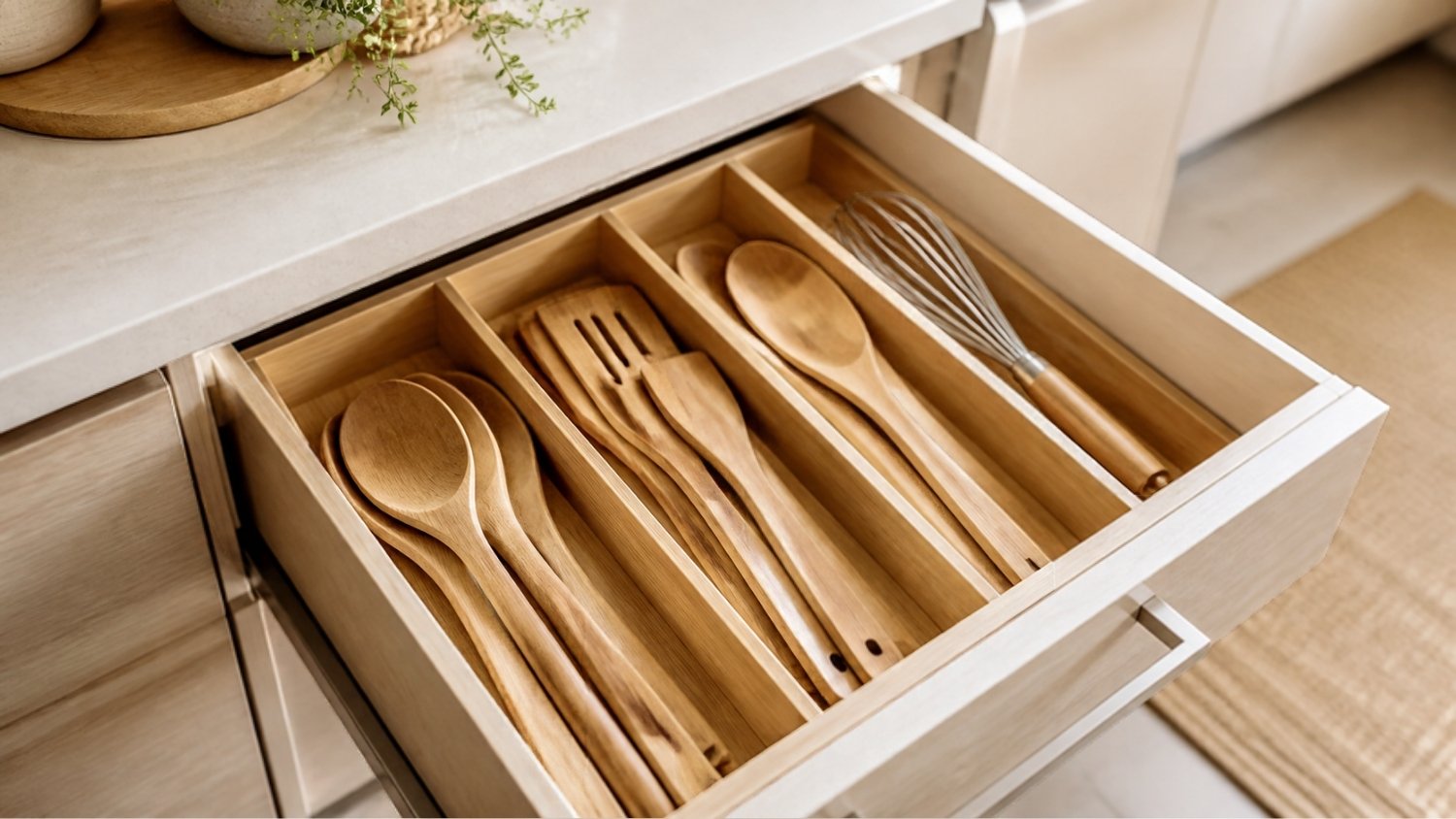
The front of your drawer is not the inside of your drawer, and a kitchen drawer organizer only fits the inside.
A frameless 24 inch cabinet hands you about 20.8 inches of interior width, and a face frame one nearer 19.3. Order to the width on the front and you overshoot by three to four and a half inches, which is why so many drawer organizers go back to the store.
- 20.8 inInterior width of a frameless 24 in cabinet
- 19.3 inThe same cabinet with a face frame
- 28 inA professional rolling pin, handles counted
- 5.25 inWhat stays inside on a three quarter extension
Will it fit? Enter the width you measured and the width the listing publishes, and the tool tells you whether it goes in, or that it cannot tell you yet. Try it
The width nobody measures before buying a kitchen drawer organizer
Yours
Pull the drawer all the way out and measure the inside of the box, not the front panel. The cabinet loses about 1.5 in to its own side panels, and Blum’s undermount runners then take another 1.656 in. A face frame costs a further 1.5 in of opening on top of that.
Two minutes, and every listing becomes a yes or a no
Step 1
Pull out your busiest drawer
Take the four numbers with the drawer fully out and write them in your phone: interior width, interior depth, interior height, and whether it comes all the way out.
Step 2
Check the depth before the width
Depth is what actually sends trays back. The common expandable cutlery trays are 17.75 to 18 in front to back, which will not go into a drawer in a 21 in or a 15 in deep cabinet, whatever the width says.
Step 3
Buy one thing, and make it trimmable
The wood trays and inserts sold for cabinetry are designed to be cut down, which turns a near miss into a fit. The rigid plastic ones are not, which is why they are the ones that end up back in the box.
Buying a drawer organizer this week? The free Kitchen Fit Planner has the interior widths, the six measurements to take first, and the one thing to check before you order. Send it to me
The four numbers, and where they come fromthe arithmetic, in the hardware makers’ own figures
Drawers are the best storage in your kitchen and everybody knows it. A drawer brings its contents out to you. A cabinet makes you kneel down and reach past the front row with your cheek against the counter edge. So it is a particular kind of annoying when the beautiful bamboo organizer arrives and just sits there, an inch and a half too wide, while you decide whether you can be bothered to send it back.
Take these with the drawer pulled all the way out. Every product listing becomes a yes or a no once you have them.
| Measure | What it is | What eats it |
|---|---|---|
| Interior width | Wall of the drawer box to wall of the drawer box | Two steps, not one. The cabinet loses about 1.5 in to its two side panels, which gives the opening. Blum’s formula then takes the opening minus 1.656 in for its undermount runners. Side mount slides give a box 1 in narrower than the opening, and the box’s own sides take about another inch. A face frame costs a further 1.5 in of opening on top |
| Interior depth | Front to back, inside the box | Blum’s common undermount runners come at 9, 12, 15, 18 and 21 in, with a heavy duty series running to 30. A 21 in runner in a 24 in deep cabinet leaves about 19 to 20 in of clear interior |
| Interior height | Drawer floor to the top edge of the sides | IKEA is unusual in publishing figures at all: 3.125 in low, 5.625 medium, 8.375 high, though those are overall box heights rather than clear interior. Most US cabinet makers publish nothing here, so measure |
| Extension | How much of the drawer comes past the cabinet | Three quarter extension leaves roughly 5.25 in of a 21 in drawer permanently inside the cabinet. Full extension brings all of it out |
Two things are worth pausing on. The first is that the interior width arithmetic is not a rule of thumb, it is the hardware maker’s own instruction, and it has two steps rather than one. Blum publishes the interior as the cabinet opening minus 1 and 21/32 of an inch. But the opening is not the cabinet: a frameless box loses about an inch and a half to its own side panels before you get there. Run both steps on a 24 inch cabinet, 24 down to a 22.5 inch opening, then minus 1.656, and you land at 20.84 inches.
The second is that a face frame costs you again, and more than people expect. The stiles run about an inch and a half each, so a 24 inch face frame cabinet opens at nearer 21 inches and hands you something around 19.3 inside. That is why an organizer that fits your sister’s frameless kitchen will not fit your framed one, and it is why Rev-A-Shelf lists separate frameless and face frame versions of the same product with different minimum openings.
What fits, and the two things that never willthe rolling pin, the big board, and plates on edge
Start with the good news, because it is useful. A half sheet pan measures 12.9 by 17.9 inches. A 24 inch deep cabinet gives you something like 19 to 20 inches of clear drawer interior. So your baking sheets do lie flat in a deep drawer, with an inch or so to spare, and they will slide in sideways in anything wider than 18 inches inside. Tongs at 12 inches and a balloon whisk at 11 go in front to back without a thought.
Now the two that defeat a standard kitchen, and nobody warns you about either.
- The rolling pin. A professional 18 inch maple pin is 28 inches overall once you count the handles. That is longer than the interior depth of any standard base drawer, so it cannot lie front to back anywhere. It has to go crosswise, which needs 28 inches of interior width, and that means a 33 inch cabinet at minimum in either construction.
- The big cutting board. A common 15 by 21 inch board is the same story and worse, because it is so close. It will not go front to back. Crosswise it needs 21 inches of interior width, and a frameless 24 inch drawer gives you about 20.8. It misses, by roughly a sixth of an inch. That is why the board is leaning against your backsplash right now, and why moving it to a 30 inch cabinet solves a problem that felt unsolvable.
Plates in drawers, and the two numbers that decide it
Standing plates on edge in a drawer is having a moment, and it does work. The constraint is not weight. A Corelle dinner plate is 10.25 inches across and weighs 12 ounces, so two dozen of them come to about 18 pounds against an undermount slide rated at 90. Stoneware is heavier, and still nowhere near the limit.
The constraint is dimensional, and it is specific. A peg board system publishes a minimum opening height of 6.625 inches, with the maker recommending 8 inches or deeper. Worth understanding why the recommendation exists: a 10.25 inch dinner plate cannot stand fully upright in either, so it leans against the pegs, and the deeper drawer is what keeps the lean under control. The large sixteen peg version also needs a 39.375 inch opening, which in a frameless kitchen means a 42 inch cabinet, not a 39. Smaller versions come at 24.25 and 30.25 inches wide and are trimmable, so plan on trimming rather than on a clean fit.
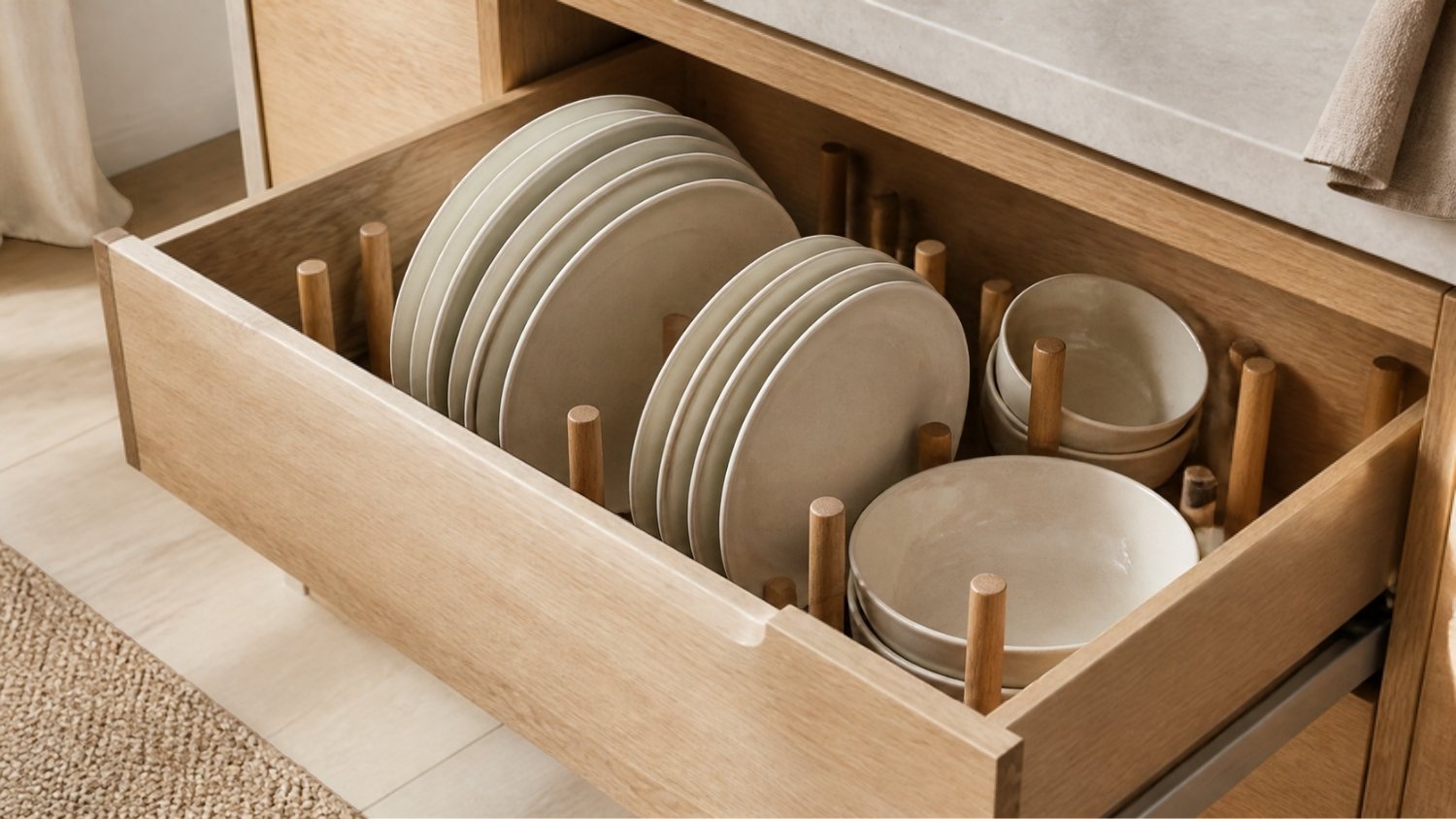
Weight, in other words, is rarely the thing standing in your way. Geometry almost always is.
How much a drawer holds, and why two numbers disagreefive published load ratings, and what they actually rate
This is one of the rare corners of kitchen organizing where the manufacturers publish real figures, so it is worth knowing them.
| Hardware | Published rating |
|---|---|
| Blum TANDEM plus BLUMOTION, the common soft close undermount | 100 lb static, 90 lb dynamic, on a 21 in box |
| Blum TANDEM heavy duty series | 150 lb static, 135 lb dynamic |
| Accuride side mount ball bearing, full extension | 100 lb |
| Big box framed cabinet, factory undermount soft close | 90 lb dynamic per drawer |
| IKEA MAXIMERA | 55 lb 2 oz |
That last row deserves its own sentence. It is not quite like for like, because IKEA publishes a maximum load for the whole drawer while Blum and Accuride rate the slide. But the gap is real and it is large, and if you are comparing an IKEA kitchen to an American framed one, a drawer full of cast iron is exactly where you would feel it.
Now the disagreement, which confuses everybody who notices it. A drawer carries two separate figures and they are not measuring the same thing. That is not a contradiction. The cabinet body is certified by one organization, the slide is rated by its maker, and they are measuring different things. If you want one number to carry around, use the smaller one.
One thing worth knowing about those ratings: they are test results, not marketing. Accuride publishes its method, cycle tests running from 2,000 to 75,000 cycles, a static test at twice the dynamic load held for 24 hours, and impact testing at the stop. What nobody publishes is what happens the day after you go past the number. So anyone telling you confidently that your drawer will drop off its runners at 101 pounds is filling in a blank.
Every organizer, and the dimension that sends it backseven products, and the figure that is never in the title
Here is the part that surprised me most while checking this. For nearly every drawer organizer sold, the measurement that fails is not the one in the product title.
| Organizer | What is actually sold | The dimension that fails |
|---|---|---|
| Expandable cutlery tray, bamboo | Expands 13 to 22 in wide, but 17.75 in deep and 2.5 in tall | Depth. It will not fit a drawer in a 21 in or 15 in deep cabinet, whatever the width says |
| Expandable cutlery tray, plastic | Expands 12 to 23.75 in wide, 18 in deep, 2 in tall | Depth again, same trap |
| Spring loaded dividers | Expand 17.5 to 22 in, about 0.6 in thick each | These are sized to the drawer’s depth, front to back, not its width. A drawer under 17.5 in deep cannot take them at all |
| In drawer knife block, bamboo | About 17 by 5.5 by 2 in, up to 16 knives | Almost nothing. At 2 in tall a knife drawer does not need to be a deep drawer, which is the opposite of what most people assume |
| Peg board plate system | Large size is 39.25 by 21.25 by 6.63 in, trimmable | Interior height and cabinet class. Minimum opening height is 6.625 in with 8 in recommended, and the large one needs a 39.375 in opening, so a 42 in cabinet |
| Drop in lid organizer | 5.375 in tall, 5.25 wide, 16.875 deep, holds six lids | It is an accessory, not a standalone. The maker designs it to drop into its peg board systems, so buy the board first |
| Tiered spice insert | 22 by 19.75 in and only 1.55 in tall, trimmable | Depth, the same trap as the trays. At 19.75 in it wants a full depth drawer. But at 1.55 in tall it will slide in above almost anything already in there |
Note the pattern, because it is the useful takeaway. The cabinet hardware brands publish a minimum cabinet opening in width, depth and height, plus a load rating in pounds. The organizers sold on Amazon publish an adjustable width range and nothing else. That asymmetry is most of the buying advice you need.
And one thing dividers do not do, whatever the packaging suggests. Six of them take about a sixth of the drawer’s width. What they add is being able to find the thing.
Why nobody uses the bottom drawera physical reason, and a figure that is being misused
You know the one. It has a pizza cutter, a cake tin you used in 2019 and something with a cord. The reason is physical rather than moral, and it is not the reason usually given.
The bottom drawer’s floor sits only a few inches off your kitchen floor. The toe kick is part of the cabinet’s 34.5 inch height rather than something added underneath it, so the box starts at roughly the toe kick line and the lowest drawer starts just above that. Using it means bending or kneeling, every single time.
You will see a 15 inch figure quoted at this point as the minimum comfortable reach, and it is worth knowing why it does not apply. That number comes from the accessibility standards, where 15 inches is the lowest an accessible control may be mounted for someone seated in a wheelchair. A standing adult reaches lower than a seated one, not higher. Nobody has published a comfortable low reach figure for you, and anyone using the accessibility number to tell you your bottom drawer is unusable has the logic upside down.
Which suggests a use for it rather than a fix. Your knees have already told you the answer. The bottom drawer is where bulk and backstock live, the things you fetch deliberately once a month, not the things you want while something is on the heat.
The related trap is extension. If your drawers stop three quarters of the way out, roughly 5.25 inches of a 21 inch drawer stays inside the cabinet permanently. That band at the back is where things go to be forgotten, and no organizer fixes it. Full extension slides do, which is the one upgrade in this article worth paying for.
Six things you will read everywhere that are not truewhat is documented, and what is not
- “Soft close slides carry less weight.” Contradicted inside a single product family. Accuride’s standard full extension side mount is rated 100 pounds, and its soft close version of the same slide is rated 100 pounds. Blum’s soft close undermount is 100 pounds static. Worth adding that 100 is not a ceiling either: Accuride’s heavier side mount is rated 150.
- “Dividers give you more space.” They cannot, and the arithmetic is on the box. Bamboo spring loaded dividers are about 0.6 inches thick each, so a pack of six consumes roughly 3.6 inches of a 20.875 inch drawer, about a sixth of the width. What you are buying is findability, which is worth the money. Capacity goes down.
- “The health code says store flatware handles up.” Misapplied. The rule about presenting only the handles comes from the Food Code and governs a self service station in a regulated food business. Nothing in it, and nothing I could find anywhere else, has an opinion about which way your forks lie at home.
- “Your kitchen needs a set number of drawer zones.” No standards body prescribes zones. The NKBA expresses kitchen storage as inches of shelf and drawer frontage instead: 1400 inches for a small kitchen, 1700 for a medium, 2000 for a large. Not one of its guidelines tells you what goes in which drawer.
- “Deep drawers waste space.” Geometrically backwards. The footprint is fixed by the cabinet, so extra height only adds volume, it never subtracts any. What deep drawers lack is subdivision, which is a product problem with a product answer, and the tiered inserts made for exactly this cost less than a cabinet.
- “Most of your utensils never get used.” No study exists behind any of the percentages in circulation. The nearest real data is a YouGov survey of a thousand US adults fielded in November 2023, and it measures ownership: more than nine in ten own measuring cups, a can opener and a spatula, while fewer than half own a garlic press, a zester or a mandoline. Nobody has counted what goes unused.
One more that is worth a sentence rather than a bullet, because it is half true. The bamboo makers do tell you to hand wash, not to soak and to avoid long contact with water, which is a precaution rather than an admission that the thing warps. I could not find a comparative test against plastic in either direction, so nobody can quote you a lifespan for either.
Where to start this weekend
Pull out your busiest drawer and take the four numbers. Interior width, interior depth, interior height, and whether it comes all the way out. Two minutes, and every listing from here on is a yes or a no.
Then buy one thing rather than a set, and make it something trimmable. The wood trays and inserts sold for cabinetry are designed to be cut down, which turns a near miss into a fit. The rigid plastic organizers are not, which is why they are the ones that end up back in the box. The same measuring logic applied to the cabinets above is in kitchen cabinet organization, the heavy things are in pot and pan storage, the cabinet everyone avoids is in under sink organization, and the jars are in food storage containers. More kitchen guides are in our kitchen organization guide.
Questions people ask5 questions
How do I measure a kitchen drawer for an organizer?
Pull the drawer fully out and measure the inside of the box, not the front panel. You want interior width wall to wall, interior depth front to back, and interior height from the drawer floor to the top edge. For scale, the front panel of a frameless 24 inch cabinet is about 3.15 inches wider than the interior, because the cabinet loses 1.5 inches to its side panels and the undermount runners take another 1.65. Add roughly an inch and a half again if your cabinetry has a face frame.
What size cutlery tray fits a 24 inch drawer?
A 24 inch frameless cabinet gives about 20.8 inches of interior width, and a framed one about 19.3, so most expandable trays fit on width. The one that catches people is depth: the common expandable trays are 17.75 to 18 inches front to back, which will not go into a drawer in a 21 inch or 15 inch deep cabinet. Check the depth before the width.
Can you really store plates in a drawer?
Yes, and weight is not the obstacle. Two dozen Corelle dinner plates come to about 18 pounds against an undermount slide rated at 90. The obstacle is dimensional: a peg board system publishes a minimum opening height of 6.625 inches with 8 inches recommended, and the large sixteen peg version needs a 39.375 inch opening, so a 42 inch cabinet rather than a 39. Smaller versions come at 24.25 and 30.25 inches wide and are meant to be trimmed.
How much weight can a kitchen drawer hold?
It depends which number you trust. The common soft close undermount slide is rated 100 pounds static and 90 dynamic, side mount ball bearing slides 100 pounds, and IKEA’s MAXIMERA 55 pounds 2 ounces. The figure that governs your drawer is the one its slide maker publishes for that exact slide. Where a cabinet maker publishes one too, use the smaller of the two.
Why do my spring loaded drawer dividers not fit?
Almost certainly because they are sized to the wrong dimension. Spring loaded dividers brace front to back, so the range printed on the box, commonly 17.5 to 22 inches, refers to the drawer’s depth, not its width. A drawer less than 17.5 inches deep cannot take them at all, however wide it is.
Sourceswhat was read, and when
Dimensions checked on September 26, 2026 against published specifications from Blum, Accuride, Rev-A-Shelf, IKEA, KraftMaid, Home Depot and Lowe’s, with load figures from the ANSI/KCMA A161.1 standard and the slide makers’ own datasheets, the reach figure from the 2010 ADA Standards, the storage frontage figures from the NKBA Kitchen Planning Guidelines, and the utensil ownership figures from a YouGov survey of 1,000 US adults fielded in November 2023. Several numbers here are arithmetic on published figures rather than published figures themselves, including the 20.8 and 19.3 inch interior widths, the 55 pound certification load and the 18 pound stack of plates. Organizer dimensions vary by model, so check the listing for the exact unit before you order.
 Kitchen Cabinet OrganizationWhat goes where, and what fits
 Under Sink OrganizationIt fails on height, not width
 Pot and Pan StorageA 12 in skillet needs 20 in
 All the kitchen guidesOne fix at a time
Saved in this browser, on this device. No account, nothing sent to us, and it goes if you clear your browsing data. See what you saved