Medicine Cabinet Organization: What That Shallow Cabinet Is Actually For
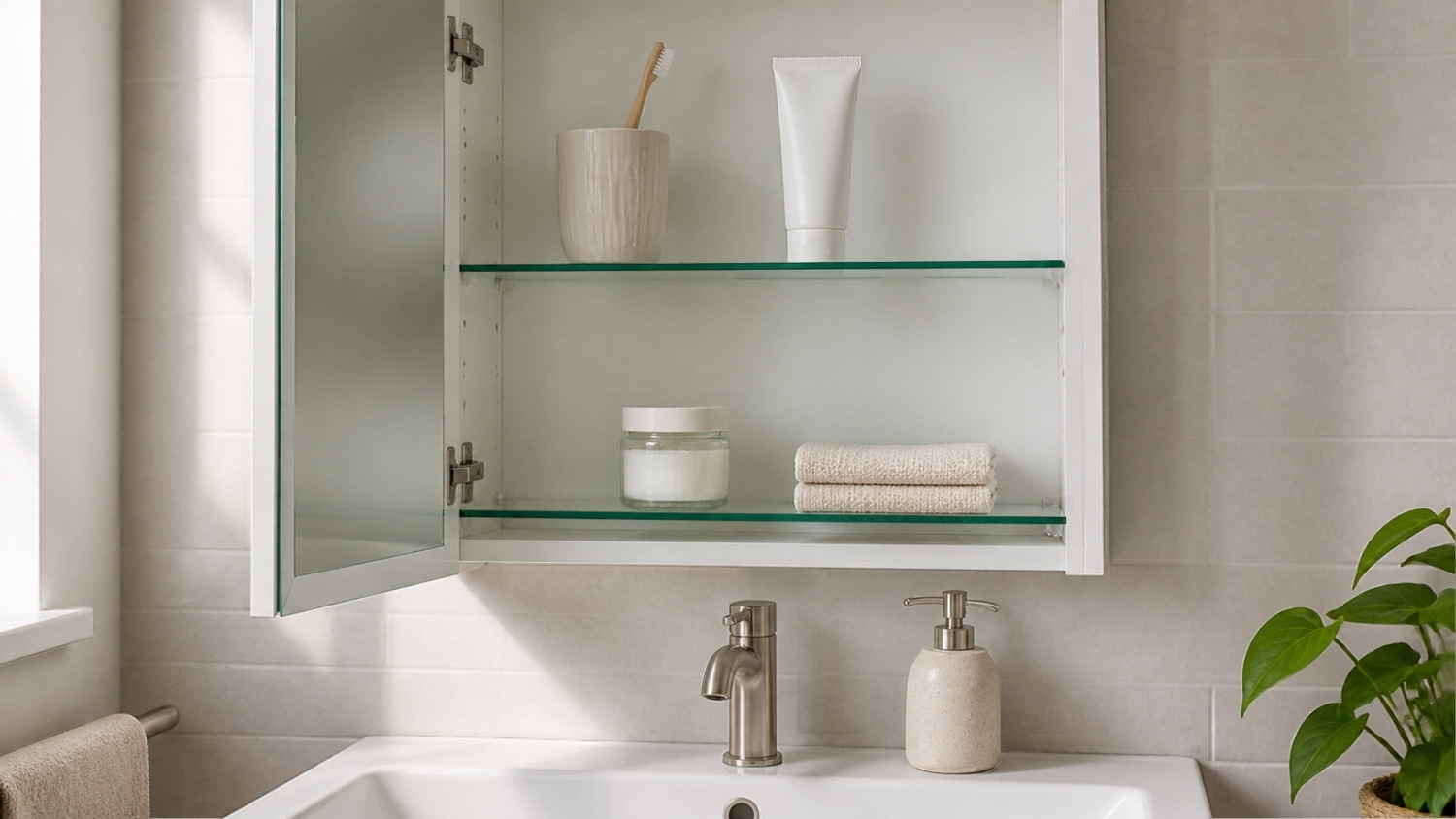
Medicine cabinet organization starts with giving that shallow cabinet to the toiletries you use standing at that sink most mornings.
The medicines themselves are a separate question, and that question is not ours: it belongs to your pharmacist and to the MedlinePlus page quoted in full below. The rest of this page is about the cabinet. What earns the shelf your eye lands on, where the tall bottles go, and what leaves the room if the bathroom is the smallest storage space you have.
- DailyOnly what you reach for standing at that sink most mornings
- Eye levelThe shelf you see first when you open the door, for those
- Tallest gapWhere the hairspray and the mouthwash go, measured in your own cabinet
- OutSpares, first, if the bathroom is your smallest storage space
MedlinePlus, the U.S. National Library of Medicine’s consumer health site, has a page on storing medicines. It opens with the reason it matters: “Storing your medicines properly can help to ensure they work as they should as well as prevent poisoning accidents.”
On the bathroom specifically it says: “If you are like most people, you probably store your medicines in a bathroom cabinet.” It then warns: “But the heat and moisture from your shower, bath, and sink may damage your medicines.” Its instruction is “Store your medicines in a cool, dry place.” and it names places: “For example, store them in your dresser drawer or a kitchen cabinet away from the stove, sink, and any hot appliances.” and “You can also store medicines in a storage box, on a shelf, or in a closet.”
On children it says: “Always store your medicines out of reach and out of sight of children.” And: “Store your medicines in a cabinet with a child latch or lock.”
The same page gives three of its other storage instructions: “Always keep medicines in their original container.” Then: “Take the cotton ball out of the medicine bottle.” because “The cotton ball pulls moisture into the bottle.” And “Ask your pharmacist about any specific storage instructions.”
It also names what not to use. Under the heading “Do not use Damaged Medicine” it says: “Damaged medicines may make you sick. Do not take:” and then lists two cases, one about a change in color, texture or smell even if the medicine has not expired, one about the state of the pills themselves. Read the two in the page’s own words: Storing your medicines, MedlinePlus. What to do about one is a question for your pharmacist, not for us.
Those are the page’s words, quoted as the page writes them. What goes beyond storing a medicine, including what to do with the ones you no longer need, belongs to your pharmacist and to that page, not to a home organizing article. Read it in full: Storing your medicines, MedlinePlus.
The rest of this is about the cabinet, with the child safety lines from that page repeated wherever a rule here could be mistaken for a rule about medicine.
Measure before you buy anything. The free Bathroom Fit Planner is what we print to check an organizer fits before ordering it. Four steps, five pages, and every published figure on it carries its source. Send it to me
Medicine cabinet organization starts with the gap nobody publishes
Yours
No listing publishes this one, because it belongs to your cabinet rather than to a product. Look at your own: where the shelves are not evenly spaced, the biggest gap is where the hairspray and the mouthwash go. Take the depth while you are there. If your cabinet is shallow, a lid that opens toward you needs room you may not have.
Arranging what stays
The rules below are for the toiletries you decided to keep in there. They are not rules for medicines: those stay “out of reach and out of sight of children”, in “a cabinet with a child latch or lock”, as the page above says.
Step 1
One test sorts the toiletries
Do you reach for it standing at that sink, most mornings? If yes, it earns the spot. If no, it can go somewhere you open less often. That test is for toiletries only.
Step 2
Put the daily toiletries where your eye lands
Stand at the sink, open the door, and notice which shelf you see first. That one goes to the handful of toiletries you touch every morning.
Step 3
Find the tallest gap, and give it the tall bottles
Look at your own cabinet. Where the shelves are not evenly spaced, the biggest gap is where the hairspray and the mouthwash go.
Step 4
For bottles and tubes, prefer open trays to hinged boxes
If your cabinet is shallow, a lid that opens toward you needs room you may not have. A low tray you slide out can work where that lid does not. This is about bottles and tubes: a closed first aid box stays closed, and a medicine stays in its original container, which is what the page above says: “Always keep medicines in their original container.”
Step 5
If you share it, split it by person rather than by category
Each of you then reaches only to your own shelf, instead of both of you reaching past each other for the same one.
Step 6
Leave room on one shelf
The things that end up on your counter are often the ones with nowhere to go. A little slack in the cabinet gives them somewhere.
Check it fits before you order. Print the sheet, measure your own shelf, and check the organizer against that number before you order. Step 1 is the wall above the toilet, and it starts at the floor rather than at the tank. Get the free planner
What earns a spot at eye levelthe short list, and what the test is not for
The cabinet above a bathroom sink usually sits at eye level, directly above where you stand every morning. It is also where the trial sizes and the gift sets end up.
Whatever you decide about the medicine, you are left with a shallow cabinet at eye level, right where you stand. Give it to the toiletries you reach for there. Medicines are not what this section is about: those are above, with your pharmacist and the MedlinePlus page.
Toothbrush, toothpaste, floss. Deodorant. A razor and shaving cream. Contact lens solution and a spare case. The moisturizer you actually use. A comb.
For toiletries, one test sorts them: do you reach for it standing at that sink, most mornings? If yes, it earns the spot. If no, it can go somewhere you open less often.
That test is for toiletries only. It is not a rule for medicines: for those, the guidance is your pharmacist and the MedlinePlus page above. It is not a rule for first aid either. Keep the kit where you can reach it fast, and for anything inside it that is a medicine, the MedlinePlus lines above say where it goes. Fast for you is not the same as reachable for a child.
What does not belong in therethree kinds of toiletry, and what is not on the list
The list below is a list of toiletries. Medicines are not on it, and neither is first aid. Something you have not needed in a long time, a thermometer or a first aid kit, is not clutter, and it belongs where you can reach it fast. For anything inside that kit which is a medicine, the MedlinePlus lines above say where it goes. Fast for you is not the same as reachable for a child. What to do with medicines you no longer need is a question for your pharmacist.
Spare toiletries. The second deodorant, the multipack of toothpaste, the bulk cotton pads. Keep the one in use at eye level and put the spares in a hall closet. If your bathroom is the smallest storage space you have, spares are the first thing that can leave it.
Toiletries you use in the shower or sitting down. If you reach for it in the bath, keeping it above the sink can mean crossing the floor wet to get it.
Toiletries you cannot remember using. The hotel bottle, the gift set, the trial size. That is storage, not use, and it is sitting at eye level. Medicines and first aid are not on this list, as said above.
Frequently asked questionsfive, and the medicine line repeated in each one
Should you keep medicine in a bathroom cabinet?
MedlinePlus, from the U.S. National Library of Medicine, says the heat and moisture from your shower, bath and sink may damage medicines, and tells you to store them in a cool, dry place instead. MedlinePlus also says to keep them out of reach and out of sight of children, in a cabinet with a child latch or lock. For anything beyond that, including what to do with medicines you no longer need, ask your pharmacist and read Storing your medicines, MedlinePlus.
What should go in a medicine cabinet?
For the toiletries you keep there: what you use standing at that sink most mornings, so toothbrush and toothpaste, deodorant, razor, contact lens solution, a daily moisturizer, rather than backup stock. This is for toiletries. It is not a rule for medicines or for first aid. For medicines, MedlinePlus says to store them “out of reach and out of sight of children”, in “a cabinet with a child latch or lock”, and adds: “Ask your pharmacist about any specific storage instructions.” Read Storing your medicines, MedlinePlus.
How do you organize a shallow medicine cabinet?
For the toiletries you keep there: put the daily ones on the shelf your eye lands on when you open the door, put tall bottles in whichever gap between shelves is tallest, and prefer low open trays to boxes with a lid that opens toward you, since a shallow shelf may not leave room for it to swing. This is for toiletries, and not for first aid: a closed first aid box stays closed. It is not a rule for medicines. For medicines, MedlinePlus says to store them “out of reach and out of sight of children”, in “a cabinet with a child latch or lock”, and adds: “Ask your pharmacist about any specific storage instructions.” Read Storing your medicines, MedlinePlus.
How do two people share one medicine cabinet?
For the toiletries you each keep there, split it by person rather than by category, so each of you reaches only to your own shelf. Sharing by category often means both of you going to the same shelf every morning. This is for toiletries. It is not a rule for medicines or for first aid. For medicines, MedlinePlus says to store them “out of reach and out of sight of children”, in “a cabinet with a child latch or lock”, and adds: “Ask your pharmacist about any specific storage instructions.” Read Storing your medicines, MedlinePlus.
Where should spare toiletries go?
Out of the bathroom if the bathroom is the smallest storage space you have. A hall closet or the top of a bedroom closet is close enough for a spare toiletry you only need now and then, and it leaves the eye level shelf for what you use daily. Medicines are not part of this. For medicines, MedlinePlus says to store them “out of reach and out of sight of children”, in “a cabinet with a child latch or lock”, and adds: “Ask your pharmacist about any specific storage instructions.” Read Storing your medicines, MedlinePlus.
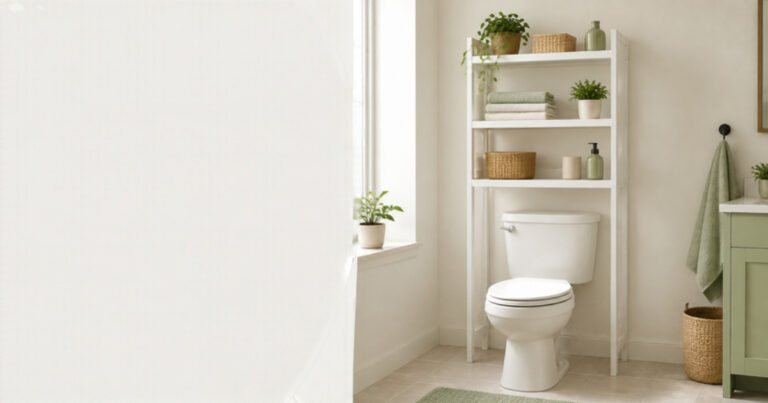
More bathroom fixes are in our bathroom storage guide, and the counter below that cabinet has its own page: why a bathroom counter fills up again. The wall above the toilet is in our over the toilet storage guide.
Taking the tape round the bathroom?
The Bathroom Fit Planner has a box for the shelf gap, a box for the depth, and three more measurements for the rest of the room. Four steps, five printable pages, and every published figure on it carries its source.
Saved in this browser, on this device. No account, nothing sent to us, and it goes if you clear your browsing data. See what you saved