Bulk Spice Containers: How to Buy Big Without Wrecking Your Rack
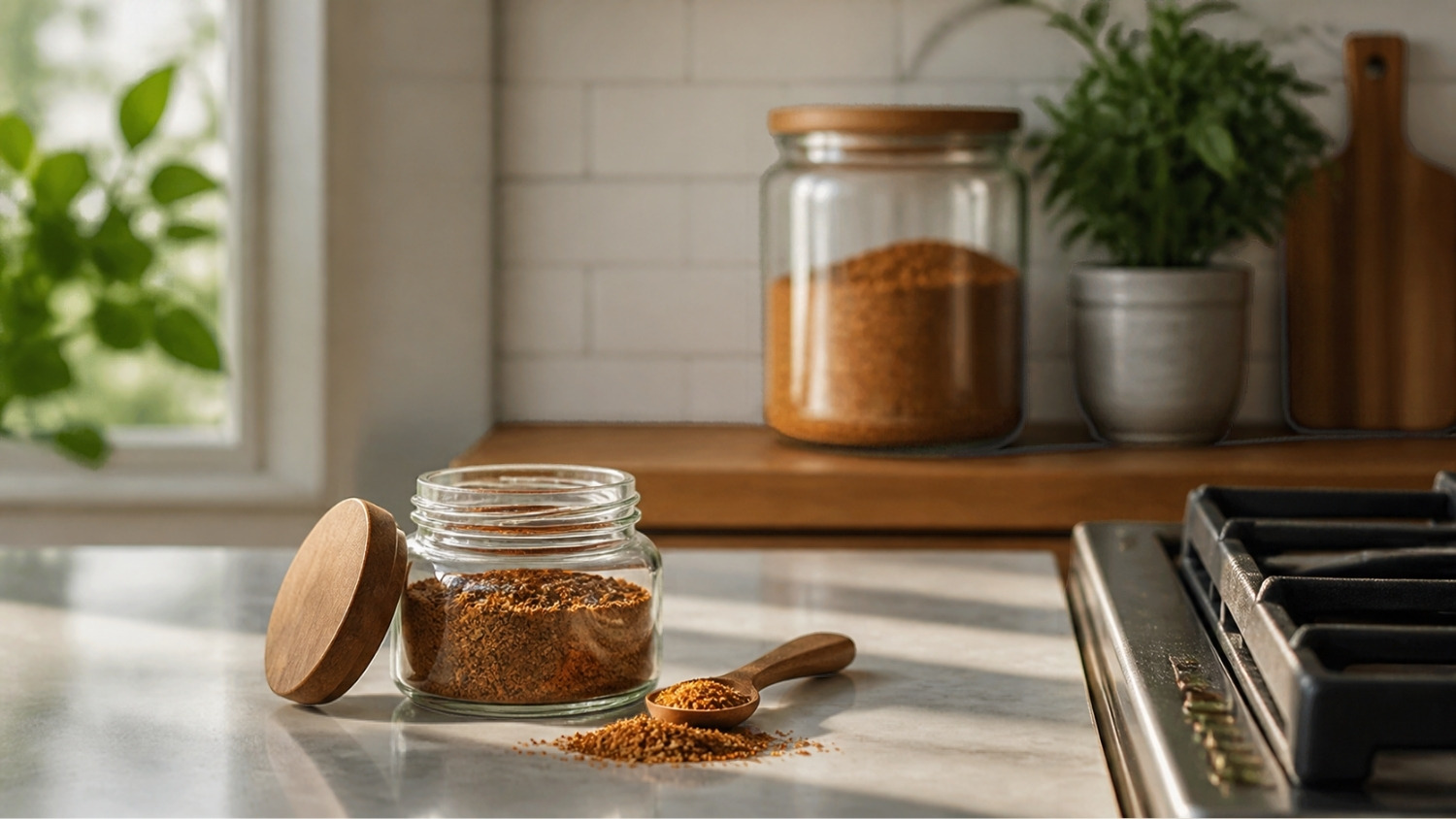
Bulk spice containers work when every spice you buy in bulk has two homes: a small working jar that lives where you cook, and a closed reserve that lives somewhere else entirely.
The reserve can be the bulk bag itself if it stays shut and stands up, and you buy a reserve container only for the ones that do not. What trips this up is trying to store the big bag where the little jar used to go. The bulk is not the problem. One container trying to do both jobs is.
- Two homesA working jar where you cook, and a closed reserve elsewhere
- The bagCan be the reserve itself, if it stays shut and stands up
- One placeAll the reserves together, not each one beside its working jar
- By positionThe new one goes behind the open one. Never by reading dates
Keep the reserves off high shelves and off the top of a cabinet. A full bulk container is heavy, and heavy or breakable containers belong below shoulder height where you are not lifting them down over your head.
The reserve goes back closed, every time, and the closed lid is what keeps it out of small hands. That is not a rule for houses with kids in them. It is the rule: kids visit. The reserves belong low rather than high, since a full container is heavy and it is not a daily reach, so height is not what protects them. The lid is. Put the lid back on and check it has caught before the container leaves your hand, and keep the reserve bin behind a closed cabinet door rather than open on the floor. Keep the lid on the bin, closed, not resting on top. A bag of paprika on its side is a bad afternoon.
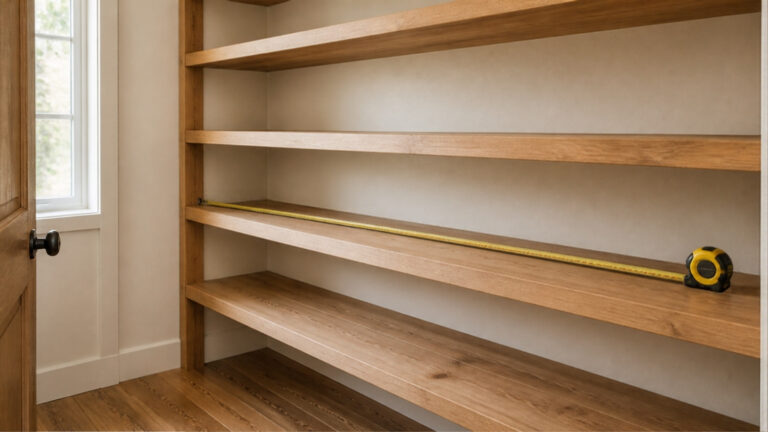
Measure the shelf the reserves will live on. The free Pantry Fit Planner asks for the gap above that shelf rather than the shelf itself. That is what decides whether a reserve container stands up there or ends up on its side. Five printable pages. Send it to me
Bulk spice containers: two homes, and they live apart
Two
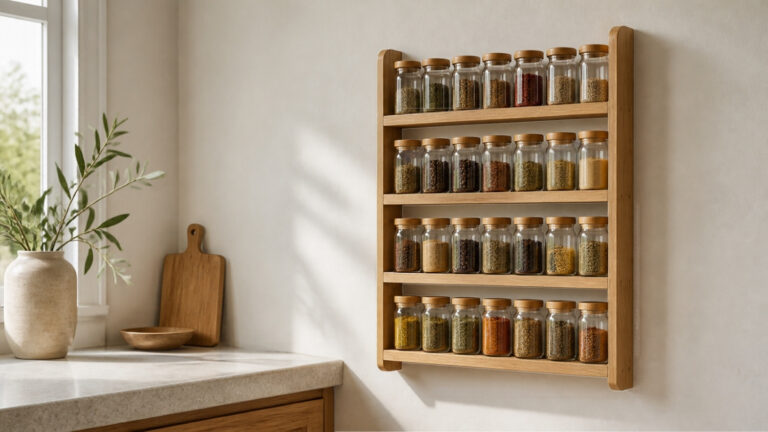
The working jar is small, it lives where you cook, and it holds what you get through between grocery runs. It is sized for your hand and your rack, not for the quantity you bought. The reserve is the bulk itself, kept closed, somewhere that is not the rack. If you take one thing from this page, let it be this: the rack holds working jars, never bulk.
Measure two things, and count one
Step 1
The gap above the shelf
Where the reserves will live. Measure the gap you are actually buying for, not another shelf in the same cabinet, because the two are not necessarily the same. This is the figure that decides whether a container stands up or ends up on its side.
Step 2
The depth of that shelf
Front edge to back wall, since the rotation needs room front to back. And the width of the space too, if the reserves are going into a bin. Write all of them down.
Step 3
Count the spices you actually buy in bulk
This is the part that costs money when you guess. That list is shorter than the list of spices you own, and counting is how you find out which ones are on it. Then buy a container only for the ones whose bag will not stay shut or will not stand up.
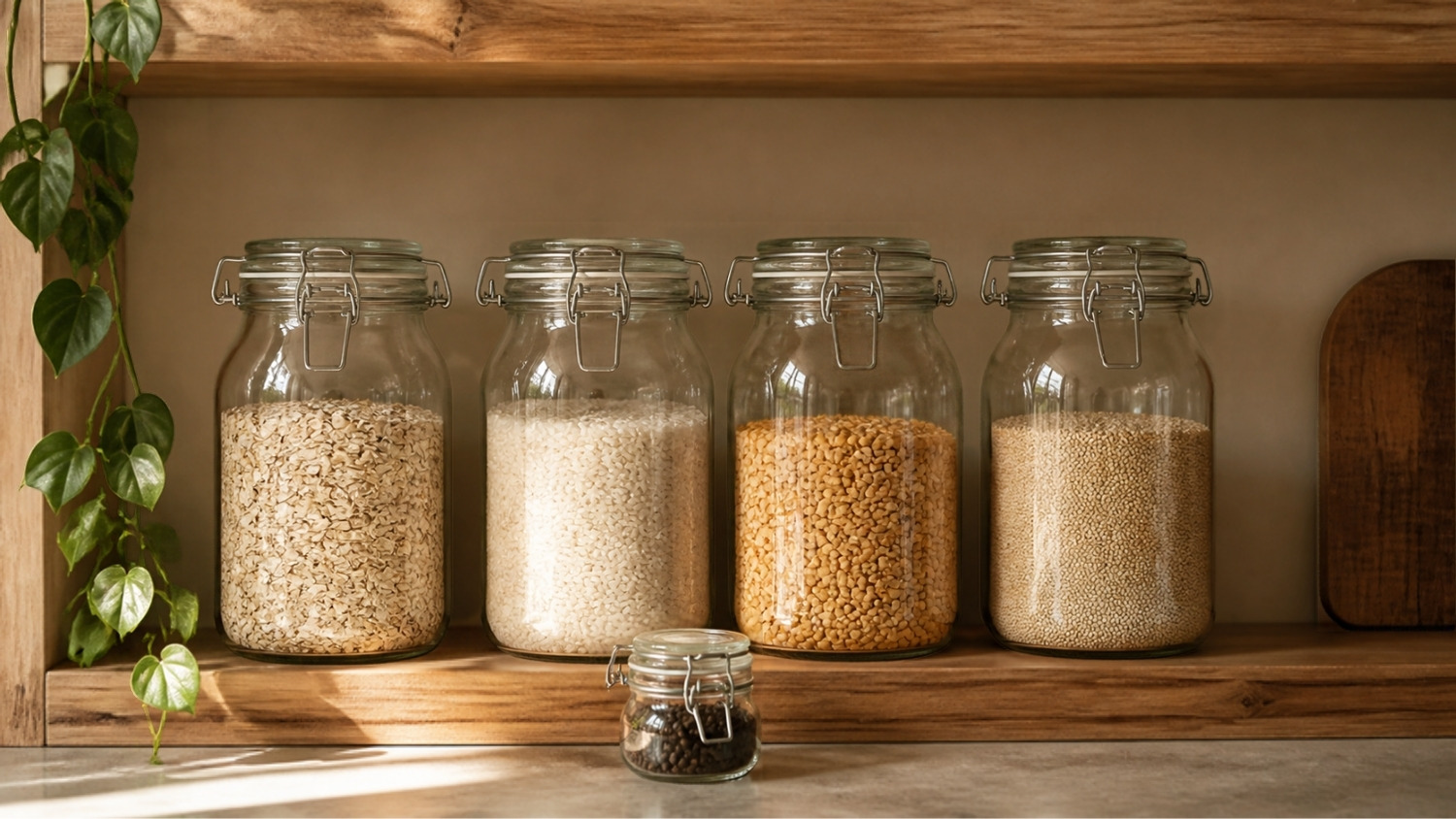
A volume is not a height. Page 4 of the planner holds the two readings we took: one maker publishes the height of its container in its Measurements section, and the other publishes no dimensions at all. Take your own gap before you order either. Get the free planner
What actually goes wrongthree things, in this order
Buying spices in bulk is how a tidy rack turns into a cabinet full of folded bags held shut with clips. The problem is not the bulk. It is that a bulk bag and a working jar are two different things doing two different jobs, and it is easy to try to make one container do both.
Three things tend to follow, in this order, and you can check your own cabinet for each one.
The bulk bag arrives and it does not fit the rack, so it goes in a cabinet. You decant a bit into the old jar. The bag gets opened, folded, clipped, and put back in a slightly different place each time.
Then you buy the same spice again, because the bag is out of sight and the jar is nearly empty and you were at the store. Now you have two bags.
Then the rotation breaks. You have no idea which bag was opened first, so you open whichever one is in front, and the older one works its way to the back of the cabinet where it stays.
None of that is a container problem. It is one container trying to be both the thing you cook from and the thing you store.
Where the reserve livesall together, and not in the rack’s cabinet
The working jar is small, it lives where you cook, and it holds what you get through between grocery runs. It is the one that goes in the rack, the drawer or the door. It is sized for your hand and your rack, not for the quantity you bought.
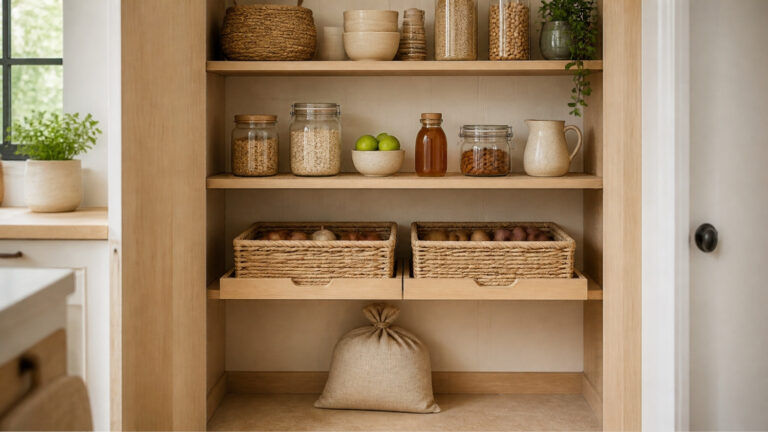
The reserve is the bulk itself, kept closed, and you only buy a container for the bags that will not stay shut or stand up, and it lives somewhere that is not the rack. A shelf in the pantry, a labeled bin with the other reserves, a low cabinet. It does not need to be near the stove, because you go to it between refills rather than every meal.
Put all the reserves together, in one place, rather than each one near its working jar. One bin, one shelf, one labeled box. You go to it between refills, not during cooking, so the extra few steps do not cost you anything mid-recipe, and having them together is what lets you see at a glance what you already own before you buy more.
Keep it out of the rack’s cabinet if you can. The reason is practical rather than theoretical: a reserve kept next to the working jars is easy to treat like one, pulled out mid-recipe, left on the counter, and put back in the wrong spot.
When the working jar runs low, you go to the reserve and refill it. That refill is also the moment to check what is left behind it.
Label so the rotation happens without you thinkingtwo labels, and one rule that does the work
Two labels, and they do different jobs.
On the working jar, write the name, large and plain, on the surface you actually look at. If the jars stand upright and you look down, that is the lid. If they face you in a rack, that is the side.
On the reserve, write the name and the month you opened it. Not the date you bought it, the month you opened it, because that is the thing you cannot tell by looking.
Then one rule, which does the rotation for you: a newly bought reserve always goes behind the one already open. Position does the work, so you do not have to read two dates and do arithmetic while you are cooking. The one in front is the one to use.
When a reserve empties, the one behind it moves forward and the next new bag goes behind that. It keeps working as long as nobody puts the groceries away in a hurry, which is why the rule has to be position rather than memory.
How long a given spice stays good, and what conditions it wants, is a question for the package, not for me.
What not to buythree things, and why each one comes back
A reserve container for every spice you own. Only the spices you buy in bulk need a reserve, and counting them is how you find out how short that list is. Buying a matching reserve for the whole rack fills a shelf with containers that stay empty.
A container that will not sit in your rack. If the rack came with jars, those jars are the constraint. A nicer jar that does not fit the slot has nowhere to go but the counter, which is the surface you were trying to clear.
One enormous jar instead of two sensible ones. It is the single container trying to do both jobs again, in a prettier shape. It is too big for the rack, and it gets opened every time you cook rather than between refills. In the aisle, lift one and ask whether you could still tip it one-handed once it is full.
What to look for on the shelf in the storefour things on a reserve, one on a working jar
Buy a reserve container for the spices on your bulk list whose bag will not stay shut or will not stand up. The others keep their own bag, inside the same bin, and cost you nothing. The rest of your spices do not need a reserve at all, because you buy them in a jar and you finish the jar.
Buy working jars that match your rack, not jars chosen for a set photo.
For the reserve, four things to look for on the shelf in the store: a lid that latches or screws rather than presses on, a flat square footprint so two sit side by side instead of rolling into each other, an opening wide enough for your measuring spoon to go in and come out level, and a wall you can see through, or a surface that takes a label.
For the working jar, the only thing that matters is that it drops into the slot your rack already has. Take a rack jar with you if you can.
Frequently asked questionsfive, including how many containers you need
Should I decant bulk spices into smaller jars?
Into a small working jar that lives in your rack, yes, and keep the rest closed somewhere else. The bulk bag itself can be that reserve when it stays shut and stands up on its own; buy a container for it only when it does not. Decanting the whole bulk bag into one jar big enough to hold it defeats the point, because that jar is then too big for the rack and ends up on the counter. Two homes per spice: one you cook from, one you refill from.
Where should bulk spices be stored?
Not in the spice rack. Put all the reserves together in one place, a shelf or a labeled bin, away from the working jars. You go to it between refills rather than every meal, so it does not need to be near the stove, and keeping the reserves together is what lets you check, before you shop, whether you already have two bags of something.
How do I rotate bulk spices?
By position, not by date. A newly bought reserve always goes behind the one that is already open, so the one in front is the one to use. Write the month you opened it on the reserve as a backstop, but let the order on the shelf do the work, because you are not going to read two dates in the middle of cooking.
How many bulk containers do I need?
Fewer than you think. Start from the spices you actually buy in bulk, not the spices you own, then buy a container only for the ones whose bag will not stay shut or will not stand up on its own. The bags that do stay shut are already the reserve, so they cost you nothing. Everything else comes in a jar you finish, and a reserve container for those is money spent on a container that stays empty.
What do I measure before buying reserve containers?
The height of the shelf gap where they will live, the depth of that shelf, and the width if they are going into a bin. Measure the gap you are actually buying for, not another shelf in the same cabinet, because the two are not necessarily the same.
More on where the working jars go is in our vertical spice rack guide, the wider room is in our pantry organization guide, and the four zones that decide which shelf the reserves get are in small pantry organization.
A volume is not a height
Page 4 of the free Pantry Fit Planner holds the two readings we took: one maker publishes the height of its container in its Measurements section, and the other publishes no dimensions at all. Take your own gap before you order either.
Saved in this browser, on this device. No account, nothing sent to us, and it goes if you clear your browsing data. See what you saved