Custom Pantry Shelving or Build Your Own: How to Decide Before You Call Anyone
Custom pantry shelving sells you three things, the measuring, the installing and the matched finish, so separate them and decide which of the three you actually need.
There are three routes, not two: have it measured and installed for you, buy a modular system and put it up yourself, or cut plain boards to sit on brackets or cleats. What you are really choosing between is whose time goes into the measuring and the installing, and how much of a mistake you can afford. And before you price any of them, one question is worth sitting with: does your pantry need new shelving at all?
- Three thingsThe measuring, the installing, the matched finish. Price them apart
- Three routesMeasured for you, a modular kit you assemble, or boards you cut
- Three readingsThe width at the back, at the front, and at the shelf’s own height
- Five figuresWhat to have written down before you talk to anyone
Before you drill. Find out what is behind the wall. You cannot tell from the surface what is inside it, and pipes and wiring can run through it. Scan the exact spot before the drill touches it, and have someone who can check the wall mark the holes for you whenever you cannot confirm what is behind them. Do not drill a spot you have not checked.
If the shelf hangs on the wall. Fix its brackets or rails into what the instructions that come with it name, and use anchors rated by their maker for the weight you intend to put on the shelf. Do that on every shelf, at every height, whatever you plan to store on it. If you cannot confirm that there is something structural where a bracket needs to go, have that part done by someone who can.
If the unit stands on the floor. Anchoring is the question, and the instructions that come with it name what it anchors to. Do that whatever it weighs and whoever lives in the house. Use the anti-tip hardware that came in the box if there was any, and anchors rated by their maker for the weight of the loaded unit if there was none. Children and furniture is the subject of Anchor It, a public campaign from the Consumer Product Safety Commission, and its pages are where to read what they publish on it. The arrangement that follows from it here: keep the heavy things low, and keep the things a child would want off the shelves altogether rather than on a high one.
The load figure. Ask what load each shelf is built for, and where that figure is written. Stay within what the system and its fasteners are rated for, and treat a shelf that comes with no figure as one you load with the lightest things you store and nothing you would not want falling.
Measure the pantry before you price anything. The free Pantry Fit Planner is the sheet to fill in standing in the room, before you ask anyone for a figure: three gaps, the depth, what you are storing, and the width of the doorway, written down in your own hand. Send it to me
Custom pantry shelving or your own boards: the width is three readings
Three readings
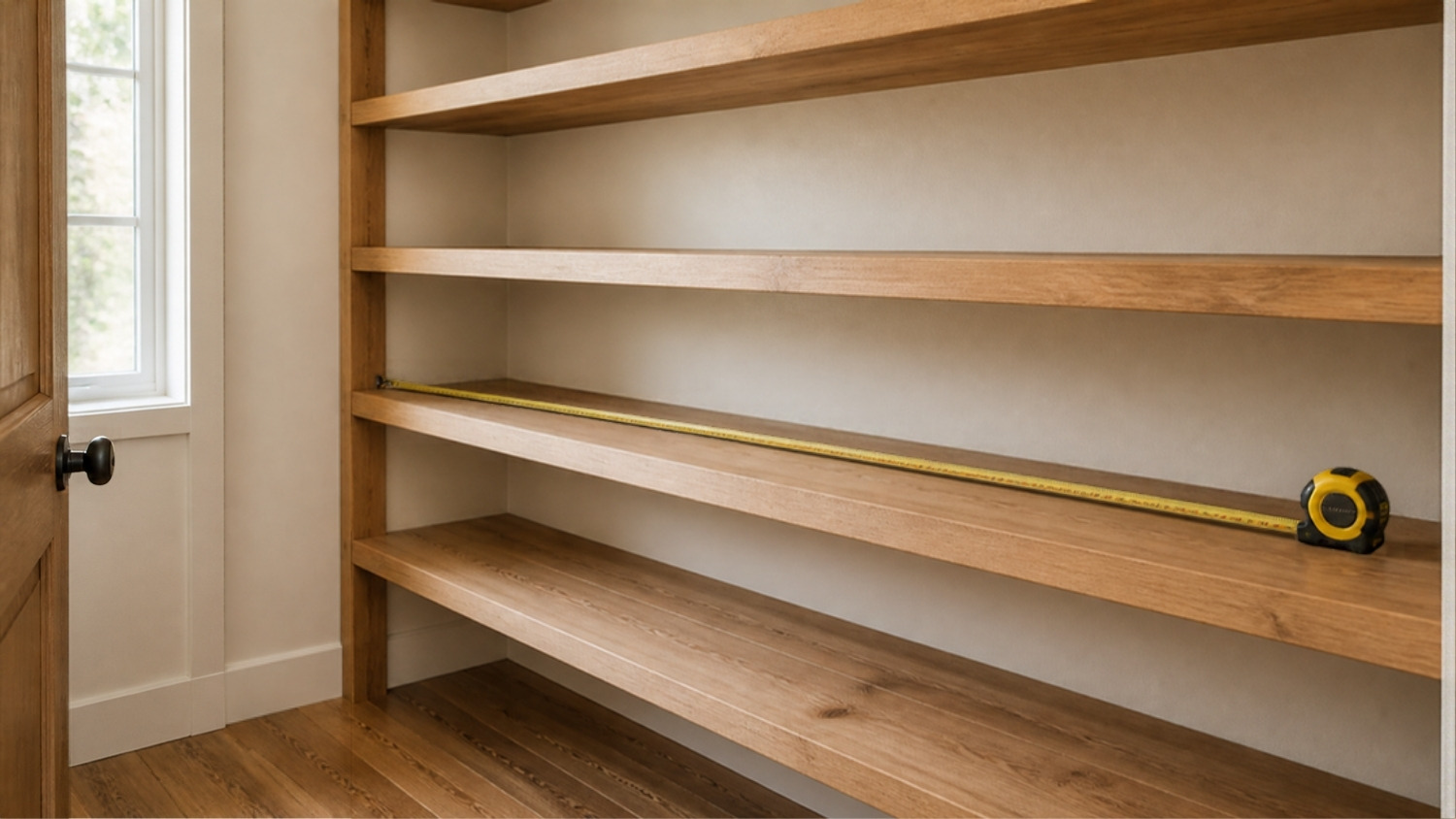
At the front, at the back, and at the height where the shelf will actually sit. Check whether your wall is the same at all three, and cut to the smallest reading, a hair under it rather than exactly on it. A board cut to a wider reading will not go in where the wall narrows. A wall that is not straight is also where paying someone else to measure is worth most, so price that against the boards before you choose.
What to measure, whichever route you take
The same five things serve all three routes, and two of them are more than one reading. Having them written down is what makes a quote comparable and a build of your own easy to cut for. Take them before you talk to anyone. One pass with a tape measure and a pencil, and every conversation that follows gets easier, because you are the one holding the numbers.
Step 1
The width, three readings
At the front, at the back, and at shelf height. Cut to the smallest, a hair under it.
Step 2
The depth, the full height, and every gap
The depth from the front edge to the back wall. The full height from floor to ceiling. And the height of each existing gap, one reading per gap, because they are not necessarily equal.
Step 3
The width of the doorway
Because whatever you buy has to come through it in one piece, or in parts that assemble inside. A quote based on your own numbers is a quote you can line up against the cost of buying the parts yourself.
Take your numbers standing in the pantry. The planner gives you a box for each one, including the two this article ends on: the gap you actually need, and the doorway whatever you buy has to come through. Use the same sheet for every quote and every order. Get the free planner
First, check whether the shelving is the problema spacing problem is not a shelving problem
A pantry that feels too small can have the right number of shelves in the wrong places, and if your shelves move, putting one somewhere else costs you your own time rather than a quote, plus the cost of any extra shelf supports your system uses.
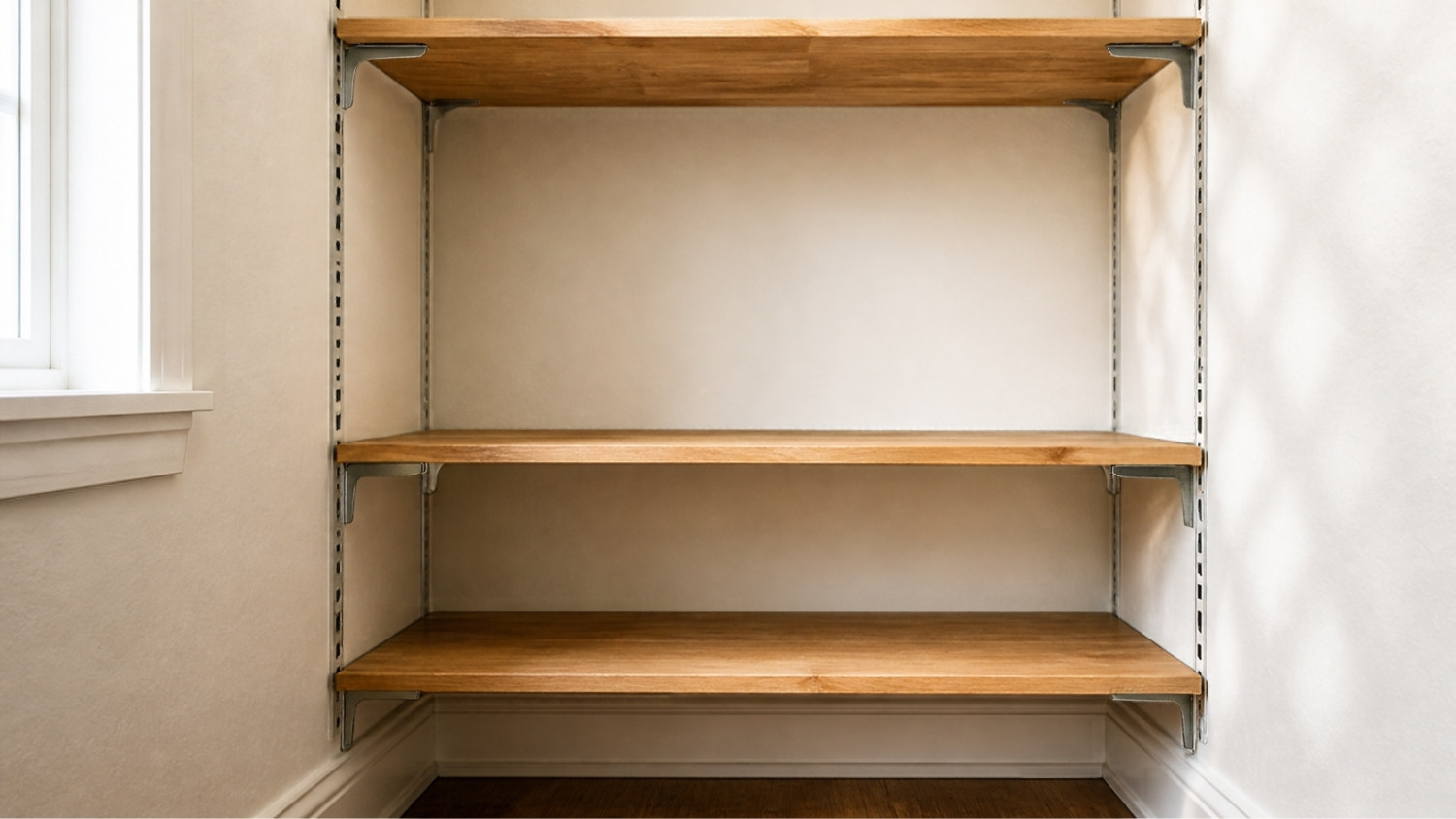
Go stand in the pantry, and look at the gaps between the shelves rather than at the shelves themselves. If your shelves are adjustable, they are what you can change without replacing the shelving.
If the gaps in yours are all the same, your tallest items may fit nowhere, and your short ones waste the space above them. That is not a shelving problem, it is a spacing problem, and if your shelves are adjustable it costs you your own time rather than a quote, plus the cost of any extra shelf supports your system uses.
Look at depth too. A shelf deeper than your reach is hard to see into, whatever it is made of. Putting deeper shelving into a pantry that already loses food at the back buys you more places to lose it.
If the gaps are wrong and the shelves do not move, then the shelving really is the problem, and the three routes below are the ways out.
The three routes, and what each one asks of youwho measures, who installs, and where the risk sits
| Route | Who measures | Who installs it | What it asks of you |
|---|---|---|---|
| Custom, measured for you | Them | Them | Access to your home, whatever wait they quote you, and possibly a decision made from a drawing, so ask whether you’ll see anything else before you sign |
| Modular system, self-assembled | You | You | Accurate measuring, a drill, and patience with leveling |
| Boards and brackets, cut to size | You | You | All of the above plus cutting, and a finish that only you have to be happy with |
None of the three is the right answer in general. They differ in where the risk sits. Custom hands the measuring to someone else, and the dates stop being yours alone to set. Ask who decides the dates, before you sign. The other two keep the measuring risk with you, which rewards a careful pass with the tape measure.
What you are actually buying when you pay for customthree things, priced separately
Three things, and it is worth naming them separately so you can judge whether you need all three.
You are buying the measuring. Somebody comes and records the room. Whether they also carry the cost if a piece is cut wrong is a question you ask, not something you assume. If your pantry is square, flat and simple, that responsibility is worth less than it is in a room with a sloping ceiling, a boxed-in pipe or a wall that is not straight.
You are buying the installing. Somebody drills, levels and finishes it. If you have never put up a shelf that carries weight, this is the part worth paying for, and that is a perfectly good reason to pay someone. A shelf that pulls out of the wall is the failure the panel at the top of this page is about, and the figure that matters is the one the maker publishes for that exact shelf.
And you are buying a finish that matches. Only you can say what that is worth in your own kitchen, which is exactly why it is worth pricing separately from the measuring and the installing rather than buried inside them.
Questions to ask before you accept a quotefive, asked standing in the room
Ask these standing in the room, and write the answers down.
What exactly is being fixed to the wall, and into what. A pantry wall is not always what it looks like from the outside, and the answer tells you whether you could have done it yourself.
What is the load each shelf is built for, and where is that figure written?
Are the shelves adjustable afterwards, or fixed at the heights on the drawing. Get this answer and the lead time in writing before the work is booked, because these are the two you will not want to reopen afterwards. If what you store changes, a fixed gap will not.
What happens if a measurement is wrong. Who recuts it, and how long does that take.
And what is the lead time. Ask how long the pantry has to stay emptied, and count that stretch of time as part of what the job costs you, alongside the figure on the quote.
If you are doing it yourselfthe gaps to decide before you buy anything
Measure at three points rather than one. The width at the front of the pantry, the width at the back, and the width where the shelf will actually sit. Check whether your wall is the same at all three, and cut to the smallest reading, a hair under it rather than exactly on it, because a board cut to a wider reading will not go in where the wall narrows.
Decide the gaps before you buy anything, by standing the tallest thing you store on a shelf and leaving room to lift it out rather than slide it. Then make at least one gap taller than you think you need, so there is somewhere to put the next tall thing you bring home.
Keep the deepest shelves lowest. Deep and high together is how you get a shelf you cannot see into and cannot reach.
Everything about drilling, anchoring and load is in the panel at the top of this page, and it is the part to read before you order rather than after.
Frequently asked questionsfive, including the two alternatives to custom
Is custom pantry shelving worth it?
It depends which of the three things you need. You are paying for the measuring, the installing and a matched finish, and they are worth different amounts to different people. In a square, flat, simple pantry where you are comfortable drilling, the measuring is worth least. In a room with a sloping ceiling, a boxed-in pipe or a wall that is not straight, that is where it earns its price. Separate the three before you compare any two prices.
What is the alternative to custom shelving?
Two alternatives rather than one. A modular system you measure for and assemble yourself, or plain boards cut to size on brackets or cleats. Take the modular system if your walls are straight and you would rather assemble a kit than cut boards; take boards if your walls are not straight, or if no kit comes in your width, because a board can be cut to follow a wall a kit cannot. A wall that is not straight is also where paying someone else to measure is worth most, so price that against the boards before you choose. Both routes keep the measuring with you, so take your time with the tape measure. Both also mean drilling into your own wall: you cannot tell from the surface what is inside it, and pipes and wiring can run through it, so do not drill a spot you have not checked. Anything you hang has to be fixed into something structural with anchors rated for the weight, and anything that stands on the floor has to be anchored to the wall, whatever it weighs and whoever lives in the house. If you cannot confirm what is behind the spot, have that part done by someone who can.
How deep should pantry shelves be?
Deep enough for what you store and no deeper than you can reach into, because what sits past your reach is hard to see and easy to lose track of. If you are already losing things at the back of your current shelves, going deeper makes that worse rather than better. Keep the deepest shelves lowest, where you can see into them.
Do I need to reshelve, or just move the shelves?
Check the gaps first. If your shelves are evenly spaced, your tallest items may fit nowhere, and your short ones waste the space above them. If your shelves are adjustable, respacing them costs your own time rather than a quote, plus the cost of any extra shelf supports your system uses. If they are fixed at the wrong heights and will not move, that is when new shelving earns its money.
What should I ask before accepting a quote?
What is being fixed into, what load each shelf is rated for and where that figure is written, whether the shelves stay adjustable afterwards, who recuts a wrong measurement and how fast, and the lead time. Write the answers down, and get the lead time and the adjustability in writing before the work is booked.
What goes on those shelves once they are up is in small pantry organization, and the wider room guide is our pantry organization guide.
One sheet, every quote
The free Pantry Fit Planner gives you a box for each of the five figures, including the gap you actually need and the doorway whatever you buy has to come through. Use the same sheet for every quote and every order.
Saved in this browser, on this device. No account, nothing sent to us, and it goes if you clear your browsing data. See what you saved