Pot and Pan Storage: Your 12 Inch Skillet Needs 20 Inches of Space
When you buy through a link on Cozy & Tidy, we may earn a commission. It does not change the price you pay, and it does not decide what we recommend. How it works
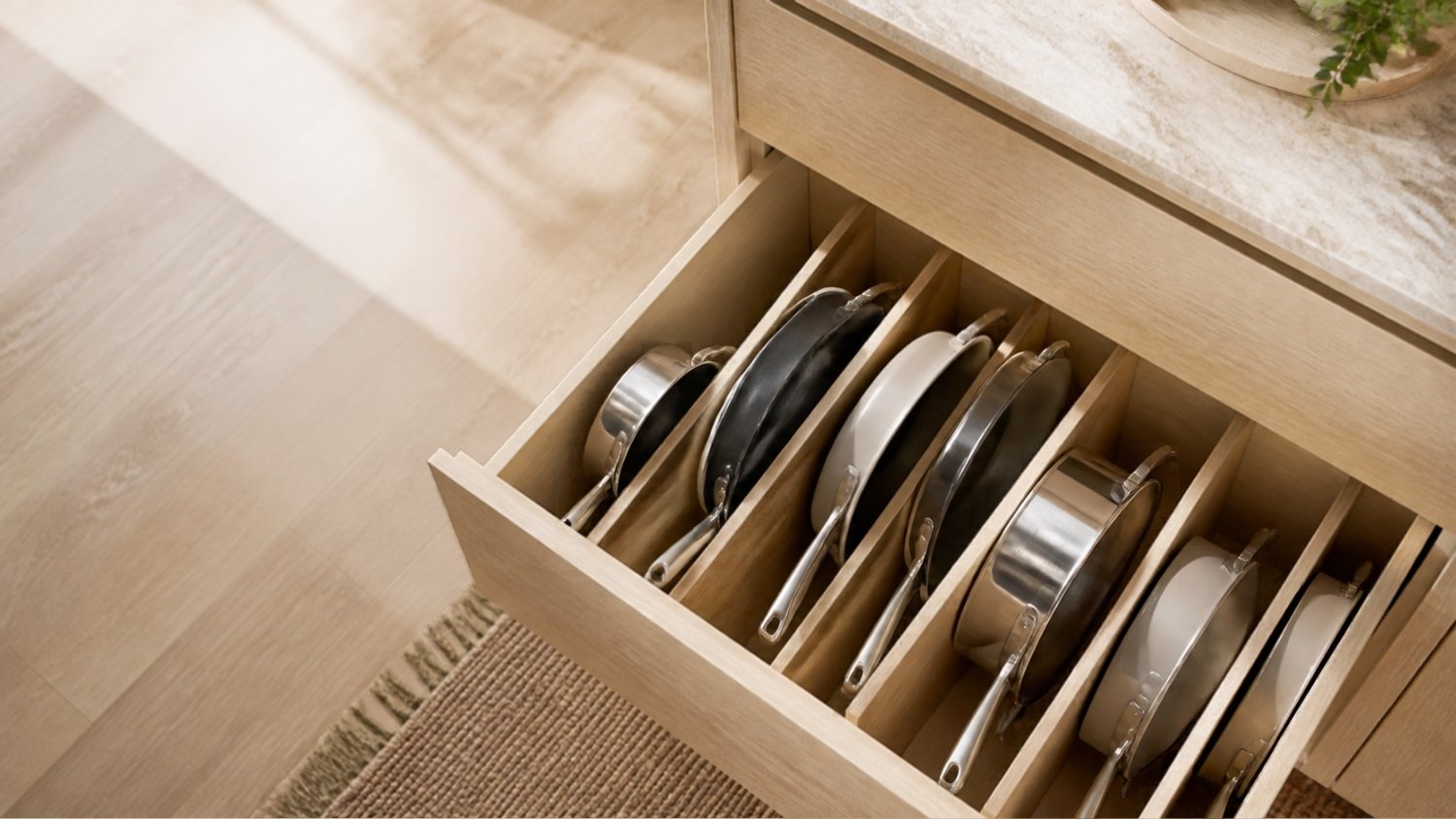
Pan storage runs on the wrong number: cookware is sized by its cooking surface and stored by its handle, and the gap between those two numbers is eight to ten inches.
A 12 inch stainless skillet measures about 20 inches from handle tip to far rim. A 14 inch one measures nearly 24. The published minimum opening of a 24 inch base cabinet is around 20.5 inches, so the 12 goes in with half an inch to spare and the 14 does not go in at all, in any orientation. Measure the overall length, never the number stamped on the pan.
- 20.1 inA 12 inch stainless fry pan, handle included. The pan itself is 12
- 23.8 inA 14 inch one. No standard base cabinet takes it, in any orientation
- 20.5 inThe published minimum opening of a 24 inch base cabinet
- 9 lbWhat a common S hook is rated at. An enameled dutch oven is 13.52
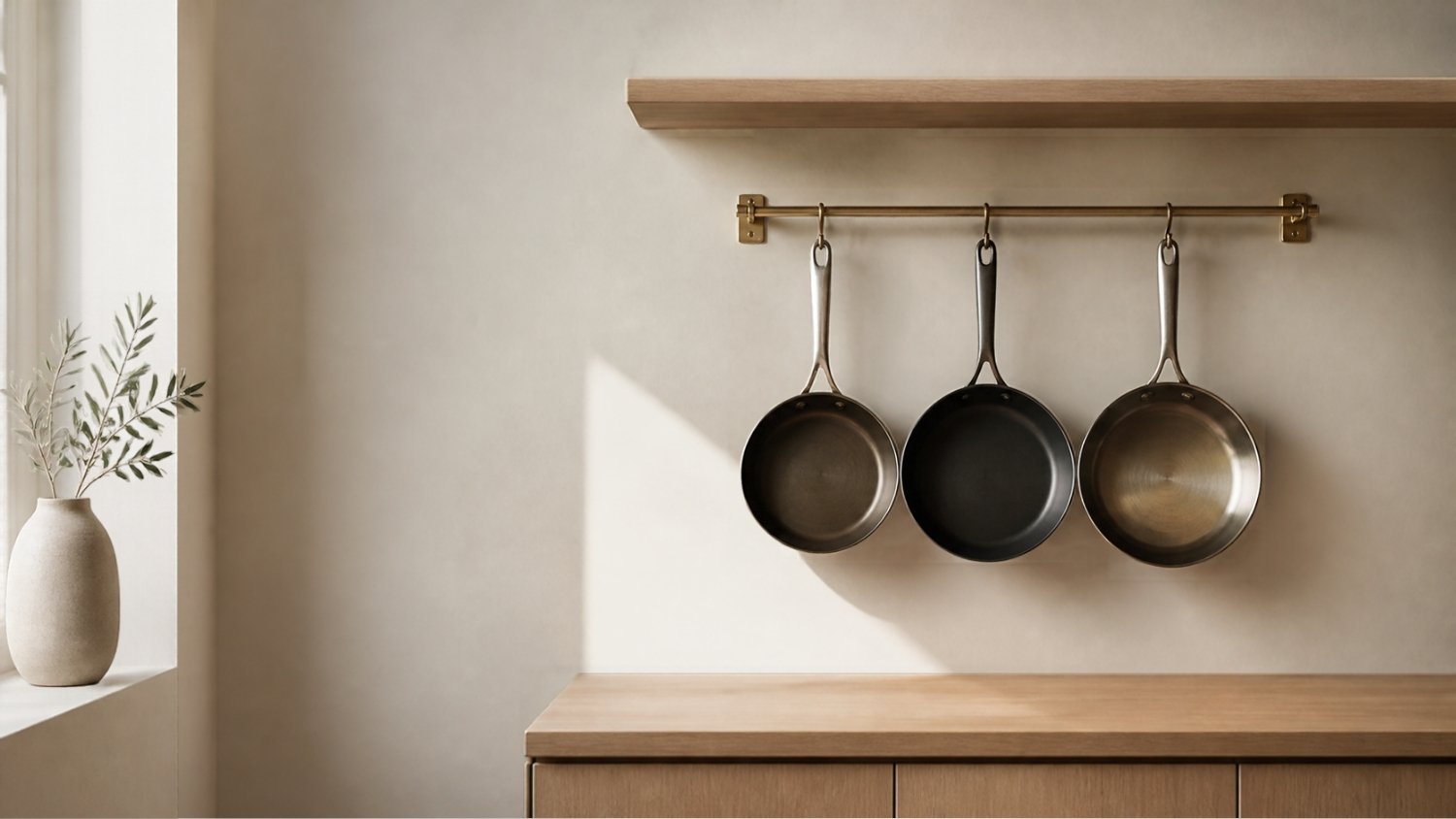
A pot rack is the answer people worry about most, usually for the wrong reason. They worry about the rack, and the rack is almost never the weak point. The rack listings I read published a wide range of capacities, so the figure on the rack you are looking at is the only one that applies to it. Wall racks generally publish lower figures, in the 50 to 60 pound region, though they are less consistently stated. Some of the best made racks publish nothing at all: Enclume, the premium American maker, states that mounting directly into ceiling joists or beams is recommended and does not publish a weight capacity for any rack I could find.
The failure point is smaller and cheaper than that. An IKEA S hook is rated at 9 pounds. Set that against the figures above: a 12 inch cast iron skillet is 7.69 pounds, so one hook carries it with almost no margin, and a 6 qt enameled dutch oven at 13.52 pounds it will not carry at all. A hook has its own published figure, separate from the rail’s, and the lower of the two is the one that governs.
On anchoring, what a given rack has to be fixed to is named in the instructions that come with it, and that is the line to read before you drill. If you cannot reach a joist or a stud, a heavy duty toggle publishes an ultimate pull out of 238 to 275 pounds in half inch drywall, and the same manufacturer says industry practice is to work to a quarter of the ultimate, which puts a single toggle at roughly 60 to 70 pounds of working load. That is one dutch oven and a margin, not a rack of cookware.
Before you buy a pan rack. The free Kitchen Fit Planner has the real overall length of every awkward pan, the six kitchen measurements that decide what fits, and a shopping checklist. Send it to me
Pan storage: the number on the pan is not the size of the pan
20.1 in
That is a 12 inch stainless fry pan, against a published minimum opening of around 20.5 inches. It fits by less than half an inch, which is why it catches on the way in and why it feels like it should not go. A 10 inch pan at 18 inches clears by two and a half. A 14 inch one at 23.8 does not go in at all.
One measurement, and one decision
Step 1
The overall length of your longest pan
Handle included. If it is over about 20.5 inches, no standard base cabinet is going to take it and you should stop trying: that pan belongs on a rack, on the stove or on an open shelf. If it is a whisker under, as a 12 inch stainless skillet is, you now know why it always catches on the way in.
Step 2
Decide where the cast iron goes
It is the heavy, moisture sensitive, awkward part of the collection. Dry, reachable, and not stacked on top of anything you care about. Cast iron is shorter and more than twice as heavy as stainless of the same nominal size, so it fits where stainless does not and then puts two and a half times the weight on whatever it is sitting on.
Step 3
Put a dishcloth between the pieces that do stack
It costs nothing and it is what the manufacturers ask for anyway. The rule that emerges from four of them is simply: something soft between the pieces, and nothing put away damp.
The awkward pans, on one page. The Kitchen Fit Planner lists the real overall length of every pan that gives people trouble, so you can check a rack or a drawer against your own collection before you order. Get the free planner
Ten pieces, measured end to endoverall length and weight, and what the lids cost you
Pots and pans are the hardest thing in the kitchen to store well, and not because you own too many. It is because they are the only category where the name of the object tells you almost nothing about the space it needs. A 12 inch skillet is a 20 inch object. A 14 inch one is a 24 inch object and will not lie flat in any standard cabinet in the country. So here are the real numbers, taken from manufacturer pages wherever one publishes them.
| Piece | Longest dimension, handles included | Weight |
|---|---|---|
| 8 in stainless fry pan | 15 in | 1.75 lb |
| 10 in stainless fry pan | 18 in | 2.25 lb |
| 12 in stainless fry pan | 20 to 20.1 in | 3 lb |
| 14 in stainless fry pan | 23.8 in | 5.58 lb |
| 10.25 in cast iron skillet | 16.12 in | 5.66 lb |
| 12 in cast iron skillet | 18.31 in | 7.69 lb |
| 5 qt cast iron double dutch oven | 12.62 in | 12.37 lb |
| 6 qt enameled dutch oven | 13.25 in across the handles | 13.52 lb |
| 5.5 qt enameled round oven | 14 in across the handles | 11.25 lb with the lid |
| Half sheet pan | 17.9 by 12.9 in | 1.6 lb |
Two things jump out of that table. The first is that cast iron is shorter and more than twice as heavy as stainless of the same nominal size: a 12 inch cast iron skillet is 18.31 inches long and 7.69 pounds, against 20 inches and 3 pounds for stainless. Cast iron fits where stainless does not, and then puts two and a half times the weight on whatever it is sitting on.
The second is the lids, which nobody measures until they are in the way, and where the published figures are thinner than you would expect. Lodge is one of the few makers to give one: its 12 inch cast iron cover is 12.125 inches across, an eighth over nominal, and 2 inches tall including the knob. So a lid stored flat, knob up, costs you two inches of vertical clearance that you had probably assigned to something else. Most makers publish no lid height at all, which is worth knowing before you buy a rack sold by lid count.
What your cabinet actually offers, and what the shelf will carry20.5 by 22 inches, and about 47 pounds
Cabinet makers rarely publish interior dimensions anywhere a shopper will find them. Organizer makers have to, because their products either fit or come back, so their minimum opening specs are the industry’s honest answer. Rev-A-Shelf’s cookware organizers for a 24 inch base cabinet ask for about 20.5 inches of width and 22 of depth, and its figures move by a quarter inch or so between products, so treat 20.5 as the working number rather than a constant.
Hold that against the table above and the conclusions are immediate.
- A 12 inch stainless skillet at 20 to 20.1 inches clears a 20.5 inch opening by less than half an inch. It fits, and it fits by so little that a slightly generous handle or a slightly tight cabinet turns it into the pan that always goes in at an angle.
- A 14 inch pan at 23.8 inches will not go into a 24 inch base cabinet at all, in any orientation, since the depth is only 22. If you own one it lives on the stove, on a rack or on an open shelf. There is no cabinet answer.
- A 10 inch pan at 18 inches clears the opening by two and a half inches, which is a large part of why the 10 is the pan everyone actually reaches for.
- A half sheet pan at 17.9 inches fits the 21.75 inch depth lying flat, but only if nothing else is sharing the shelf.
And what the shelf underneath will carry
A cabinet shelf carries a rating that comes from a certification test, and the figure that applies to yours is the one its maker publishes for that exact cabinet. On a 24 inch base cabinet shelf, taking the interior at roughly 20.7 by 21.75 inches, that works out to about 47 pounds. That is my arithmetic on the standard rather than anybody’s published rating, and it is a threshold the shelf has to survive rather than a capacity, so a real shelf will carry more. Even so, put a 13.52 pound enameled dutch oven, a 12.37 pound double dutch oven and a 7.69 pound cast iron skillet on it and you are at 33.6 pounds from three pieces.
Deep drawers have the same problem stated differently. An IKEA high drawer gives 8.375 inches of height and a published maximum load of 55 pounds. Four dutch ovens reach it. Skillets are lighter, so you would get seven or eight of those in before the number bites. And at 8.375 inches it takes an 8 inch stock pot body but not the pot with its lid on, which is the kind of detail that only becomes obvious after you have bought the drawer.
Stacking, and what the makers actually sayfour manufacturers, in their own words
This is where the internet is loudest and the manufacturers are quietest, so it is worth reading what they actually wrote.
- Calphalon, on nonstick: stacking nonstick pans on top of each other can scratch the interior, so place a paper towel, napkin or trivet between each pan. Note what that does not say. It does not say the coating is ruined, and it does not tell you to stop stacking.
- All-Clad: if stacking, use pan protectors or soft liners. It also tells you to dry the pan thoroughly with a towel after washing, and it ships plastic separators with its enameled cast iron specifically so that lid and body cannot trap water between them.
- Le Creuset: store in a single row and not stacked if you can, and when you must stack, use a protector. Then it lists the alternatives itself: a dishcloth, a silicone trivet, shelf liner, bubble wrap or paper towels. It also says to store the pot with the lid on, right side up, with something between lid and rim.
- Lodge, on enameled: dry the piece completely, then store in a cool dry place, and it names the stovetop as one.
So the rule that emerges from four manufacturers is simply: something soft between the pieces, and nothing put away damp. On whether that something has to be a purchased protector they split. Calphalon and Le Creuset both name free substitutes, a paper towel among them. Lodge and All-Clad name only the product. Nobody publishes a test showing the felt outperforms the dishcloth.
Cast iron: the paper towel is not folkloreit is Lodge’s own written care instruction
Here is the one that surprised me. The internet treats the paper towel between lid and pot as a clever hack passed between grandmothers. It is not. It is Lodge’s own written care instruction, on the sheet that ships with the pan: when storing lids, place a paper towel between them and the pot to prevent moisture build up.
The same sheet gives two more instructions worth having. Hang or store cookware in a dry place, and note that Lodge names hanging first. And rub with a very light layer of vegetable oil before putting it away, preferably while the pan is still warm.
What is not in there is just as useful. Lodge’s care documentation says nothing at all about stacking bare cast iron, and nothing about lid off versus lid on beyond the paper towel instruction, which assumes the lid goes on. Two of the most repeated cast iron storage rules on the internet have no manufacturer behind them.
Where Lodge does have a view is the oil. Its instruction names vegetable oil, and it says it pre seasons its own cookware with soy vegetable oil and nothing else. So the endless argument about flaxseed versus canola is an argument the manufacturer is not having.
One more finding worth recording, because it stopped a sentence I had already drafted. Several university extension services publish cast iron guides that come up constantly in search, and most of them cover seasoning, cleaning and rust removal with no storage section at all. The nearest thing to a storage rule in any of the ones I read is North Carolina State’s, which is about water rather than arrangement: never leave any water in or on your cast iron, and never leave it in a wet sink. For everything else about storage, Lodge is the source.
Six things you will read everywhere that are not trueand who is telling you
- “Nesting pans ruins nonstick.” Overstated. Calphalon documents that stacking can scratch a nonstick interior and tells you to put a paper towel in between. It does not forbid stacking. And the decisive counter evidence comes from the same company: Calphalon sells a nonstick line engineered to nest, marketed on saving space by doing exactly that. A major nonstick maker builds and sells nonstick designed to be stacked.
- “Vertical storage saves a third of your space.” No manufacturer or study publishes a percentage for vertical or divider storage that I could find. The only space saving percentage anywhere in this category belongs to a nesting cookware line, which is the opposite idea. If you see a figure, it was invented.
- “Pan protectors are essential.” The makers do not agree on this. Le Creuset, which sells them, also lists a dishcloth, a silicone trivet, shelf liner, bubble wrap and paper towels as alternatives, and Calphalon specifies a paper towel, napkin or trivet. Lodge and All-Clad name only the product. What nobody publishes is a test showing the purpose made felt outperforms a folded cloth.
- “Never store cast iron with the lid on.” Contradicted by two manufacturers. Lodge’s instruction presumes the lid goes on, with a paper towel between. Le Creuset says to store the pot with the lid on, right side up. The real enemy is trapped moisture, not the lid, which is why All-Clad ships spacers rather than telling you to leave lids off.
- “Hanging racks damage your pans.” Not supported anywhere I looked, and contradicted by the makers. Lodge names hanging first among its storage options. Le Creuset explicitly endorses a pot rack. The real constraint on hanging is the hook rating, not the pan.
- “This organizer holds eight pans.” Check who is counting. Manufacturers publish lid counts, up to fourteen on a 21 inch pull out and up to seven on a 12 inch one, and I could not find a pan count published by any of them. The pan counts in blog posts are not manufacturer figures.
One last thing worth noticing. The strongest language against nesting your pans tends to come from companies selling cabinet organizers, while a cookware manufacturer builds and sells pans designed to nest. That is not a reason to dismiss the organizers, which are useful. It is a reason to notice who is telling you, and to weigh the advice against your own cabinet rather than against the copy.
Frequently asked questionsfive, including why your 12 inch skillet catches
How do I stop my pans scratching each other?
Put something soft between them, which is what every manufacturer that addresses stacking actually asks for. Calphalon specifies a paper towel, napkin or trivet. Le Creuset lists a dishcloth, a silicone trivet, shelf liner, bubble wrap or paper towels alongside the felt protectors it sells. No source claims the purchased protector performs better than the free options.
How much weight can a pot rack hold?
Published capacities run from around 50 to 60 pounds on wall racks up to about 130 on a large wooden ceiling rack, and some premium makers publish nothing at all. The rack is rarely the limit though. Hooks are: a common S hook is rated at 9 pounds, which will not carry a 13.5 pound enameled dutch oven. Mount into joists or studs, and if you truly cannot, a heavy duty toggle works out to roughly 60 to 70 pounds of working load each.
Should cast iron be stored with the lid on or off?
On, with a paper towel between the lid and the rim. That is Lodge’s own written instruction, not a household tip, and Le Creuset says the same in different words. The thing you are actually preventing is moisture trapped between two surfaces, which is why All-Clad ships plastic spacers with its enameled pieces rather than telling you to leave the lid off.
Why does my 12 inch skillet not fit in the cabinet?
Because it is not a 12 inch object. A 12 inch stainless fry pan measures about 20 inches from handle tip to rim, against a published minimum cabinet opening of around 20.5 inches. It fits, but by less than half an inch, which is why it catches and why it feels like it should not go in. A 10 inch pan at 18 inches overall clears by two and a half. And a 14 inch pan at 23.8 inches does not fit a standard base cabinet at all.
Can I keep pots and pans in a deep drawer?
Yes, and it is the nicest place for them, with two limits. An IKEA style high drawer gives 8.375 inches of interior height, which takes an 8 inch stock pot body but not the pot with its lid on. And its published maximum load is 55 pounds, which four dutch ovens will reach. US undermount slides are rated higher, commonly 90 to 100 pounds, but the certification standard for the cabinet itself is more conservative than either.
The same measuring logic applied to the cabinets is in kitchen cabinet organization, to the drawers in kitchen drawer organization, to the cabinet everyone avoids in under sink organization, and to the jars in food storage containers. More kitchen guides are in our kitchen organization guide.
The awkward pans, measured for you
The free Kitchen Fit Planner has the real overall length of every pan that gives people trouble, the six kitchen measurements that decide what fits, and a shopping checklist that tells you which dimension to verify before you order.
Dimensions and weights checked on September 26, 2026 against published specifications and care instructions from Lodge, Le Creuset, All-Clad, Calphalon, Made In, IKEA, Nordic Ware, Rev-A-Shelf, Enclume, TOGGLER, Home Depot and Lowe’s, with shelf and drawer load figures from the ANSI/KCMA A161.1 standard. The 47 pound shelf figure is my arithmetic on that standard, taking a 24 inch base cabinet interior at roughly 20.7 by 21.75 inches, rather than a published rating, and it is a threshold the shelf must survive rather than a limit. Where a manufacturer publishes no overall length, the figure comes from a retailer spec and is marked as approximate. Cookware dimensions vary by line, so check the listing for your own pan before you buy an organizer for it.
Saved in this browser, on this device. No account, nothing sent to us, and it goes if you clear your browsing data. See what you saved