Closet Shoe Organizers: What Actually Fits, and What Ruins Your Shoes
When you buy through a link on Cozy & Tidy, we may earn a commission. It does not change the price you pay, and it does not decide what we recommend. How it works
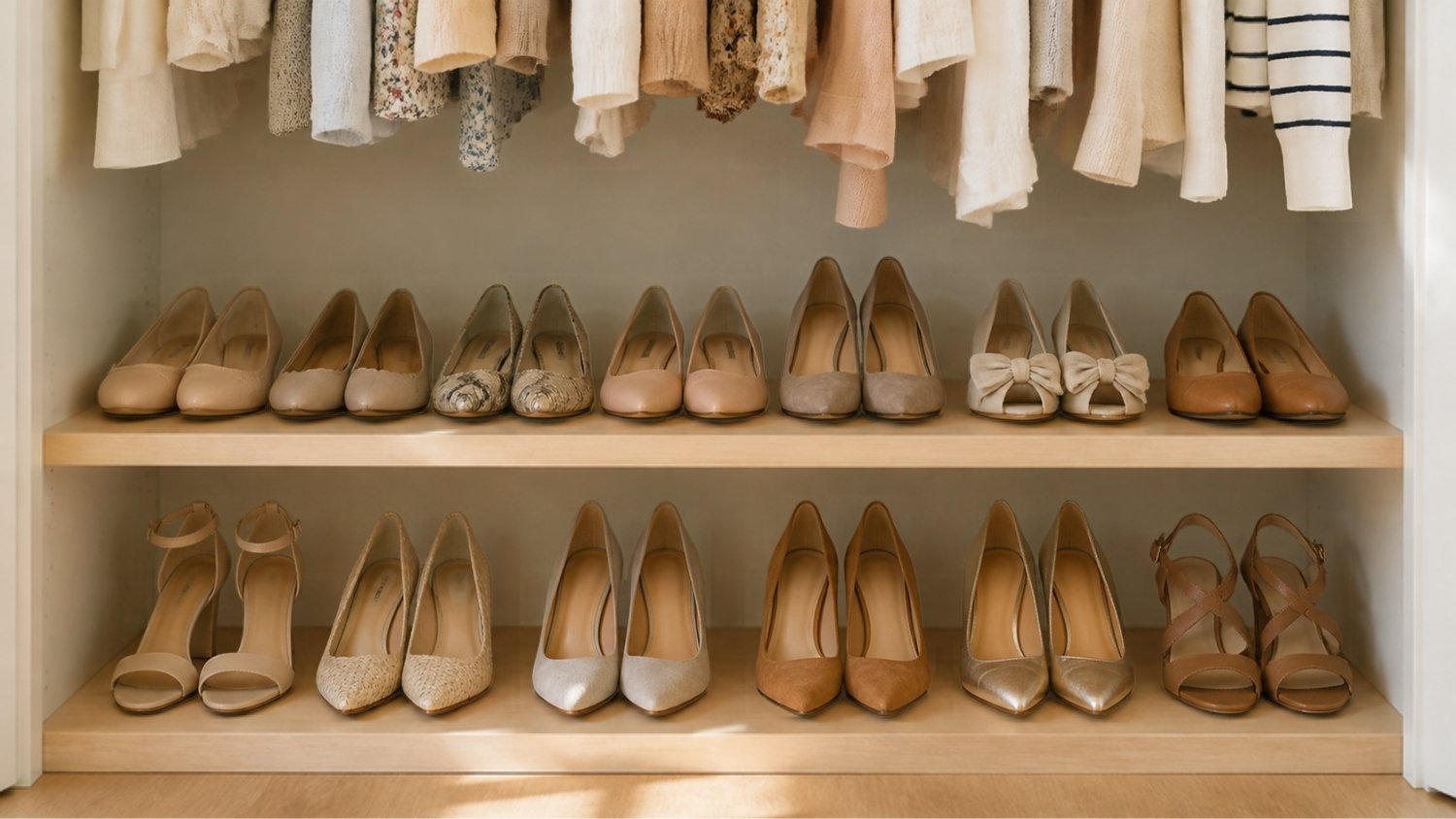
A shoe organizer for closet shelves is decided by depth, and by the weight limit printed on it, never by the number of pockets.
Allow about 12 inches of shelf depth for loose shoes, 15 if clear boxes are going on it, 7 to 9 inches between shelves and 8 to 10 inches of width per pair. An over-the-door organizer is the cheapest capacity in the closet at around $19, but weigh a few of your own shoes against its rating before you fill it. And keep leather out of the basement: above 65 percent humidity is where the trouble starts.
- 12 inShelf depth for loose shoes. 15 in if clear boxes go on it
- 7 to 9 inBetween shelves. 12 to 14 for boots
- 8 to 10 inWidth per pair, so a 24 in shelf holds two or three
- 65%The humidity the CCI calls favorable for mold on leather
What the door carries. On an ordinary interior door, the number that matters is the organizer’s own weight rating, not its pocket count. Target rates its 24 pocket model at 25 pounds in total. Ratings across the models I read ran from about 10 pounds up to 40, door-hung and rod-hung alike, so read the figure printed on the one you are actually buying and weigh a few of your own shoes against it. A bifold panel does have a top edge, so a narrow organizer can hang on one, but it swings with the door, and no listing I read publishes what a bifold door is rated to carry. Ask the maker before you hang anything on one.
Anything tall on a base. The seven tier rotating carousel is about 63 inches tall on a rotating base, which makes it a tip-over question rather than a closet shelf. The Anchor It campaign from the Consumer Product Safety Commission is where to read what their own pages publish about securing furniture of that kind.
Take your measurements first. The free Closet Layout Planner has the measuring sheet, the standard dimensions on one page, and a shopping checklist with the measurement to verify for each item. Including the shoe ones. Send it to me
Why a shoe organizer for closet floors was never going to work
11 to 14 ft
At 8 to 10 inches of width a pair, 17 pairs need roughly 136 to 170 inches of shelf. A 6 foot closet gives you 6 feet of floor. Shoe storage is a width problem, not a shoe problem, and once you see the arithmetic the right product becomes obvious.
Three steps, in the order that saves money
Step 1
Count your pairs, and split them three ways
Daily, seasonal, and twice a year. The three groups go to three different places, and skipping this is why people buy one big product that solves a third of the problem.
Step 2
Measure closet depth, and the door edge
Depth is what disqualifies products. US interior doors come in 1 3/8 and 1 3/4 inches, 1 3/8 being much the more common, and some organizers fit only up to 1 1/2. Measure the door edge before ordering rather than after.
Step 3
Daily on the door, seasonal on a shelf, the rest in boxes
Sneakers, flats and sandals go in the door pockets, around $19 for the organizer. Seasonal pairs go on a shelf or rack. The twice-a-year pairs go in clear boxes at $1.50 to $6 each, kept inside the heated part of the house.
Will it fit? Enter the depth you measured and the depth the listing publishes, and the tool tells you whether it goes in, or that it cannot tell you yet. Try it
If you have not taken your five measurements yet, start with our guide to closet layout dimensions, because a 14 inch shoe shelf in a 22 inch closet leaves you nowhere to stand. And if the closet is too narrow for any of this, see how to plan a narrow reach-in.
Count your pairs firstwhat the surveys say, and the arithmetic on your own pile
Shoes are where closet plans quietly fall apart. You measure the rods, you buy the pretty bins, and by Friday there are still eleven pairs in a heap on the floor.
The best sourced figure I found puts the American women’s average at 17 pairs. That was a poll of 1,009 women for ShopSmart, run by the Consumer Reports National Research Center, and it is worth saying plainly that it dates from 2011, so treat it as an order of magnitude rather than a current figure. A more recent one, commissioned by the footwear brand KURU in 2023 from 1,000 Americans, puts the average at 12 pairs, though a brand-run survey of both sexes is a different thing again.
Now do the arithmetic on your own pile. At 8 to 10 inches of width per pair, 17 pairs need roughly 136 to 170 inches of shelf, which is 11 to 14 linear feet. A 6 foot closet gives you 6 feet of floor. So the floor was never going to hold your shoes, no matter how neatly you lined them up. You need vertical space, or another wall, or both.
One more reason to get them off the floor: shoes stored at eye level get worn, and shoes stored on the floor get stepped over, which is how you end up with three pairs in rotation and fourteen in storage.
The dimensions that decide which organizer fitsseven working numbers closet designers build to
Check any product you are about to order against these, and check them against your own closet depth first.
| What | Guideline | Why |
|---|---|---|
| Shelf depth, flats and sneakers | 12 in, up to 15 for larger sizes | A women’s shoe box is about 12 in long, a men’s about 14 |
| Shelf depth, boots | 14 to 16 in | Boots are bulkier and need the extra depth to sit flat |
| Space between shelves, everyday shoes | 7 to 9 in | Flats and sandals need only about 7 |
| Space between shelves, boots | 12 to 14 in | Tall boots need the top of the shaft clear |
| Width per pair | 8 to 10 in | Leave about 1 in between pairs so you can lift one out |
| Pairs per 24 in shelf | 2 or 3 | Three only at the narrow end of 8 in a pair. At 10 in, two |
| Lowest shelf off the floor | 6 to 12 in | Keeps shoes off the vacuum line and out of the dust |
Angled shelves are worth asking about, because tipping the shelf forward lets you see the toes without adding depth. Some makers do publish the angle: Organized Living’s slanted wood shoe shelf bracket is a 30 degree slant. Others do not, so ask, and check that the front lip is deep enough to stop a shoe sliding off.
Depth is the number that disqualifies products, exactly as it does for hanging clothes.
Over-the-door, the cheapest capacity in the closet$19, and the three traps in the capacity label
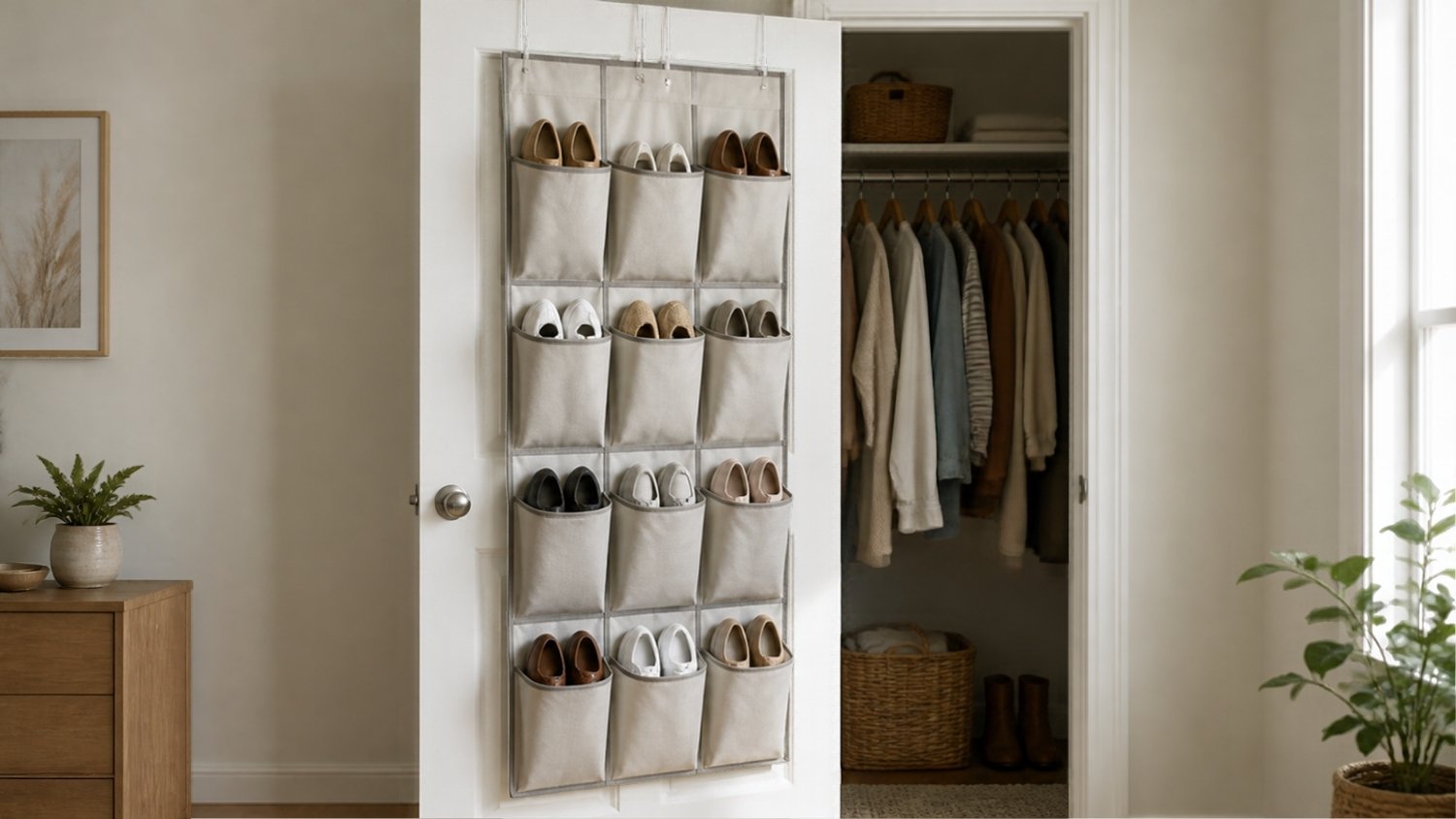
Pound for pound this is the best value in the whole category, and it uses space you are not using for anything else. A 24 pocket organizer is around $19 at Target, and the number that matters is not the pockets. Target rates that one at 25 pounds in total.
Do the weight, not the pocket count. A pair of running shoes is about 1.3 pounds, so 25 pounds is roughly 19 pairs of those. Leather shoes and boots run two to four pounds a pair, so the same organizer takes only 6 to 12 pairs of those. Fill all 24 pockets and what you are holding can pass the rating its own listing publishes, so weigh a few of your own shoes and multiply before you fill it.
So put sneakers, flats and sandals in the pockets, and keep boots out of them. A version that hangs from the closet rod instead of the door starts lower, around $9, but it eats rod space you probably need for clothes.
Read the capacity label carefully, because this category is full of traps. An organizer sold as a 26 shelf model holds 13 pairs, not 26, and Honey-Can-Do’s own 24 pocket model holds 12 because it uses two pockets per pair. Count pairs, never pockets or shelves.
- Door thickness. US interior doors come in 1 3/8 and 1 3/4 inches, and 1 3/8 is much the more common. Plenty of hooks are sold to fit either, but some organizers fit only up to 1 1/2 inches, so measure your door edge before ordering rather than after.
- Whether the door still closes. This is the single most common complaint on these products: the hooks are too thick at the top and the door will not shut. If your door sits tight in its jamb, hang the organizer on the bedroom door instead, or move it to adhesive hooks lower down.
- What kind of door it is. A bypass slider has a track in the way and cannot take one at all, so in that closet the organizer goes on the bedroom door.
Clear boxes, and the size ceiling nobody prints on the labelprices, and what happens above a men’s 13
Clear stackable boxes are the right answer for off-season and special-occasion pairs, and they are cheap. At The Container Store a standard shoe box is about $2.50, or about $1.50 each when the case of five is discounted, and the larger men’s size $3.75 to $5. An extra-wide box at Walmart is about $6. IKEA fabric boxes are $9.99 for a pack of four.
Here is the detail that matters if you are buying for larger feet. The extra-wide box is rated for shoes up to a men’s 13 or a women’s 14. If you wear a men’s 14, check the listing very carefully, because product titles in this category contradict each other constantly. The reliable move is to compare the box’s exterior length against the shoe you actually own, then subtract for the wall thickness. A standard clear box is about 13 inches on the outside, and I did not find an interior figure published on the seller’s page. For scale, Nike puts a men’s 13 foot at 11 11/16 inches, and the shoe is always longer than the foot, which is why the extra-wide box rated for a men’s 13 runs past 14 inches deep.
What about the boxes the shoes arrived in? The organizer Jean Prominski, quoted in Nike’s own storage guide, makes the case for moving them out: cardboard boxes do not hold their shape once stacked, so the shoes get dented, and you cannot see what is inside, which means you stop wearing them. Keep the box only if you plan to resell the pair.
What actually ruins shoes in storagehumidity, soles that crumble unworn, and the creasing rule
This is the part that separates a closet that stores shoes from a closet that slowly destroys them, and almost none of it is about tidiness.
Humidity, which is the real enemy
The Canadian Conservation Institute, which publishes the storage guidelines museums work to, gives the timeline in numbers: for leather, skins and parchment, mold grows in two days at 90 to 100 percent relative humidity, ten days at 80 percent, and 100 days at 70 percent. And it names the line itself: relative humidity above 65 percent is favorable for mold on leather, skins, furs and parchment. Keep leather cool, stable, below that line, and out of direct light.
Which tells you where shoes should not live: basements, garages, sheds and unheated attics. That is exactly where most of us put the off-season bin.
Soles that crumble without being worn
Polyurethane soles break down by hydrolysis, meaning water vapor splits the polymer over time. It happens whether or not you wear the shoes, and warmth plus humidity speeds it up. A safety footwear manufacturer puts a standard polyurethane sole at roughly three years in normal conditions and 18 months in tropical ones, and the footwear research body SATRA gives the same three year figure, from a case study on casual trainers. Read it as a direction rather than a date, because the pace depends on how damp the storage is. The point stands either way: a damp closet shortens the life of a sole you never put on.
Creasing, and the cedar question
Conservation practice for leather is to pad objects out so they keep their three dimensional shape, and to pad any sharp fold that would otherwise crack. For shoes that means supporting them with acid-free tissue, and the CCI is explicit about not overstuffing. Cedar shoe trees do the same job and are claimed to absorb moisture as well, though it is fair to note that every source making that claim also sells them.
Toe-out or heel-out? It does not matter
I found no footwear brand or conservation body stating a correct orientation, so spend your energy elsewhere. The one placement trick worth doing comes from professional organizer Cara Palmer, quoted by House Digest: turn one shoe of each pair to face you and the other to face away. She estimates the saving at 20 to 30 percent more space on a rack, which is an organizer’s estimate rather than a measurement, and it works best with sneakers and flats.
The products, and what each one actually holdsIKEA prices, under-bed bins, and the carousel to think twice about
Once the daily pairs are on the door, the seasonal ones need a shelf or a rack. At IKEA, GREJIG is $4.99, TJUSIG holds about 6 pairs at $29.99, and ÄLGANÄS is a steel rack holding about 12 pairs at $19.99. If you want a closed cabinet instead, BISSA holds about 12 pairs at $69.99.
Use under-bed bins last. A two pack holding 32 pairs is the usual format. Check the cell length before anything else: Hold N’ Storage’s cells are 11.5 inches long, so anything above about a men’s 10 will not lie flat. Compare the price per pair against the door organizer on the day, because both move.
One product to think twice about: the rotating shoe carousel. The seven tier version holds 28 pairs, which sounds excellent, but the listings put it around 23.6 inches in diameter and about 63 inches tall, and the ones I found are marketplace house brands rather than established closet makers. In a standard 24 inch deep reach-in the base itself barely fits and the door opening will stop you loading it, so it belongs in a walk-in or a corner of the bedroom. Treat it as furniture, not as closet storage, and see the warning above on securing anything tall on a base.
Before you fix a shoe shelf
Dimensions.com puts shoes on 12 inch shelves, and the other depths sold are on closet shelf depth. For the height to fix it at, and the hanging rod above it, see closet rod height. And if you are weighing built-in shoe shelving against a kit, the numbers are in what closet built-ins really cost.
Questions people ask5 questions
How much space does one pair of shoes need?
Plan 8 to 10 inches of width per pair, with about an inch between pairs so you can lift one out without knocking the next. For depth, a women’s shoe box is roughly 12 inches long and a men’s about 14, which is why 12 inches is the usual shoe shelf depth for loose shoes. Go to 15 if you plan to put clear boxes on the shelf, since the extra-wide ones run past 14 inches deep, and 14 to 16 for boots.
How far apart should shoe shelves be?
7 to 9 inches for everyday shoes, and flats and sandals need only about 7. Allow 12 to 14 inches for boots. Keep the lowest shelf 6 to 12 inches off the floor so shoes stay out of the dust and you can still vacuum.
Do over-the-door shoe organizers fit every door?
They fit ordinary interior doors, which are 1 3/8 or 1 3/4 inches thick, though some organizers are rated only up to 1 1/2. A bifold panel can take a narrow one, but it swings with the door, and no listing I read publishes what a bifold door carries. A bypass slider cannot take one at all, so use the bedroom door instead. The most common complaint is that the hooks are too thick and the door no longer closes, so check your jamb before you commit.
Should I keep shoes in their original boxes?
Only if you plan to resell them. Cardboard boxes lose their shape once stacked, which dents the shoes, and you cannot see what is inside, so those pairs stop getting worn. Clear boxes solve both problems from about two dollars fifty each, less when the case is on offer.
Is it bad to store shoes in the garage or basement?
Yes, and the reason is humidity rather than temperature. The CCI puts the threshold for leather at 65 percent relative humidity, above which mold is favored, and gives the pace: ten days at 80 percent, 100 days at 70 percent. Damp also accelerates the breakdown of polyurethane soles, which crumble in storage without ever being worn. Keep shoes inside the heated part of the house.
Sourceswhat was read, and when
Specifications checked on September 25, 2026 and re-checked on October 10 against the sellers’ own pages at Target, The Container Store, Walmart and IKEA, with pair counts from Honey-Can-Do, IKEA and Target, shoe sizing from Nike, sole life from SATRA, and humidity thresholds from the Canadian Conservation Institute’s own leather guidance. The pair counts derived from weight limits are my arithmetic on the maker’s published total, not the maker’s own figure. Retail prices in this category move weekly, sometimes by half, so treat every price here as an order of magnitude and check it before ordering.
More closet fixes, one problem at a time, in our closet organization guide.
Take your measurements first
The free Closet Layout Planner gives you the measuring sheet, the standard dimensions on one page, three layouts that work, and a shopping checklist with the measurement to verify for each item. Including the shoe ones.
Saved in this browser, on this device. No account, nothing sent to us, and it goes if you clear your browsing data. See what you saved