Under Sink Organization: What Belongs There and What the Plumbing Leaves You
When you buy through a link on Cozy & Tidy, we may earn a commission. It does not change the price you pay, and it does not decide what we recommend. How it works
Make More Room Under Your Kitchen Sink
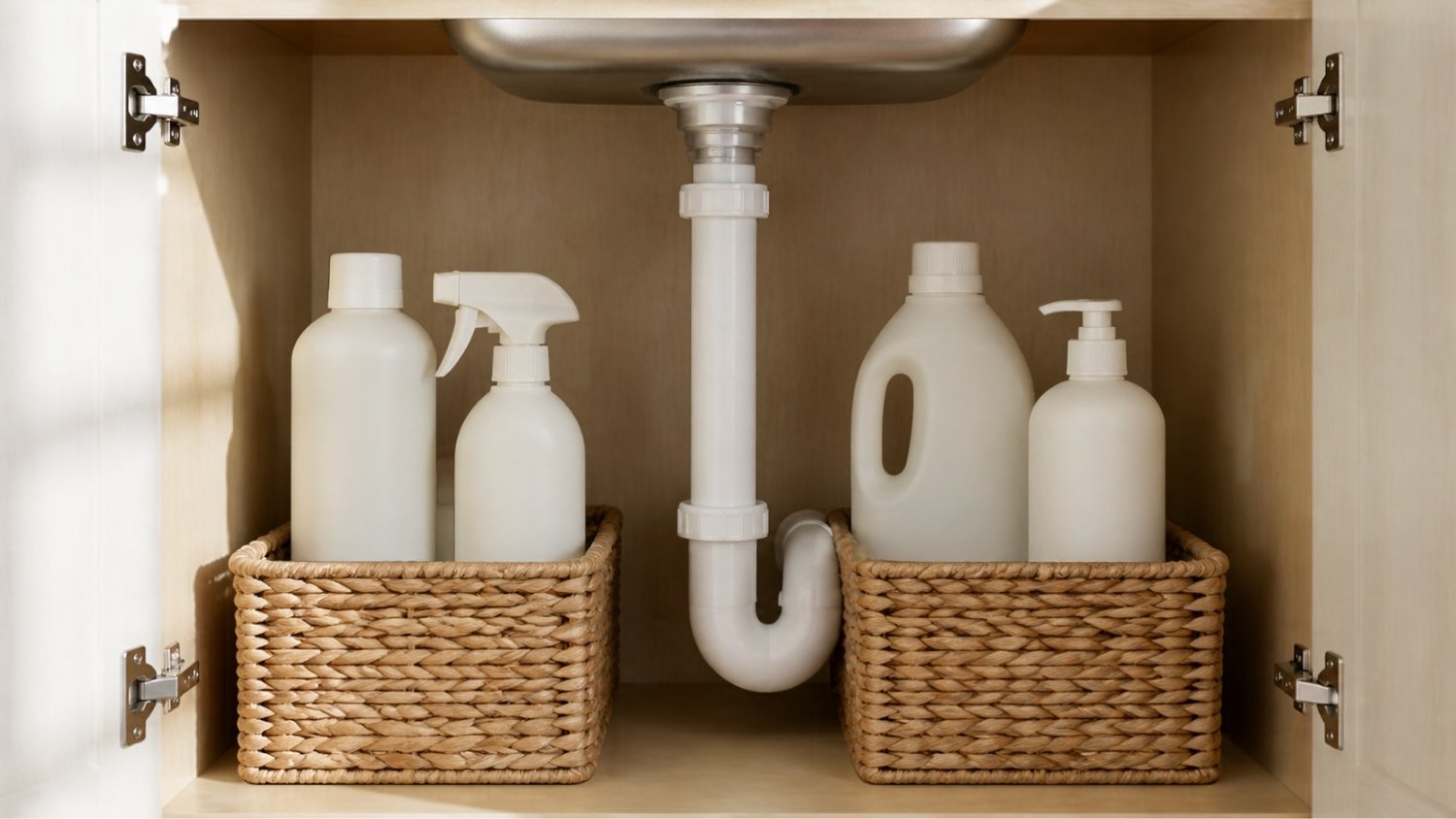
An under sink organizer fits the space the pipe leaves, not the cabinet.
The quick fixEmpty the cabinet. Measure the clear width, the clear depth and the clear height on each side of the pipe, because the two sides are not the same. Then shop to the side you are actually going to use. If small children are in the house, read what the EPA and the CPSC ask for before you put anything back.
- 2 sidesThe pipe rarely lands dead centre, so measure each one
- 3 numbersClear width, clear depth, clear height, per side
- No shelvesWhat the spec sheet says a sink base comes with
The free Kitchen Fit Planner. Five printable pages with the clearances to measure, including the drop under a disposal and the opening a pull-out really needs. Send it to me
Your under sink organizer in three easy steps
Step 1
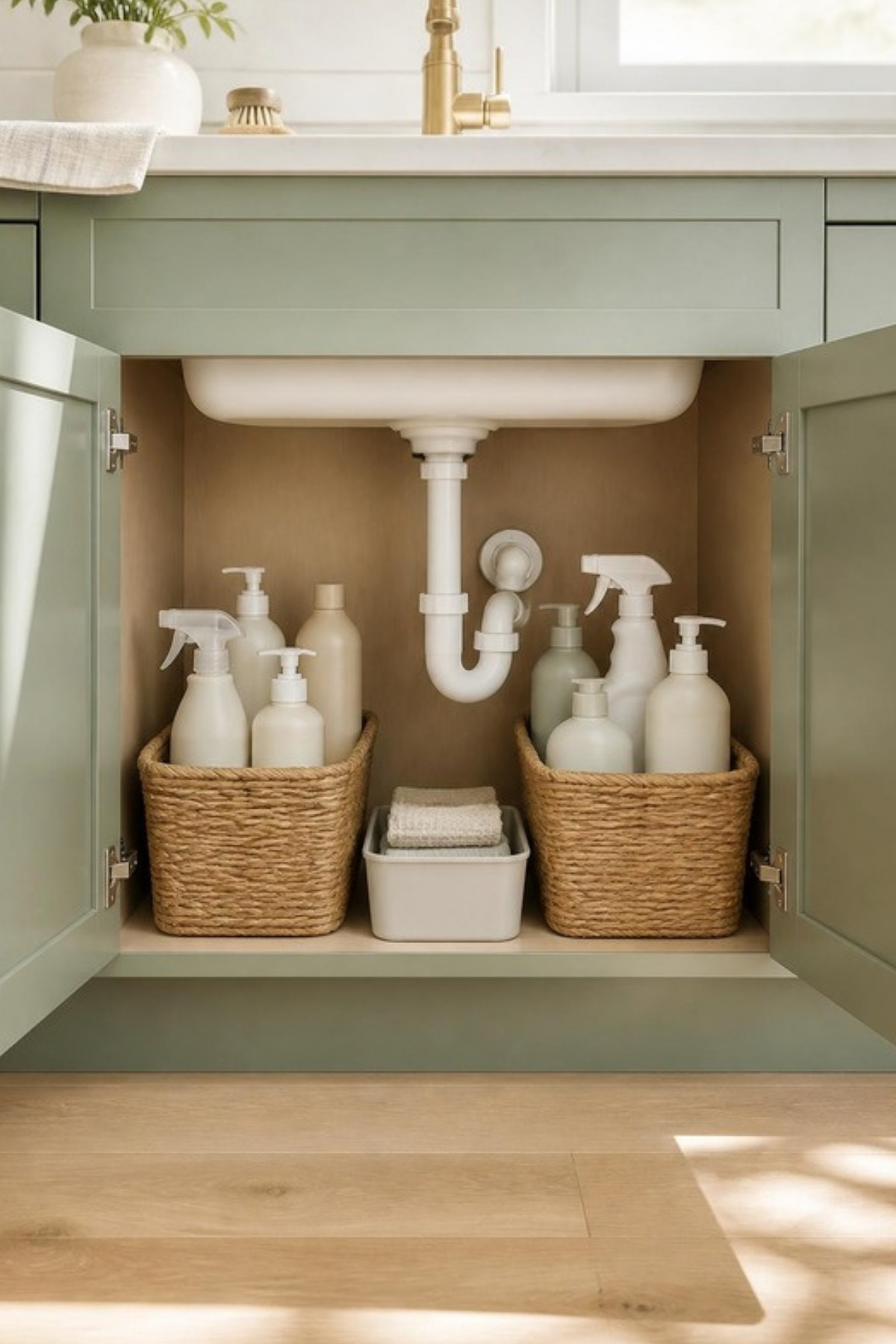
Empty it onto a towel
About fifteen minutes. Set aside anything empty, expired or unused for a year before the rest goes back.
Step 2
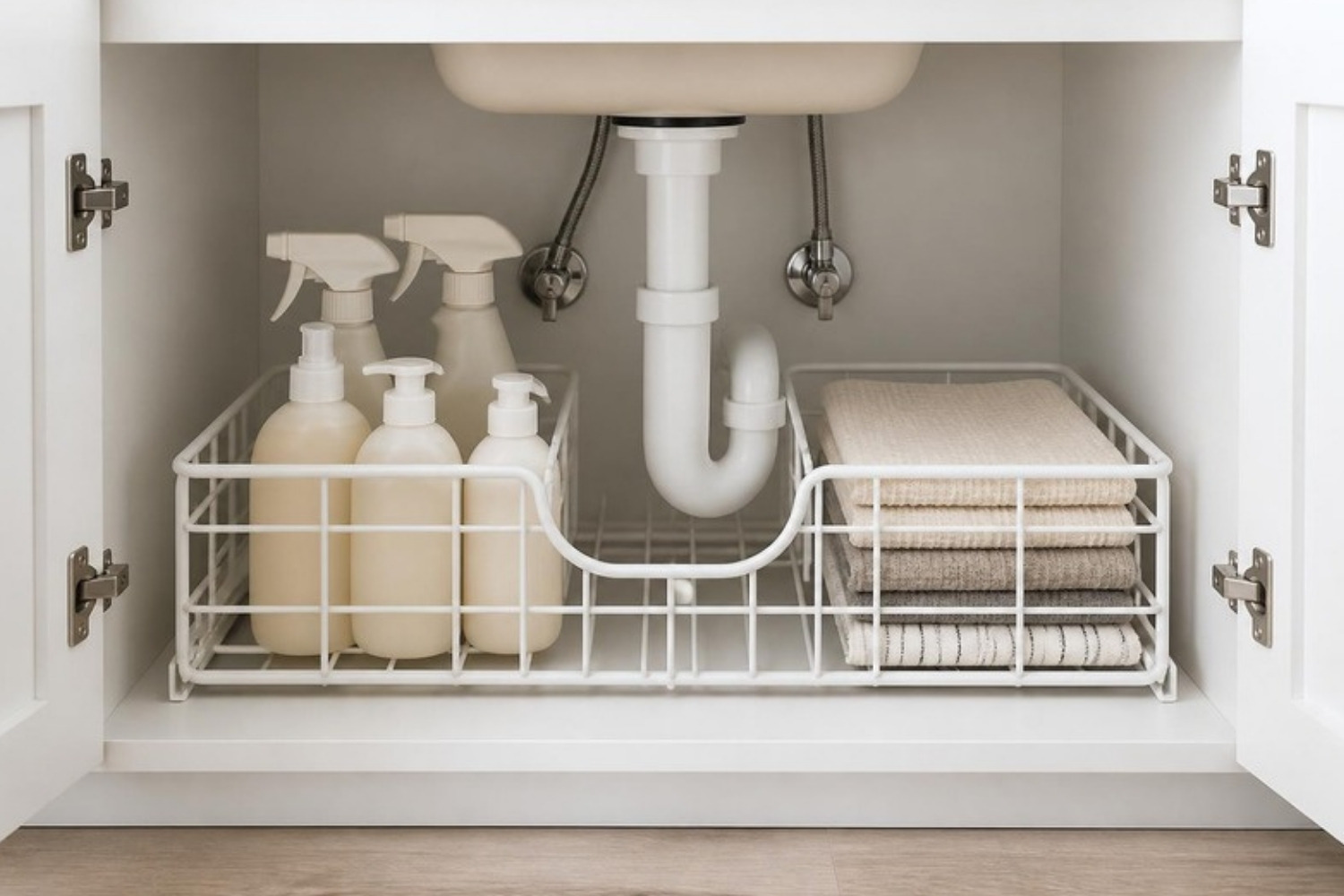
Measure each side separately
Clear width, clear depth, and the clear height under the pipe. Left and right are different. Write down which side is bigger.
Step 3
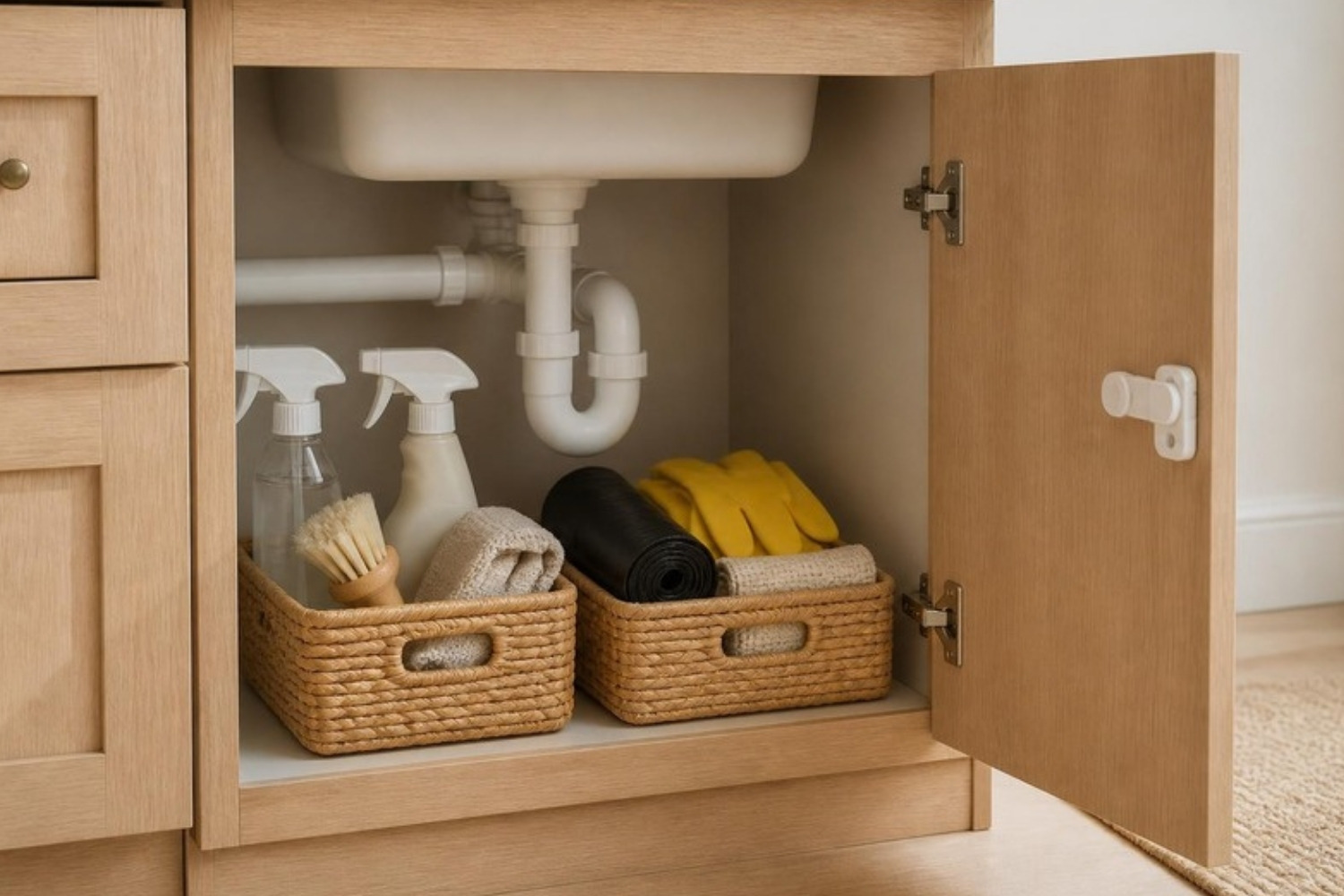
Shop to the side, not to the cabinet
Two bins, each sized to its own side. Or one pull-out fitted to the bigger side, if the clear height there allows it. And if small children are in the house, settle the latch question first: what the EPA and the CPSC ask for is in the next section.
If there are small children in the house
Latch or lock the cabinet. The EPA prefers hazardous products stored up high in a locked cabinet, and says that where they cannot go up high, install safety latches on lower cabinets. The Consumer Product Safety Commission asks for a latched or locked cabinet.
Keep everything in its original labeled container. Never decanted into a cup or a bottle. Both agencies ask for this alongside the latch, and it costs nothing.
Keep food out of this cabinet. The commercial food code prohibits storing food under drain lines that are not shielded against drips, and a home sink base is exactly that.
The exposure figures behind these three, and the honest limits of what they support, are in the details below.
Make sure it fits
Yours
Floor of the cabinet to the lowest point of the trap, taken on each side of the pipe. Height is the one the plumbing eats into: the L shaped reversible pull-outs ask for 19.5 in of clear opening height, and a disposal hanging 12.6 to 13.4 in down takes that from the top. It is not the only one that rules a piece out. A wide unit is decided by the opening width, and each side has its own width and depth.
Check the fit
That figure belongs to one product, and it is the clearest one published in this category. Your own cabinet decides the rest.
What you will need
To do the job
- A tape measure.
- A towel, to empty the cabinet onto.
- Something to write on. The one note that matters is which side of the pipe is bigger.
If children can reach this cabinet
- A child safety latch for the cabinet door, if the cleaning products stay down here. The EPA prefers hazardous products stored up high in a locked cabinet, and says that where they cannot go up high, install safety latches on lower cabinets. The Consumer Product Safety Commission asks for a latched or locked cabinet, products in their original labeled containers, and kept away from food. Both are quoted in full in the section above.
Only once you have measured
- Two bins or baskets, each sized to its own side.
- Or one pull-out, if one side is clearly bigger and the clear height allows it.
- A mat, if you want to catch a drip. It contains a drip, and nothing read for this article documents more than that.
None of the third group is a purchase you have to make to find out what fits. The cabinet works emptied, measured, and reloaded with what you already own. The other calculators live on our free tools page.
Taking the tape to the cabinet this weekend? The Kitchen Fit Planner has a page for the clear height on each side of the trap, with the drop under a disposal printed beside the box you write yours in. Download the planner
Which under sink organizer suits which cabinet
-
A U shaped pull-out
Best forA trap that sits near the middle, when you want one unit rather than two. It is the one built to go around the pipes and a disposal.
What it takesRoom across the cabinet opening, which is less than the number on the cabinet.
What decides itThe opening width. Organizer makers assume a 30 in face frame base gives them about 24.75 in to work with, not 30.
-
An L shaped reversible pull-out
Best forA cabinet with one clearly bigger side. It is sold left or right in the same box, so one product serves either.
What it takesClear opening height, taken from the top, which is exactly where a disposal already hangs.
What decides itHeight. 19.5 in of clear opening on the published model, and a disposal takes that from the top.
-
Two separate baskets or bins
Best forA trap near the middle when neither side is big enough for a unit.
What it takesNothing in clearance, and they come out for cleaning, which fixed shelves do not.
What decides itEach side on its own. A bin only has to fit the side it stands on, so the two can be different sizes.
-
A two tier expandable shelf
Best forNothing we can confirm. This is the one to be careful with.
What it takesUnknown. It publishes an adjustable width range and four height levels, and nothing else: no minimum opening and no weight capacity.
What decides itNothing you can check against. An adjustable range is not a fit, and the listing publishes no figure to hold it to.
Where this one goes wrong
-
Mistake Measuring across the cabinet opening The opening is the widest the cabinet ever gets. The drain and the two supply lines come down through the middle of it, so nothing that wide has anywhere to go.Instead Measure the clear run on each side of the trap, separately. Those two numbers are the cabinet you actually have.
-
Mistake Buying one wide unit for the whole cabinet The drain rarely lands dead centre, so it leaves two pockets that are usually not the same size. One wide unit has to straddle the pipe, and most are not built to.Instead Measure both sides and shop to the one you will actually use: two bins sized separately, or a unit sold with a cut-out for the trap. Write down which side is bigger before you shop.
-
Mistake Measuring height up to the counter A garbage disposal hangs 12.6 to 13.4 in below the sink, and the trap sits lower still. The counter is not the lowest thing above your shelf.Instead Put the tape on the cabinet floor and stop at the lowest point of whatever is above it, on each side.
-
Mistake Shopping by the number on the cabinet A 30 in sink base is not a 30 in opening. Organizer makers assume about 24.75 in of usable opening on face frame cabinetry, which is five and a quarter inches less.Instead Open the doors and measure the opening itself, at its narrowest point, and shop to that number.
Five things you will often read that are not true
- Never store anything under the kitchen sink. No source says the cabinet should be empty. Specific categories come out, not everything.
- Never keep bleach and ammonia in the same cabinet. What is documented is the mixing hazard, not two closed containers sitting side by side.
- Cleaning products expire. True for bleach, with a real figure. For dish soap or all purpose spray I found no sourced shelf life at all.
- A given percentage of home water damage starts under the sink. Of the insurer publications I read, none breaks water claims down by cabinet. That figure does not exist.
- This organizer fits any sink cabinet. The makers’ own specs publish a different minimum opening for essentially every model, and separate minimums for width, depth and height.
Details and measurementswhat the cabinet is, what the plumbing takes, and every published figure
The only cabinet sold with nothing in it
Every kitchen has one cabinet that defeats the person who owns it, and it is almost always this one. Not because you are disorganized. Because it is the only cabinet in the room that arrives as an empty box with a pipe through the middle of it.
Look at the spec sheet for a standard 36 inch sink base and you will find, under number of shelves, the words no shelves. The two panels above the doors that look like drawers are false fronts. So you get a box 36 inches wide, 24 deep and 34.5 tall, with no shelf, no drawer, and a drain and two supply lines running down through the middle of it.
Then the plumbing divides what is left into two pockets, and they are usually not the same size, because the drain rarely lands dead center. You can see the industry acknowledging this in the products: the L shaped pull outs made for sink bases are sold as reversible, left or right, so one product serves a cabinet whose usable side could be either.
What the plumbing actually takes
Worth knowing what the code does and does not decide here, because it explains why no two sink cabinets are alike. The pipework under a sink takes the height it takes, and the figure that matters for storage is the clear height you measure yourself with the door open. What no rule sets, anywhere, is how high the trap sits above your cabinet floor or how far forward it sits. That is left to whoever installed it, which is why every sink base is a slightly different puzzle.
The other occupants are more predictable, and they are bigger than people expect.
- A garbage disposal hangs about 12.6 to 13.4 inches below the sink and weighs 10 to 15 pounds. One published model is 7.5 inches across the body. That is a cylinder roughly the size of a large coffee tin, directly under one bowl, and it is immovable.
- A reverse osmosis system is a 15.5 by 5.25 by 17 inch unit, plus a storage tank around 11 inches in diameter and 15 tall. Between them they take roughly a quarter of your cabinet floor, standing up, before you put a single bottle in. Unlike the disposal they sit on the floor rather than hanging, so they cost you area rather than height.
And here is the third measurement, the one the plumbing takes first: height. The L shaped reversible pull outs, which are sold for vanity sink bases but are the clearest published example of the type, ask for 19.5 inches of clear opening height. A disposal hanging 13 inches down takes most of that before you start, and it takes it from the top, where the organizer needs it. Width and depth are easy to check at the cabinet door. Height is the one the plumbing eats into.
There is one more number the spec sheets give away quietly, and it is worth being precise about who is saying it. Cabinet makers do not publish sink base opening widths. Organizer makers publish the minimum opening their product needs, and for a 30 inch sink base that figure is around 24.75 inches on face frame cabinetry. That is a conservative floor set so the product fits the worst case rather than a measurement of your cabinet, but it tells you how much of a 30 inch nominal width the industry assumes the frame will eat. If you have ever wondered why the organizer that fit your friend’s kitchen did not fit yours, that gap is usually the whole story.
What each organizer publishes, and what fails
There is a clean divide in this category and it is the most useful buying rule I can give you. Cabinet hardware brands publish a minimum cabinet opening in width, depth and height, plus a load rating in pounds. Consumer organizers publish an adjustable width range and nothing else. That is not a small difference. An adjustable width range is not the same as a fit.
| Organizer | What is published | The dimension that fails |
|---|---|---|
| U shaped pull out | Built to navigate around pipes and disposals, 90 lb soft close slides on one common model | Opening width. Organizer makers assume about 24.75 in on a 30 in face frame base, not 30 |
| L shaped pull out, reversible, sold for vanity sink bases | Minimum opening 12.125 W by 19.5 D by 19.5 H | Height. 19.5 in of clear opening, which a disposal hanging down from above takes away |
| Pull out trash, single 35 qt | Needs a 10.75 to 12 in opening | Width, and then the trap in the way of the travel |
| Pull out trash, double 35 qt | Needs a 21 in opening, or 15 in wide by 20.625 tall for the bottom mount version | Height again, on the bottom mount |
| Two tier expandable shelf | Adjustable width, four height levels | Nothing is published. No minimum opening, no weight capacity |
| Under sink mat | 34 by 22 in silicone | At 34 in it is wider than the opening of anything short of a 42 in cabinet |
And one product that deserves its own paragraph, because the advice is everywhere and the evidence is nowhere. The tension rod for hanging spray bottles. I went looking for a published weight rating from a tension rod manufacturer and could not find one. Compare that with the pull outs above, which print 90 and 110 pound slide ratings on the box. That does not make the rod a bad idea, and people use them successfully. It does mean you are working without a stated capacity, so keep it to light bottles and do not assume a number nobody has published.
What belongs there, and what does notthe list, and the one distinction everyone flattens
Iowa State University Extension addresses this cabinet head on, and its list is refreshingly concrete.
- Yes: vinegar, dish soap, dishwasher products, cleansers, scrubbers, sponges, brushes and kitchen gloves. A fire extinguisher, mounted where you can grab it. The disposal wrench, which it calls the one tool appropriate for storage there. Vases, contained trash bags and recycling bags.
- No: food and pet food, which may mold. Towels and paper goods, which absorb both water and the smell of everything around them. Metal tools, pots, pans and small appliances, because of rust. Bought ahead overstock, which belongs somewhere drier. And anything already broken or finished, which is most of what is in there now.
On food the agreement is total and the reasoning is worth having. The commercial food code prohibits storing food under sewer lines that are not shielded to intercept potential drips. A home sink base contains exactly that, plus two supply lines. The USDA names under the sink outright as a place not to keep shelf stable food. Texas A&M AgriLife singles out potatoes and onions, though its reasoning there is about heat rather than drips.
One distinction in that source is worth drawing out, because it gets flattened everywhere else. Iowa State keeps the everyday cleaning things under the sink, cleansers and dish soap included. What it says has no place there is the harsh and flammable end of the shelf: bleach, insecticides, solvents, thinners, paints and polishes. That is a line between ordinary cleaning products and hazardous ones, not a blanket ban, and it sits comfortably alongside the federal guidance rather than against it.
The numbers behind the latch
Poison Control’s 2024 figures put cleaning substances first among the things children aged five and under are exposed to, at 87,031 exposures. Honest note on what that supports: no federal source credits a cabinet latch with the long decline in child poisoning deaths, which belongs to child resistant packaging. The latch is supported by the exposure data, which is about your kitchen specifically.
A study of national poison data from 2016 to 2023 found 633,317 pediatric household cleaning product exposures, of which 84 percent involved children under three and 97 percent happened at home. The single largest age band was one to two year olds, at nearly 45 percent.
The longer history is worth knowing, and it is not the tidy story usually told. Child resistant packaging, introduced under the Poison Prevention Packaging Act, cut deaths under five dramatically: the CPSC’s own comparison runs from an annual average of about 167 in the early 1970s to about 82 across 2021 to 2023. But the recent direction is upward, not downward. Deaths under five went from 34 in 2019 to 43, then 59, then 97 in 2022 and 90 in 2023, with the CPSC attributing much of the rise to narcotics rather than to household products.
Two honest notes on that. The mortality decline belongs to packaging, not to cabinet latches: no federal source attributes any part of it to a latch, and I am not going to claim one for it. And the rise since 2019 is being driven by a category that has nothing to do with the cabinet under your sink. What the latch is supported by is the exposure data, which is about your kitchen specifically.
Water damage: what is real and what is inventedthe figure that does not exist, and the one that does
You will read that some large percentage of home water damage starts under the kitchen sink. I went looking for that figure in the insurance data and it does not exist. Not at Triple-I, not at Travelers, not at State Farm. Of the insurer publications I read, none breaks water claims down by the cabinet they started in. They publish by cause, plumbing supply, appliance, water heater, and not by location. So any percentage you see for this is not traceable to a published insurance breakdown.
What is real is the scale of the category. Non weather water claims run at just over one per fifty homeowners policies a year, averaging almost eleven thousand dollars. Measured more broadly, including freezing, water came to 22.6 percent of homeowners claims in 2023 with a five year average severity of $15,400. Both figures trace back to the Insurance Information Institute and they count different sets, so do not add them together. Either way, this is not a small category.
- Under sink mats. The common size is 34 by 22 inches in silicone, and they are useful for catching a drip and for saving the cabinet floor from a slow weep. But no listing I found publishes the lip height, which is the only dimension that would tell you what it holds, one listing contradicts itself between its own title and its own feature list on capacity, and no independent test or insurance study documents that a mat reduces water damage. A mat contains a drip. That is a real thing and it is not the same as prevention.
- Leak detectors and shutoff valves. Here there is actual evidence, and it is for the valve rather than the puck. An analysis of 2,306 homes fitted with an in line automatic shutoff found a 96 percent drop in escape of water claims and a 72 percent drop in severity in the year after installation. Two caveats belong with that figure: the study was run in partnership with the device maker, and the homes had far worse claim histories beforehand, meaning they self selected after a loss. It is still the strongest number in this whole subject.
And the cheapest piece of advice in the article, from a cabinet maker rather than an insurer: stop draping the damp dishtowel over the sink base door. KraftMaid states plainly that over time this causes permanent water damage to the door. It is probably already happening in your kitchen.
The evidence behind the five mythswhat is documented, source by source
- Nothing belongs under the sink. Iowa State Extension lists what belongs there by name, and both the food code and the organizer manufacturers treat the cabinet as usable storage.
- Bleach and ammonia side by side. What is documented is the mixing: combining them produces chloramine gases, with coughing, shortness of breath and chest pain, and worse at higher exposure. What is not documented anywhere I looked, by any health department or federal agency, is a hazard from the two sitting in closed original containers side by side. The rule that is actually published is different and duller: original labeled containers, away from food.
- Cleaning products expire. Household bleach keeps about six months at 50 to 70 degrees Fahrenheit and degrades faster above that, and a diluted solution is only good for 24 hours. For dish soap or all purpose spray I could not find a sourced shelf life at all, so treat any number you see for those with suspicion.
- A percentage of water damage starts under the sink. The insurance figures, including the two that are real, are in Water damage: what is real and what is invented, above.
- It fits any sink cabinet. The organizer makers assume a 30 inch nominal face frame cabinet leaves about 24.75 inches of opening, so the number on the cabinet cannot tell you what fits.
Where to go next
The three steps and the three measurements are at the top of this article, and the latch is in the section on small children. More kitchen guides are in our kitchen organization guide, with the cabinets in kitchen cabinet organization, the drawers in kitchen drawer organization and the heavy things in pot and pan storage.
Questions people ask5 questions
What should not be stored under the kitchen sink?
Food and pet food, which can mold. Towels and paper goods, which absorb water and odors. Metal tools, pots, pans and small appliances, because of rust. And bulk backstock, which wants somewhere drier. The food rule has the clearest reasoning behind it: the commercial food code prohibits storing food under sewer lines that are not shielded against drips, and a home sink base is exactly that.
Is it safe to keep cleaning products under the sink?
With a child safety latch, yes, and that is the federal position. The EPA prefers hazardous products up high in a locked cabinet and says that if they cannot go up high, install safety latches on lower cabinets. The CPSC asks for a latched or locked cabinet, original labeled containers, and separation from food. One extension service goes further and says cleaners have no place under the kitchen sink at all, so if you want the cautious reading, that is it.
Why will no organizer fit under my sink?
Two reasons. The first is height. The L shaped reversible pull outs ask for 19.5 inches of clear opening height, and a garbage disposal hangs 12.6 to 13.4 inches down from the sink, taking that height from exactly where the organizer needs it. The second reason is that nominal cabinet width is not opening width: the organizer makers assume a 30 inch face frame sink base leaves about 24.75 inches of usable opening, which is five and a quarter inches less than the number on the cabinet.
Do under sink mats actually prevent water damage?
They contain a drip, which is worth having, but no independent test or insurance study documents that a mat reduces water damage or claim cost. The evidence in this area is for in line automatic shutoff valves instead: one analysis of 2,306 equipped homes found a 96 percent drop in escape of water claims, though it was run with the device maker and the homes had self selected after earlier losses.
Can I hang spray bottles from a tension rod?
People do, and it may well hold. But I could not find a published weight rating from any tension rod manufacturer. Compare that with cabinet pull outs, which publish 90 and 110 pound slide ratings. If you use a rod, use it for light bottles and do not assume a capacity that nobody has stated.
Sourceswhat was read, and when
Checked on September 26, 2026 against the FDA Food Code, EPA and Consumer Product Safety Commission guidance, Iowa State University Extension, USDA and Texas A&M AgriLife, published plumbing code figures, product specifications from Rev-A-Shelf, InSinkErator, Moen, APEC, KraftMaid, Home Depot and Lowe’s, poison exposure and fatality figures from the National Capital Poison Center, the Consumer Product Safety Commission’s 2025 pediatric poisoning report and a 2016 to 2023 analysis of national poison data, and insurance figures from the Insurance Information Institute and a 2020 LexisNexis loss correlation study. Where two sources disagree, the article says so rather than picking one. Some organizer specifications quoted here are published for vanity sink bases, which are the clearest documented example of the type, and the article says so where that is the case. Cabinet openings vary by model, so measure your own before you order.
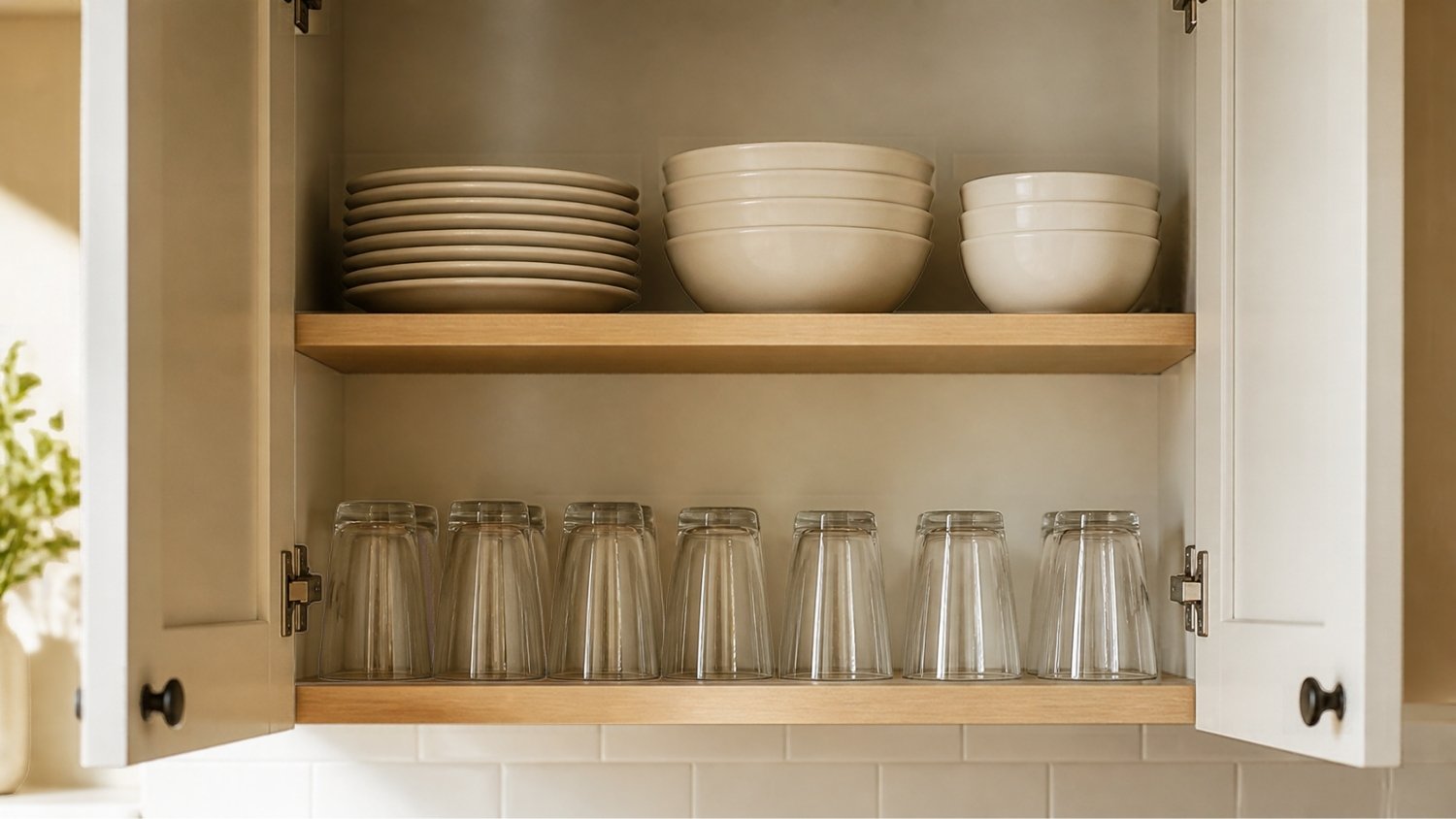 Kitchen Cabinet OrganizationWhat goes where, and what fits
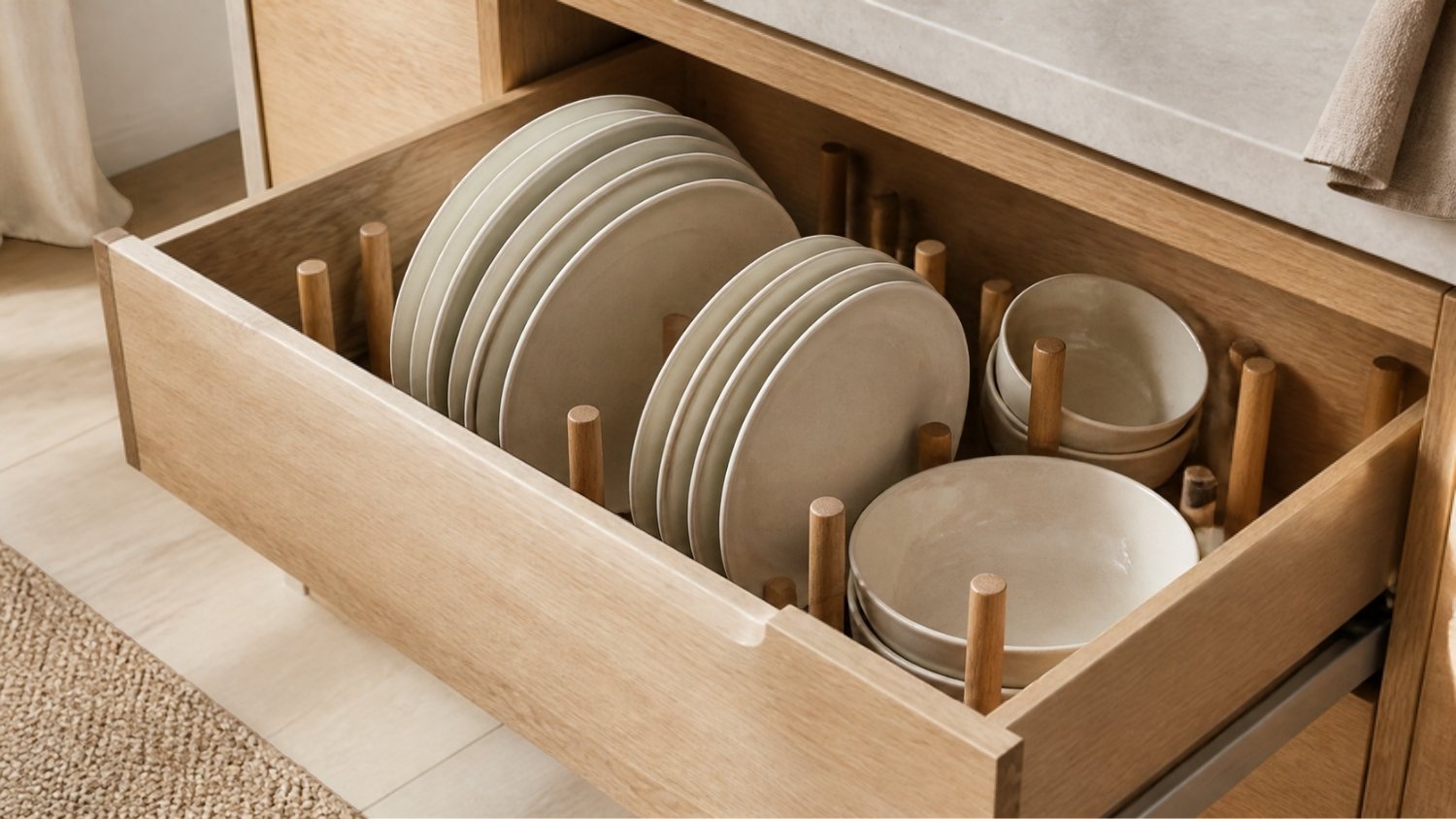 Kitchen Drawer OrganizationThe width nobody measures
 Pot and Pan StorageA 12 in skillet needs 20 in
Saved in this browser, on this device. No account, nothing sent to us, and it goes if you clear your browsing data. See what you saved