Food Storage Containers: What Decanting Actually Does, and What It Costs
When you buy through a link on Cozy & Tidy, we may earn a commission. It does not change the price you pay, and it does not decide what we recommend. How it works
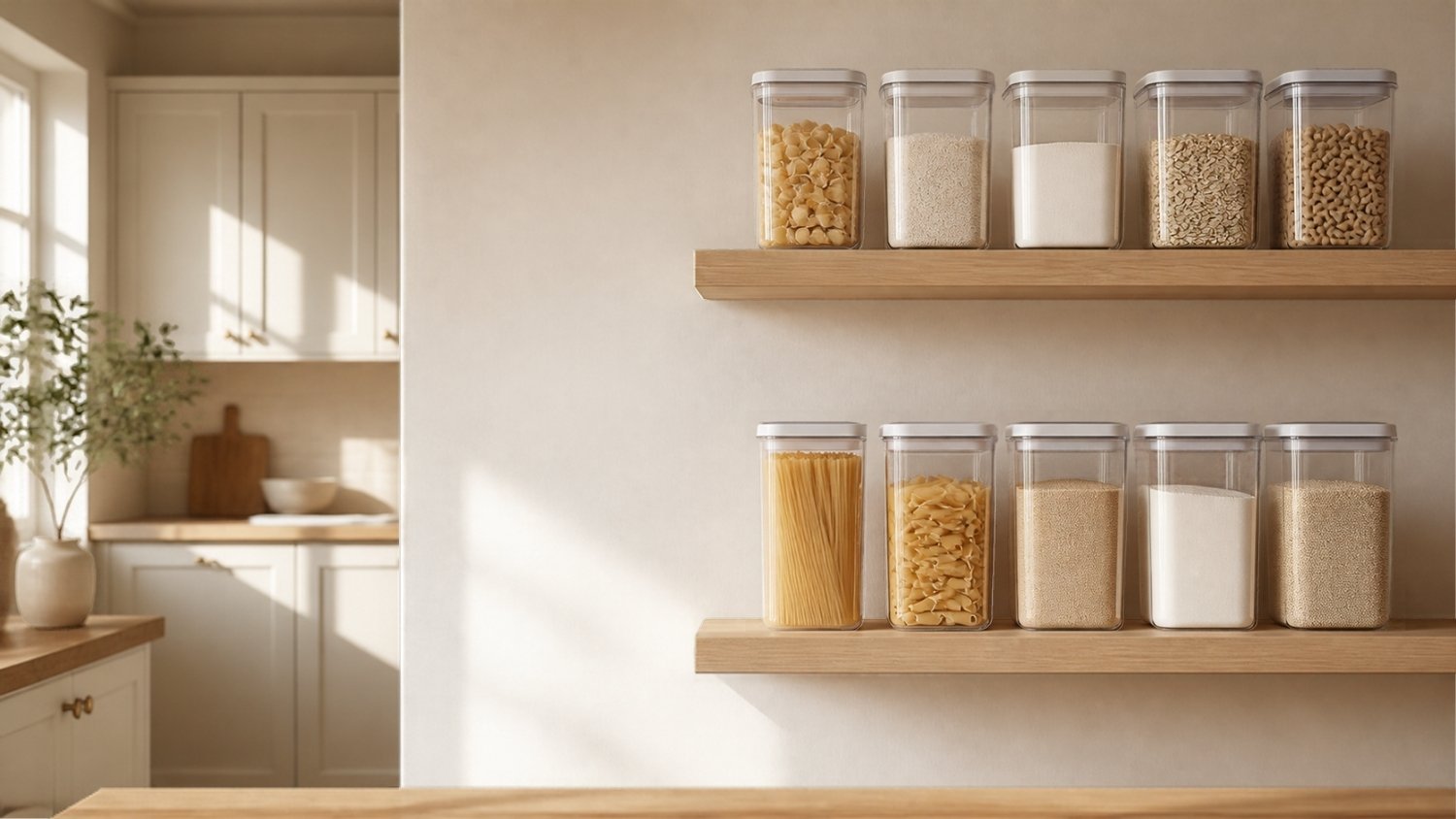
Decanting into food storage containers is documented to do one thing, and it is not the thing you have been told.
Extension services say airtight containers stop powders clumping and crackers going soft. That is moisture and texture. Not one of them quantifies a shelf life gain, and both the major guides list keeping food in its original packaging as an equally acceptable option. Penn State goes further and says to leave bulk flour in its bag inside a covered container. So pour things into jars because you like it and because it keeps the crackers crisp. Just do not expect the food to last longer for it.
- 2 to 3 monthsOpened ready to eat cereal. The shortest clock on the whole list
- About 4 monthsBrown sugar, the staple most people get wrong by the widest margin
- Below 85 °FWhere the pantry has to stay. Ideally 50 to 70. This matters more than the jar
- Not publishedAny shelf life gain from decanting, in any extension source I could find
Two land grant university extension services give directly contradictory advice about which plastic recycling numbers are safe for food storage. Utah State recommends number 1 for bulk dry food, lists number 7 as normal for large reusable water jugs, says number 3 can be used for both food and non food purposes, and thinks number 4 is probably not the best choice for long term storage. Iowa State says the safe numbers are 2, 4 and 5, rules out number 7, and calls 1, 3 and 6 single use only. Two honest caveats before you conclude they are at war: the Utah State guidance is from 2009 and now sits in that service’s archive, and the Iowa State item is a staff blog post from 2023. What it still tells you is the thing that matters. The resin code is a recycling sorting mark, not a food safety certification, and nobody should be reading their storage policy off the triangle on the bottom of a tub.
What they agree on is the rule that carries weight, and Oregon State states it plainly: store food only in its original packaging or in food grade containers, meaning glass and ceramic, plastic bags and rigid containers, and plastic, paper and foil wraps. Iowa State adds the corollary, which is not to re-use single use plastics that came with purchased food. Buy containers sold for food. Stop reading the triangle.
Microwaving plastic. Never microwave plastic is too broad. The USDA’s actual rule is to use only cookware manufactured for microwave use, and what it specifically names as unsafe is cold storage packaging: margarine tubs, cottage cheese and yogurt cartons, foam trays and plastic wraps, because they are not heat stable and chemicals can migrate. Manufacturers split on their own lines, which is the practical point. Rubbermaid’s meal prep containers are microwave safe, and its pantry canisters are explicitly not. Pyrex’s plastic lids can warp in the microwave unless you remove them or vent them by at least a quarter inch.
What the bag carries that the jar does not. The USDA is explicit that best by, sell by and use by dates are quality dates rather than safety dates, so losing the printed date matters less than people say. The one exception it names is infant formula, where the date is a safety date, so that one stays in its own packaging. What you do lose is harder to replace: the cooking instructions, which you cannot reconstruct for an unfamiliar grain, the allergen statement, and the lot code, which is the thing a recall notice asks you for. Write the date on the jar, and photograph the lot code on the bag before it goes in the bin.
Before you spend on a container set. The free Kitchen Fit Planner has the shelf depths to measure, the storage time for every pantry staple, and a checklist to shop from. Send it to me
Food storage containers: the one figure no cabinet page publishes
Yours
Cabinet depth is standardized at 12 inches for uppers and 24 for bases. Of the wall cabinet pages I read, none published a shelf to shelf clearance figure. So this is the one number you have to take yourself, and it is the one that decides a container set. Two cereal containers from two serious brands sit more than three inches apart in height.
Where to start this weekend
Step 1
Buy one container, not a set
Make it a cereal container. It is the one staple with a documented two to three month clock on it, it is the one thing in the cabinet that goes soft, and it is the cheapest way to find out whether you like living this way before you commit to twelve matching jars.
Step 2
Measure the shelf to shelf height first
In the cabinet it is going into. That figure is not standardized and no page publishes it, and the two cereal containers in the table below are more than three inches apart in height. Write it in your phone and buy nothing taller.
Step 3
Write the date, photograph the lot code
When you pour, write the date on the jar. Then photograph the lot code on the bag before it goes in the bin, because that is the thing a recall notice asks you for and the jar will not have it.
Every staple, with its real clock. The Kitchen Fit Planner carries the storage time for each pantry staple with the extension service that published it, plus the shelf depths to measure before you order anything. Get the free planner
What decanting does, and what it costs youthe extension services are more permissive than the internet
There is a particular pantry photograph that has done more to sell containers than any advertisement ever could. Matching jars, bamboo lids, chalk labels, everything at the same height. It is beautiful and I understand the appeal completely. What follows is not an argument against it. It is what the evidence actually says, so that you can spend the money knowing what you are buying.
Start with what the extension services actually recommend, because it is more permissive than the internet suggests. The Pacific Northwest extension guide, issued jointly by Oregon State, Washington State and Idaho, says to keep food in its original containers or transfer it to metal, glass or plastic containers with tight fitting lids. Virginia Tech says the same in the same breath. Both options, equally weighted, no preference stated.
The documented reason to transfer is specific and modest: dry foods not stored in airtight containers absorb moisture, which makes powders clump and crackers lose their crispness. That is the whole of it. No extension source I could find puts a number on a shelf life gain from decanting, and they publish shelf lives by food rather than by container.
Two things matter more than the jar, and both are free. Temperature: keep the pantry below 85 degrees Fahrenheit, ideally 50 to 70. And humidity: above about 60 percent, dry foods absorb moisture and cake regardless of what they are in.
Two related things, stated without alarm
BPA. The FDA’s current position is that BPA is safe at the levels occurring in foods. It did amend its regulations so they no longer authorize BPA based materials in baby bottles, sippy cups and infant formula packaging, and it is worth knowing why: those amendments were based on the industry having already abandoned those uses, and the FDA states plainly that an amendment based on abandonment is not based on safety. That is the accurate version, and it is neither the reassurance nor the alarm you usually get.
Replacing containers. There is no calendar anywhere. I could not find a replacement interval published by any manufacturer. The only guidance is condition based, from Iowa State: when plastic containers become scratched, stained or damaged they can harbor bacteria, so replace them on discoloration, odor or a change in taste, not on a birthday.
The sizes they come in, and the 14.5 inch trapsix published dimensions, and the bins that stop the door shutting
Manufacturers are surprisingly shy about dimensions, so here are the ones actually published, and one contrast that decides more than the rest.
| Container | Published size | Worth knowing |
|---|---|---|
| OXO POP Big Square Short, 2.8 qt | 6.3 by 6.3 by 6.7 in | The only POP size with a manufacturer published dimension. The 6.3 in square is the Big Square footprint, shared by all its heights |
| Rubbermaid Brilliance Pantry Cereal Keeper, 18 cup | 10.25 by 4.75 by 9.375 in | Needs 9.375 in of shelf gap. Measure yours |
| OXO POP cereal dispenser, 4.5 qt | About 10.25 by 3 by 12.6 in, retailer published | Needs about 12.6 in of shelf gap, more than a foot. Measure yours. OXO publishes no dimensions for it and two retailers disagree slightly |
| Progressive ProKeeper flour container, 4 qt | 8 by 6.5 by 9.5 in, retailer published | The maker confirms it holds a standard 5 lb bag of flour and has a magnetic leveler inside, but publishes no dimensions |
| Pyrex Simply Store 3 cup rectangle | 7.25 by 5.5 by 1.75 in | Nests and stacks with the rest of the line |
| IKEA 365+ rectangular, 34 oz, plastic | 8.25 by 6 by 2.25 in | Stackable and nestable, microwave safe with the lid left ajar. The same size comes in glass and steel, and the steel one is not microwave safe at all |
That third row is the useful one. Two cereal containers from two serious brands sit more than three inches apart in height. Two caveats on the taller figure, because this is exactly where these articles usually go wrong: OXO publishes no dimensions at all for that container, the 12.625 comes from a retailer, and a second retailer lists the same product at 12.54. The conclusion survives either way, but the number is not the manufacturer’s.
Snack bins, and the 14.5 inch trap
The pantry bins sold at every big retailer come in two families and they sit on the same shelf in the store. The large ones measure around 14.5 inches on the long side, per the retailer listings, and are designed for a pantry shelf or a refrigerator rather than a cabinet. A 12 inch wall cabinet gives you something like 11 inches of usable depth once the door and the back panel are accounted for. So a bin like that overhangs by three inches or more, and a bin that overhangs can stop the door shutting.
The shorter ten inch class bins are the ones sized for a 12 inch wall cabinet, and nothing on the shelf edge tells you which is which. Measure your usable depth once, write it in your phone, and buy nothing deeper.
Lids, and the claim nobody will put a number onfive lid footprints across sixteen sizes, and the catch
Every brand in this category sells you on an interchangeable lid system. Rubbermaid: one lid fits multiple of its meal prep containers. OXO: each lid size fits a variety of container sizes. IKEA: fits with the rectangular lids.
OXO is the one that actually shows its working. Its own guide lists the pairings lid by lid, and they come to five lid footprints across sixteen container sizes. Rubbermaid, by contrast, says one lid fits multiple of its meal prep containers and never says how many. Nobody at all publishes a figure of the form “this system cuts your lid count by so much”, so if you see one it came from an article rather than a maker.
And there is a catch in the arithmetic anyway. Going by OXO’s own piece counts, a set ships one lid per container, so buying the set does not reduce your lid count at all. The reduction only happens later, when you replace a base and keep the lid you already own.
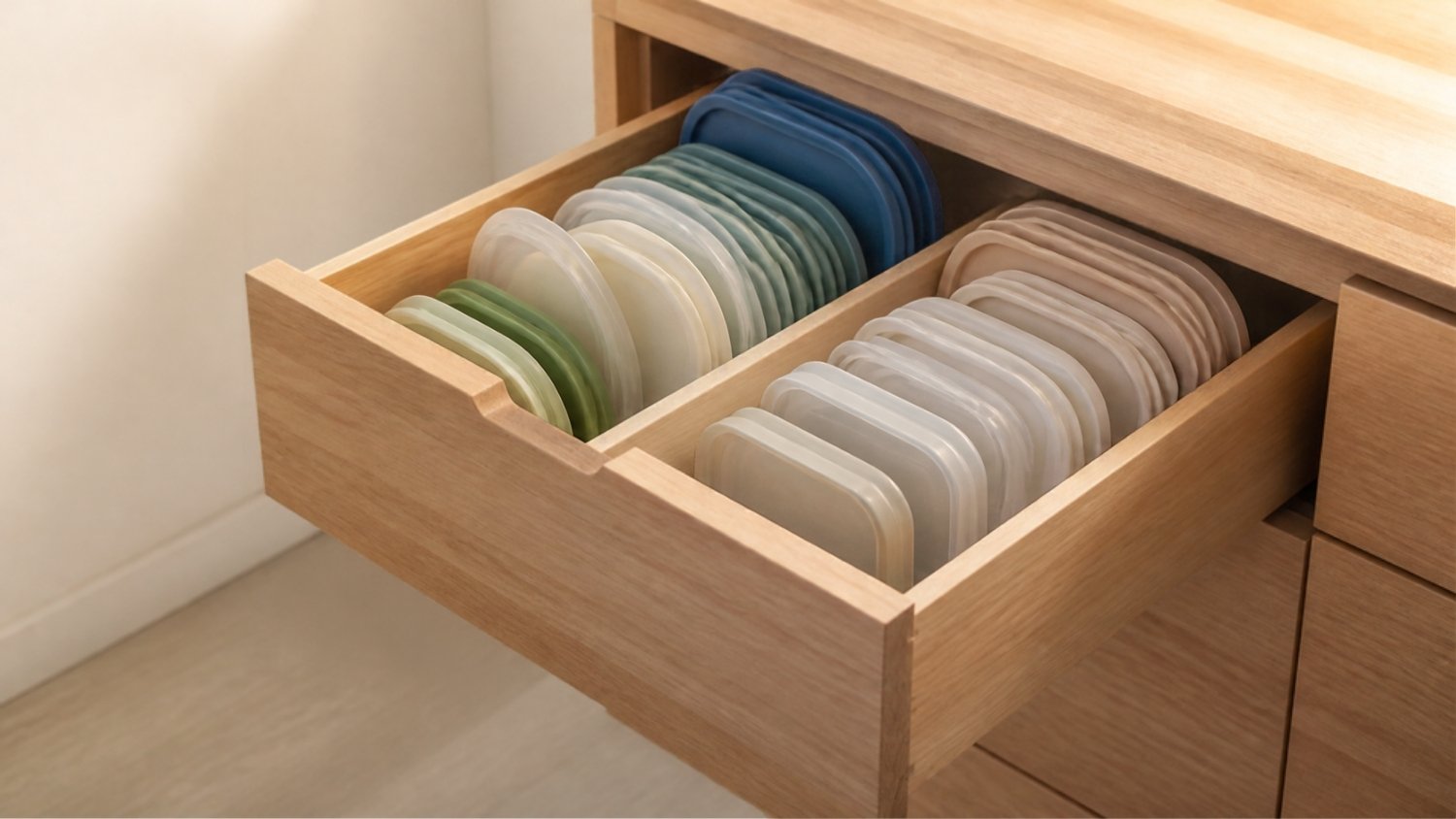
For the lids you already have, the one manufacturer that publishes a count puts it in the product name. The 24 lid organizer is 10.8 inches deep, 13.2 wide and 3.3 tall, and holds lids up to 9 inches. The 40 lid expandable version stretches from 13.2 to 21.3 inches wide but stands 5.8 inches tall, so measure the inside height of your own drawer before you order that one.
One more lid warning from a maker, easy to miss. Snapware’s peel off lids are stated plainly on the product page as not airtight and not leak proof, which is worth knowing before you use one for flour.
Pantry bugs, and the thing a container actually doeshalf the value is containing a problem you already have
This is where airtight containers earn their money, and where the usual framing is still slightly wrong. Every extension service says the same thing: store dry goods in tightly closed glass, metal or heavy plastic containers. What they add, which nobody repeats, is why. The University of Illinois puts it in one sentence: containers prevent pantry pests from getting into food, as well as preventing them from getting out of infested foods.
Read that second half again. Half the value of a sealed container is containment of a problem you already have. Because, as UC’s integrated pest management program puts it, the source is commonly a package damaged at the store, or an opened one that is little used and forgotten. The infestation usually arrives inside the food. Minnesota’s guidance is careful about this too, recommending containers for insect free foods, and noting that pests may chew their way into packages or crawl in through folds and seams.
So the containers are worth having and they are not a force field. The same sources name three other things alongside them:
- Buy in quantities you will use up quickly. Minnesota puts a number on it, two to four months. The bulk bag is a false economy if it sits.
- Check packages before they leave the store. They should be sealed and unbroken.
- Clean the shelves periodically, into the corners and cracks, because spilled food is what sustains a population once one arrives. If something is suspect, freezing works, though the two sources give different doses: Minnesota says at least four days at zero degrees, Illinois says three to seven days at 27 degrees or colder. Take the longer of the two and you are safe on both.
And one thing to stop doing, in the University of Minnesota’s own words: there is no evidence that placing bay leaves or sticks of spearmint gum in a cabinet will prevent or get rid of stored food insect pests. That is about as blunt as an extension service gets.
How long it actually keepseight staples, with the disagreements left in
Here are the figures, drawn from the Virginia Tech, North Dakota State, Ohio State and Pacific Northwest extension charts, with the disagreements left in rather than averaged away, because a reader about to write a date on a jar deserves to know the range is real.
| Staple | Pantry life | Note |
|---|---|---|
| Ready to eat cereal, opened | 2 to 3 months | The shortest on this list, and four extension charts agree exactly. This is what justifies a cereal container |
| All purpose flour | 6 to 12 months | About a year refrigerated |
| Whole wheat flour | 3 to 6 months, or 6 to 8 depending on the source | Natural oils turn rancid. Penn State says refrigerate it year round |
| Dry pasta | 2 years unopened, about 1 year opened | Sources broadly agree |
| White rice | 1 to 2 years | One source halves it to a year once opened, another does not distinguish |
| Brown rice | 1 year, or 1 to 2 | Shorter because of oil oxidation. Use the shorter figure |
| Granulated sugar | 18 to 24 months once opened | Indefinite unopened, according to Virginia Tech |
| Brown sugar | About 4 months | Two extension charts give 4 months, and this is the staple most people get wrong by the widest margin. Airtight container, covered tightly |
The cereal row and the brown sugar row are the two to act on. Nothing else in this table has a clock that short once opened, and no container changes either of them. What a good cereal container does is stop the box going soft in week three, which is a real and underrated benefit that nobody advertises because it sounds too small.
Five things you will read everywhere that are not trueand three numbers that do not exist anywhere
- “Clear containers cut your food waste by a given percentage.” No primary source publishes that figure, and I looked hard. Every result is an organizing blog or a container retailer. The big number people borrow, that a large share of US food is wasted, comes from research covering the entire chain from farm to landfill, and has nothing to say about whether you can see your lentils.
- “Throw the original packaging away.” Not as blanket advice. Both major extension guides list original packaging as an equally acceptable storage method, and Penn State specifically tells you to leave bulk flour in its bag inside a covered container. Keep the label information even when you keep the jar.
- “Glass is always better than plastic.” Glass wins on stains, odors and oven use, all documented by the makers. It also carries a breakage risk that plastic does not, and Pyrex’s own safety sheet is direct about it: avoid sudden temperature changes, never use it on a direct heat source, and do not use or repair a piece that is chipped, cracked or badly scratched. The claim that glass keeps food fresher is asserted in places and sourced nowhere.
- “Replace your plastic containers every few years.” No manufacturer publishes a replacement interval. The only guidance anywhere is condition based: replace when a container is scratched, stained or damaged, or when there is discoloration, odor or a change in taste.
- “Snacks at child height mean children eat better.” I went looking for this at the American Academy of Pediatrics and at Harvard’s Nutrition Source and could not find it. The AAP’s guidance on children’s snacks says to keep a range of healthy foods handy and says nothing at all about placement or visibility. The one adjacent finding that is documented is about package size: people eat more of a snack simply because the package is bigger. That supports portioning into small containers. It does not support a shelf at toddler height.
While we are here: nobody publishes how many containers a household needs, nobody publishes a space saving percentage for stacking, and no manufacturer publishes a maximum stack height or a stacked weight limit. Those three numbers do not exist in any primary source.
Frequently asked questionsfive, including which plastic numbers are safe
Does decanting food into containers keep it fresher?
Only in a specific and modest sense. Extension services document that airtight containers stop dry foods absorbing moisture, which keeps powders from clumping and crackers from going soft. None of them quantifies a shelf life gain, and the major guides list original packaging as an equally acceptable option. Temperature matters more: keep the pantry below 85 degrees Fahrenheit, ideally 50 to 70.
Which plastic numbers are safe for food storage?
The honest answer is that the number is not the test. Utah State Extension lists 1 and 7 as fine for food storage; Iowa State Extension calls 1 single use only and rules 7 out. They also swap positions on 3 and 4. Worth knowing that the Utah State guidance is from 2009 and archived while the Iowa State one is a 2023 blog post, so the gap is probably time rather than a live dispute. Either way the resin code is a recycling sorting mark, not a food safety certification. What both services agree on is to use containers sold for food, and not to re-use single use packaging that came with something else.
Do airtight containers stop pantry moths?
They do two things, and one of them is not prevention. Containers keep new pests out and they keep an existing infestation from spreading to everything else on the shelf. But infestation usually arrives inside the food, from a package damaged at the store or one left open too long, so containers are recommended alongside buying small quantities, checking packages before you buy, and cleaning the shelves. And bay leaves do not work: the University of Minnesota says there is no evidence for them.
Why does my cereal container not fit the cabinet?
Height, almost certainly. Two well known cereal containers are about three inches apart: one is 9.375 inches tall, published by its maker, and the other is listed by retailers at roughly 12.6. Cabinet depth is standardized at 12 inches for wall cabinets, but shelf to shelf clearance is not standardized at all, so it is the one number you have to measure yourself.
How often should I replace plastic food containers?
On condition, not on a calendar. No manufacturer publishes a replacement interval. Iowa State Extension’s guidance is that scratched, stained or damaged plastic can harbor bacteria, and to replace a container if there is discoloration, odor, or a change in the taste of what you keep in it.
More kitchen guides are in our kitchen organization guide, with the cabinets themselves in kitchen cabinet organization, the drawers in kitchen drawer organization, the heavy things in pot and pan storage, and the cabinet everyone avoids in under sink organization.
The staples, with their real clocks
The free Kitchen Fit Planner has the shelf depths to measure, the storage time for every pantry staple with the service that published it, and a checklist to shop from.
Checked on September 26, 2026 against manufacturer pages from OXO, Rubbermaid, Pyrex, Snapware, IKEA, Progressive and YouCopia, and against guidance from the USDA Food Safety and Inspection Service, the FDA, and the Oregon State, Virginia Tech, Penn State, Iowa State, Utah State, North Dakota State, Minnesota, Ohio State and Illinois extension services, with pest guidance additionally from University of California integrated pest management. Where two sources disagree, both figures are given rather than averaged. Several container dimensions are published by retailers rather than by the manufacturer, and where a manufacturer publishes nothing the article says so instead of guessing.
Saved in this browser, on this device. No account, nothing sent to us, and it goes if you clear your browsing data. See what you saved