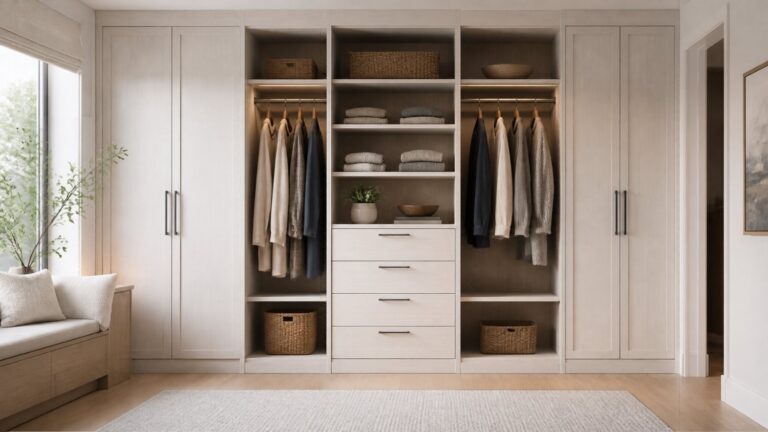
Narrow Closet Layout: How to Fit Far More In
When you buy through a link on Cozy & Tidy, we may earn a commission. It does not change the price you pay, and it does not decide what we recommend. How it works
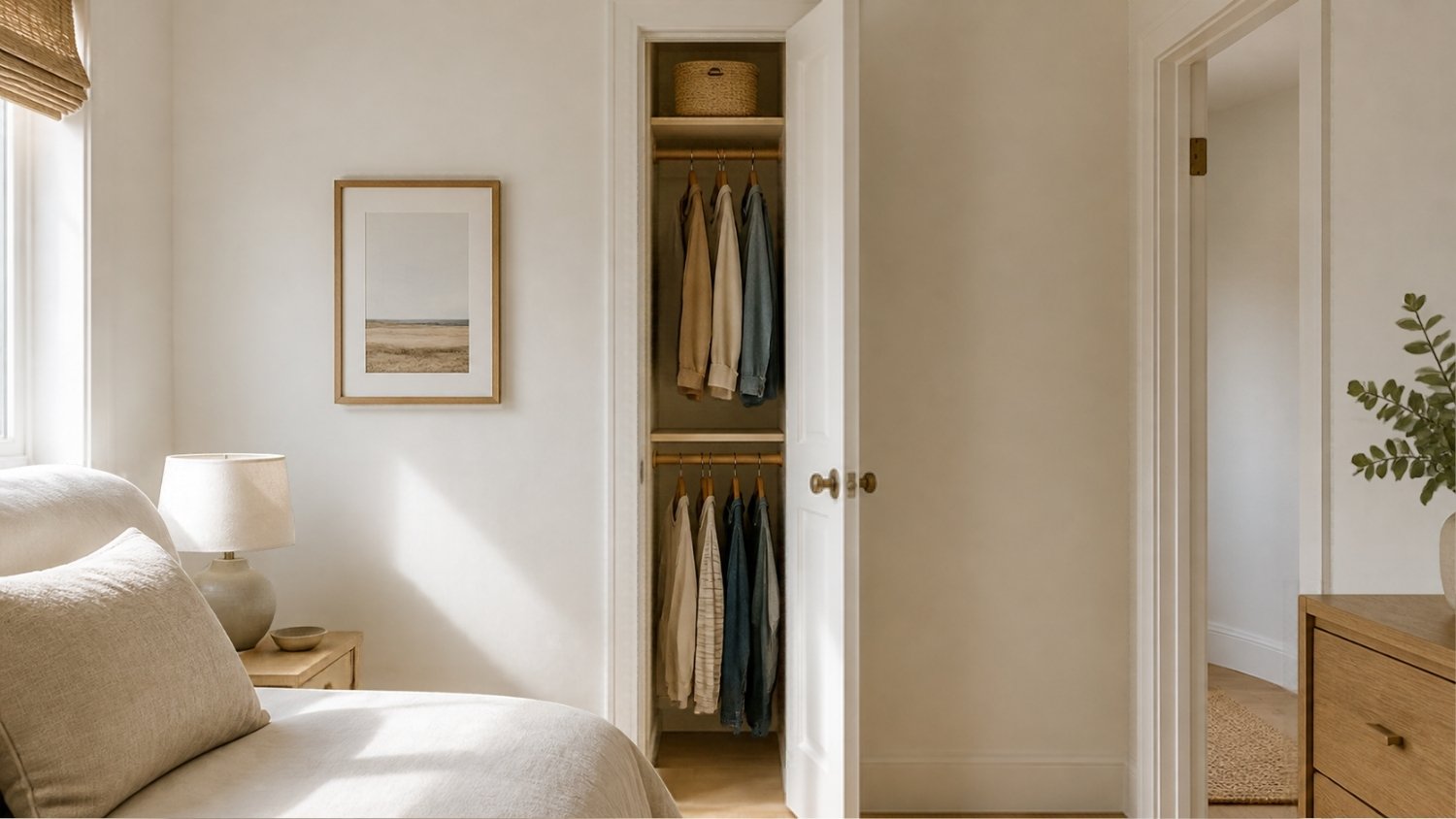
In a closet under 4 feet wide, the narrow closet layout that works is two rows of hanging across most of the width.
Build it at a top rod of 84 inches and a bottom rod of 42, which gives a 42 inch gap above and 42 inches of floor clearance below. Nothing longer than 40 inches goes on either of them. Keep one full-height section at the end for coats and long dresses, sized to how many you own. Then get the shoes off the floor, because in a narrow closet the floor is where you stand.
- 84 inThe top rod. One step above the published standard
- 42 inThe bottom rod, and the gap between the two
- 40 inThe cutoff. Longer than that goes with the coats
- 50 to 80%More hanging space than a single builder’s rod
Check the reach first. Reach up to 84 inches and lift a hanger off, before you drill anything. John Louis Home publishes 80 to 82 inches as its standard top rod and suggests 84 for taller adults, so 84 is the taller-adult figure, not the general one. If it is out of comfortable reach for you, this exact pair will not work: dropping the top rod to 82 leaves a 40 inch gap, and a 40 inch shirt then touches the rod below. Build it at 82 and 42 if you need to, and drop your own cutoff to 38 inches instead of 40.
Any unit that stays put gets strapped to the wall. The CPSC “recommends that consumers anchor furniture, including dressers, securely to the wall,” and its tip-over standard ASTM F2057-23 covers “dressers, armoires, wardrobes, and other clothing storage units.” Check the box for the restraint, and fit it. A closet is exactly the kind of place a child climbs unseen. Fit it even if no child lives with you.
Plan it before you buy it. The free Closet Layout Planner gives you the measuring sheet, the dimensions on one page and three layouts, including this one. Send it to me
The narrow closet layout, in one drawing
84 in
A builder’s rod sits at 66 to 72 inches, and everything above it is doing nothing. Move it up to 84, add a second at 42, and you get two usable rows out of the same wall. The 42 inch gap is what lets a 40 inch shirt clear the rod below it, and the 42 inches underneath is what lets a 40 inch shirt clear the floor.
One rule covers the whole double-row section: nothing longer than 40 inches goes on either of those rods.
Five steps, in the order that saves you money
Step 1
Count what you own, before you plan anything
Take your hanging clothes out and make two piles, using 40 inches on the hanger as the line. Measure the jackets rather than assume: men’s suits run 39 to 42 inches, so the ones over 40 belong in the long pile, and an outerwear jacket can reach 44.
Step 2
Hang two rows instead of one
Top rod 84, bottom rod 42, with a full-height section at the end for the coats. A 46 inch closet with one rod gives you 46 inches of hanging; split it and you gain roughly 50 to 80 percent, depending on how wide that coat section has to be.
Step 3
Get the floor back
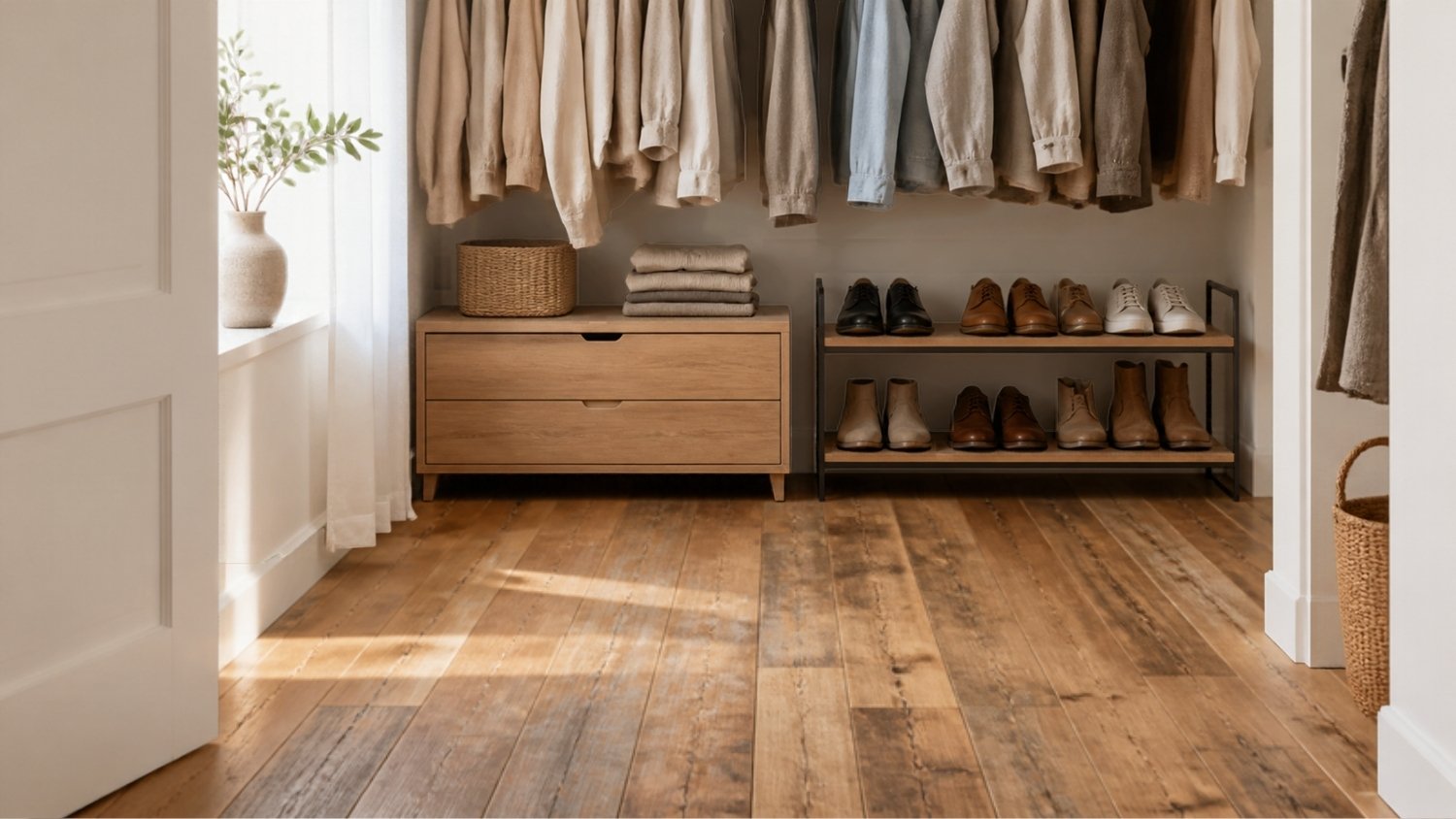
The floor is not storage, it is where you stand. Shoes go on the back of a hinged door, on a low shelf, or under the bed if you wear them twice a year.
Step 4
Use the top shelf for what it is good at
Off-season clothes, spare bedding, a suitcase. Measure the gap between the shelf and the ceiling before you order bins, because your own shelf height decides it and it is easy to get wrong.
Step 5
A drawer unit, but only if it can open
The drawers pull out forward through the closet opening, so the unit’s depth is only half the question. With a bypass slider only half the opening is ever clear, so put the unit under the half you leave open. And strap it to the wall, as above.
Will it fit? Enter the depth you measured and the depth the listing publishes, and the tool tells you whether it goes in, or that it cannot tell you yet. Try it
Measure, count your clothes, decide the layout, then shop. It is tempting to shop first, and that is exactly how a closet ends up with an organizer that fits the closet but not the wardrobe.
Step 1 in full: how much rod each thing takesnine garment types, with lengths and rod space
A narrow closet is not a small walk-in. It is a different puzzle. You can see everything from where you stand, which is the good news. You get a few feet of rod, and the floor vanishes the moment you put anything on it. Here is the better news: a narrow closet is exactly where a smarter layout pays off most.
Take your hanging clothes out and make two piles, and use 40 inches as the line. Short things, 40 inches or less on the hanger: shirts, blouses, pants folded over the bar, shorter skirts and the shorter jackets. Long things, more than 40 inches: coats, robes, dresses, outerwear jackets, long skirts, and pants you hang full length.
Now work out how much rod each pile needs. Organized Living publishes the figures in its own clothing storage guide, and these are the two numbers that decide your whole layout. The lengths below include the hanger, and the ranges combine the guide’s men’s and women’s tables.
| What it is | Length on the hanger | Rod space it takes |
|---|---|---|
| Shirt or blouse | 36 to 40 in | 0.5 to 1 in |
| Pants, folded over the bar | 28 to 32 in | 1 to 2 in |
| Skirt | 34 to 44 in | 1 to 2 in |
| Pants, hung full length from the waist | 46 to 52 in | 0.5 to 2 in |
| Suit or jacket | 32 to 42 in | 2 to 4 in |
| Outerwear jacket | 40 to 44 in | 4 to 6 in |
| Dress | 46 to 66 in | 1 to 3 in |
| Winter coat or robe | 46 to 66 in | 2 to 6 in |
| Long formal dress | 72 to 78 in | 1 to 3 in |
Coats are where people get caught out. One winter coat can take 6 inches of rod. A blouse takes half an inch. Four coats is anywhere from 8 to 24 inches of your closet gone before you hang a single shirt.
If your long things add up to less than a quarter of the total, move them somewhere else entirely. Another closet, a hook on the back of a door in another room. That one decision tends to buy you more space than anything you could order. The same guide suggests adding 10 to 15 percent on top of whatever you measure, for the things you have not bought yet.
Step 2 in full: where the 84 and 42 come fromthe published figures, and which part is my own reading
John Louis Home publishes the heights: top rod at 80 to 82 inches from the floor, bottom rod at 40 to 42, and you must keep at least 36 inches between them. That 36 is a minimum, not a target, and it is not enough for a 40 inch shirt.
Check both ends before you fix anything, because this is where layouts go wrong. A garment on the top rod has to clear the rod underneath it, and a garment on the bottom rod has to clear the floor. Both come out at the same limit, 42 inches, so build it at 84 and 42: that gives you a 42 inch gap above and 42 inches of floor clearance below. John Louis Home suggests raising the upper rod to 84 inches for taller adults, and 42 is the top of its 40 to 42 inch range for the lower rod. Organized Living’s closet design guide pairs those same two numbers, 84 and 42, though it gives them as shelf heights for a child’s closet rather than as rod heights for an adult one. So the pair is not invented, but the version here is my own reading of what the published figures allow.
Shirts at 36 to 40 are fine, clearing by at least two inches at both ends. A 42 inch suit rests on the rod below it, or reaches the floor from the lower rod. A 44 inch outerwear jacket fails at both ends. Anything longer than 40 inches belongs in the full-height section with the coats, and that rod wants to be at 84 too, so a 78 inch formal dress still clears the floor by six inches.
Two ways to build it, and they are not the same thing. A fixed second rod screwed into the side walls, plus moving your existing rod up, is what produces the layout above. A hanging double rod does something different: it hooks over the rod you already have and hangs a fixed drop below it, so you end up with two short sections rather than one high and one low. Measure the drop on the one you are looking at before you buy, and check it against your shirt length.
Step 3 in full: three places shoes can go insteadand the one that depends on your door
Things left on the floor cost you access to the rest of the closet, which is why shoes on the floor make a small closet feel so much worse than it is.
- The back of the door, for the pairs you wear every week, if your door swings open on hinges. A bypass slider, where two panels slide past each other, will not work with one. Here is which shoe organizers actually fit.
- A low shelf, if the door rules that out. Organized Living gives the depth a pair takes front to back: 7 to 8 inches for women’s, 8 to 12 for men’s, so a 12 inch shelf handles most of it.
- Under the bed, for the pairs you wear twice a year. Those have no business taking closet space.
Step 4 in full: the top shelf, and the bin that will not fittwo makers, two different clearances
The shelf above the rod should hold what you touch twice a year: off-season clothes, spare bedding, a suitcase. Put it in labeled bins that match in size, because a stack of mismatched bags is what makes a tidy closet still look chaotic.
Measure the gap between that shelf and the ceiling before you order bins, because your own shelf height decides it and it is easy to get wrong. If your top rod is at 84 inches, the shelf has to sit above it, not at the same height: John Louis Home mounts its garment bars 2 inches below the shelf, which puts the shelf near 86 and leaves you about 10 inches under an 8 foot ceiling, nearer 9 once you allow for the board itself. Easy Track’s own kits work out differently, since it recommends hanging the rail 76 inches up, putting the top of the unit at 84 and leaving 12 inches. A bin two inches too tall is a bin that ends up on the floor, so measure rather than assume.
Step 5 in full: the drawer unit, and the depth that decides it14 to 16 inches, and what your door does to that
A drawer unit under the short hanging section replaces a dresser and frees up your bedroom, which is one of the best trades available in a small home. The catch is depth.
The drawers pull out forward, through the closet opening, so the unit’s depth is only half the question. In a 24 inch deep closet a unit around 14 to 16 inches deep leaves room behind it and still lets you stand in front. The real check is the door. A hinged door that opens fully is fine. With a bypass slider, where two panels slide past each other, only half the opening is ever clear, so put the unit under the half you leave open. Fabric drawers on a frame, or a rolling cart you pull out before opening, solve it for a fraction of the price.
Where to go next
If you have not taken your measurements yet, start with our guide to closet layout dimensions, which lists the five numbers to take and what each one decides. For the published figures on a reach-in specifically, with the source named next to each one, see reach-in closet dimensions.
Questions people ask5 questions, including how narrow is too narrow
How narrow can a closet be and still work?
Depth matters more than width. John Louis Home says to keep the rod at least 12 inches off the back wall, and a shirt on a hanger needs a few more inches in front of the rod before it touches the door. Organized Living puts the minimum for a reach-in closet at 24 inches deep, and that is the figure to plan around. Below about 20 inches the clothes press on the door, and at that point you are better off turning the rod ninety degrees and running it front to back on a bracket fixed to the side wall. Here is why that works. A hanger is around 17 inches wide. With the rod running side to side, those 17 inches have to fit into the closet’s depth, which is what a shallow closet cannot give you. Turn the rod front to back and the clothes face sideways instead, so the 17 inches now has to fit across the closet’s width, and the depth only decides how many garments fit along the rod.
Should I hang two rows across the whole closet?
Only if you own almost no long clothes. Count your coats and dresses first and give them a full-height section sized to fit: at 2 to 6 inches of rod each, four coats needs 8 to 24 inches. Everything else gains from the second row.
Can I do this in a rental without drilling?
Mostly yes. A hanging double rod needs no tools, over-the-door organizers hook onto a hinged door, and a freestanding shelf unit just stands inside the closet. The compromise is weight: a double hang puts more on the existing rod, and if you have no published figure for that rod, that is the question to settle before you buy. Check the limit the maker prints on the box before you fill it.
Where do long skirts go?
With the coats, not in the two row section. Skirts run 34 to 44 inches on the hanger, so anything over 40 goes with the coats. It is an easy one to miss when you split a closet into two rows.
What should never go in a narrow closet?
Anything you use less than twice a year, unless it lives in a bin on the top shelf. Suitcases, sports gear and spare bedding take the space your clothes need, and they are the first things to move out when the closet feels full.
Sourceswhat is published, and what is my own working figure
Garment lengths, rod space and shoe depths come from Organized Living’s own clothing storage guide. Rod heights, the minimum gap between rods and the rod’s distance from the back wall come from John Louis Home. The 84 inch top of unit is Easy Track’s recommendation for its own kits. The anchoring recommendation and the ASTM F2057-23 scope come from the CPSC. Organized Living’s closet creation guide is the source for the 24 inch minimum reach-in depth, and for the 84 and 42 pair, which it gives as shelf heights for a child’s closet. Reading them as adult rod heights is my own. The rest are my own working figures rather than published specs: the 17 inch hanger width, the 14 to 16 inch drawer unit depth, the 40 inch cutoff between short and long, the under 4 feet definition of a narrow closet, the one quarter rule for dropping the long hang, the 20 inch point at which clothes press on the door, the 12 inch shoe shelf, and the estimate of how much you gain by splitting the rod. Checked September 28, 2026.
More closet fixes, one problem at a time, in our closet organization guide.
Measure once, buy once
The free Closet Layout Planner gives you a measuring sheet, the dimensions on one page, three layouts including this one, and a shopping checklist telling you which measurement to check for each item.
Saved in this browser, on this device. No account, nothing sent to us, and it goes if you clear your browsing data. See what you saved