Reach-In Closet Dimensions: Standard Sizes, Shelf and Rod Heights
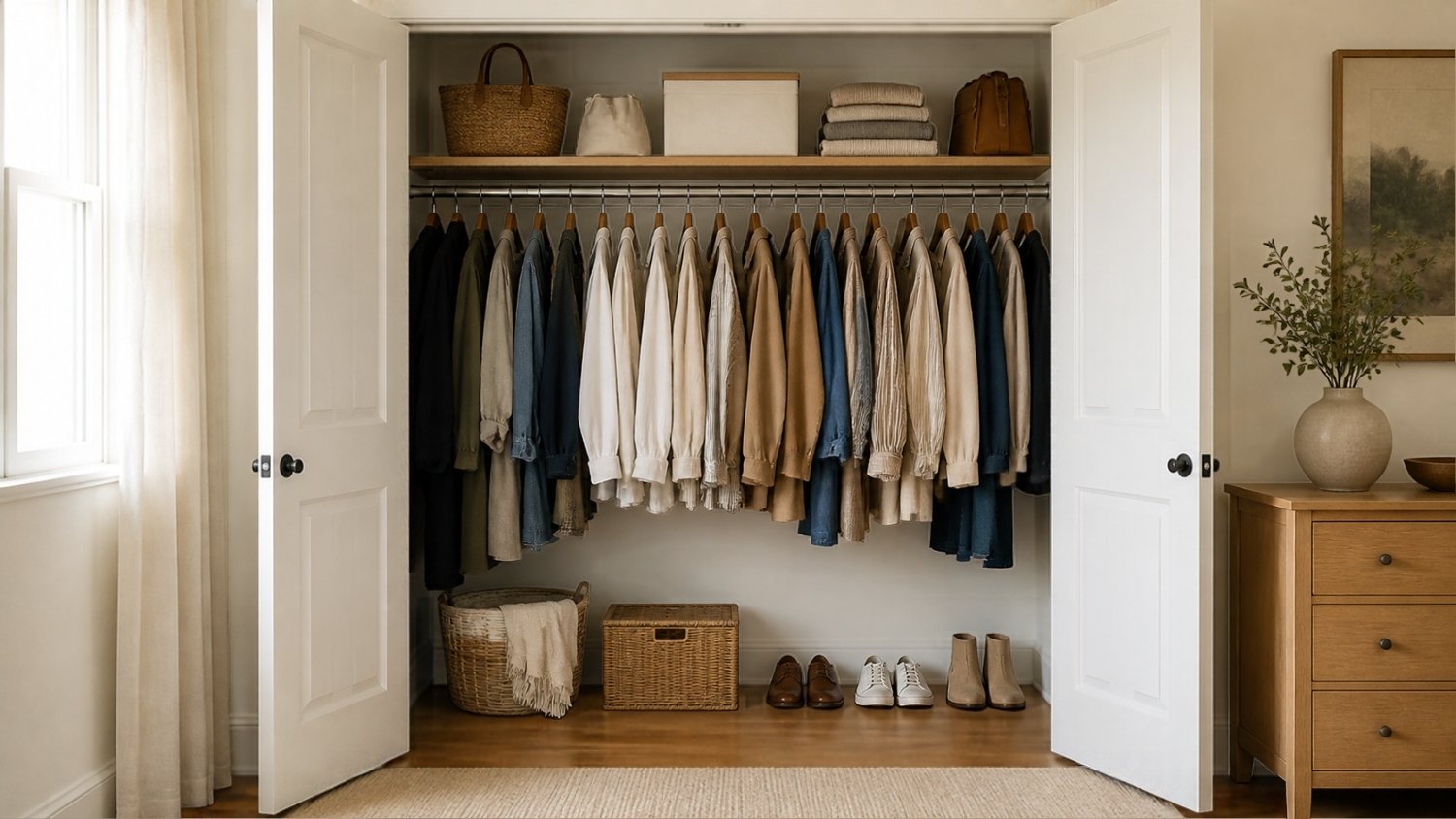
Reach-in closet dimensions vary from source to source, and the disagreement is the useful part.
Angi reports the most common reach-in as around 6 feet wide and 24 inches deep. The sources do not agree on what that 24 inches is: Closet World calls it typical, Dimensions.com recommends it, and Hunker calls it the standard minimum. For heights, Hunker places a double hang at 42 and 84 inches above the floor. Every figure below is given with the source that publishes it, and with the exact word that source uses.
- 24 inThe depth four sources give, and one of them calls it a minimum
- 72 inAngi’s most common width. The range runs 36 to 96
- 68 / 50 / 42 inHunker’s long, mid and short hang rod heights
- 36 inClear floor needed in front of a door that swings open
Is your figure a rod height or a shelf height? They are not interchangeable, and guides publish both. Hunker puts the upper shelf and the upper rod of a double hang at the same 84 inches. On a long hang they separate: a rod at 68 inches, a shelf at 70 or 71.5. Check which one you are reading before you drill.
Measure your ceiling before you plan a double hang. This is a caution the manufacturer raises itself. ClosetMaid writes: “Obviously, low ceilings will affect whether or not a shelf can be placed at 84.”
Keep your measurements in one place. The free Closet Layout Planner is a measuring sheet plus three layouts, five printable pages, so nothing you buy is too deep, too tall or blocks the door. Get the free planner
The reach-in closet dimensions that decide where the rod goes
68 / 50 / 42
Hunker gives one height per garment length. A long hang at 68 inches for dresses and coats, a mid hang at 50 so pants hang without being folded over a hanger, a short hang at 42 for shirts or blouses. A double hang is the fourth case, and Hunker’s own words for it are two short hangs, one above the other, which is why a coat does not go in either of them.
Four things to check before you buy
Check 1
Whether your figure is a rod height or a shelf height
Hunker puts both at 84 inches in a double hang. On a long hang they separate: a rod at 68 inches, a shelf at 70 or 71.5.
Check 2
Which claim your 24 inches is
Closet World calls it typical, Dimensions.com recommends it, Angi calls it sufficient. Hunker calls it a minimum. Typical and minimum are two different claims, and only one of them tells you that going below it stops working.
Check 3
Your ceiling height, before planning a double hang
ClosetMaid raises this itself for the 84 inch shelf. Measure it before you plan anything at that height.
Check 4
Your exact width, written down, to take to the store
ClosetMaid says “All shelving can be cut to your closet measurements, usually right at the store.” The figure you need is your width, not a stock length.
Will it fit? Enter the depth you measured and the depth the listing publishes, and the tool tells you whether it goes in, or that it cannot tell you yet. Try it
Where to go next: how to measure a closet covers taking these numbers with a tape and what to write down for each, and narrow closet layout applies them to a reach-in under 4 feet wide, including how to fit two rows of hanging.
What counts as a reach-in closettwo limits, and where a walk-in starts
Hunker’s definition names both limits at once: “A reach-in closet is usually just deep enough to allow clothes to hang perpendicular to the back wall, and it needs to be shallow enough so that you can reach to the back of the closet without stepping inside.”
Dimensions.com names only the second of those two limits: storage that works “without the need to physically enter the closet space.”
For the other side of the line, Closet World says a walk-in should be “at least 36 inches deep, allowing you to enter and walk around within the space.” That is a threshold for calling something a walk-in. It is not a rule that every shallower closet is a reach-in.
Depth: what each source publishes, and what it calls iteight figures, four sources, one disagreement that matters
| Figure | What the source calls it | Who publishes it |
|---|---|---|
| 24 inches | “a standard comfortable closet depth” | Dimensions.com |
| 24 inches | “typically about 24 inches deep” | Closet World |
| 24 inches | “plenty for most” | Angi |
| 24 inches | “the standard minimum depth” | Hunker |
| 22 inches | below it, “isn’t deep enough to allow hanging clothes” | Hunker |
| 20 inches | “as narrow as 20 can be used if desired” | Dimensions.com |
| 18 to 24 inches | the Standard row of its size table | Angi |
| 28 inches | for “coats or other bulky hanging items” | Hunker |
Four sources give 24 inches, and the fourth means something different by it. Closet World, Dimensions.com and Angi describe it as comfortable, typical or sufficient. Hunker writes “The standard minimum depth for a reach-in closet is 24 inches.” Typical and minimum are two different claims.
Below 24 inches, each source draws the line in a different place.
Hunker gives the depth a hanging garment occupies, in its walk-in section: “Given that hanging clothes take up 2 feet of depth”. The rest of that sentence describes a walk-in.
Closet World adds what the depth does for the clothes: reach-ins are “typically about 24 inches deep, allowing for comfortable storage without clothes brushing against the back wall.”
Width, and Angi’s full size table36 to 96 inches, and why a stock length does not matter
| Reach-in type | Width | Depth |
|---|---|---|
| Standard | 4 to 6 feet | 18 to 24 inches |
| Medium | 6 to 8 feet | 22 to 28 inches |
| Large | 8 feet and up | 28 inches and up |
Closet World reports that reach-ins “come in various widths, from 36 to 96 inches.” Angi reports the most common as “around 6 feet wide,” which is 72 inches.
ClosetMaid lists its SuperSlide shelving in “4′, 6′, 8′, and 12′ lengths” and its Close Mesh shelving in “6′ and 12′ lengths.” It also says “All shelving can be cut to your closet measurements, usually right at the store.” So your width does not have to match a stock length. Take the measurement with you.
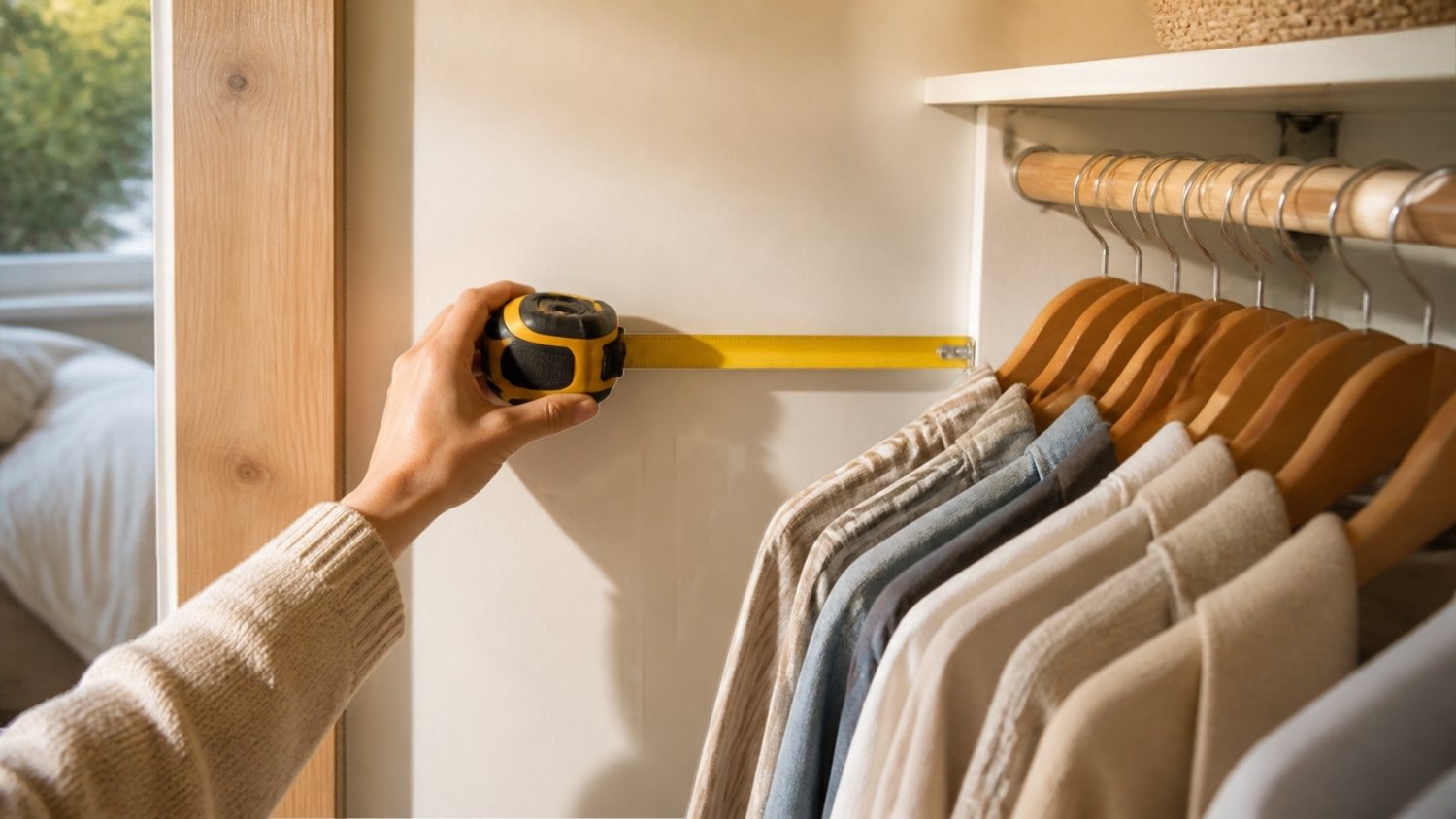
Rod heights and shelf heights, side by sideand why ClosetMaid publishes two different sets
Guides publish both. Check which one your figure is before you mark the wall. ClosetMaid gives 84 and 42 inches together, for double or short hanging space, without saying which goes where. I have put 84 on the double hang upper row, and 42 on the double hang lower and short hang rows.
| Layout | Rod height from floor | Shelf height from floor |
|---|---|---|
| Long hang, “dresses and coats” | 68 in, Hunker | 70 in called typical and 71.5 in in the Long Hang step, both ClosetMaid |
| Mid hang, pants | 50 in, Hunker | not published on these sources |
| Short hang, “shirts or blouses” | 42 in, Hunker | 42 in called typical, ClosetMaid |
| Double hang, upper | 84 in, Hunker | 84 in called typical and 85.5 in in the Center Stack and Double Hang steps, both ClosetMaid |
| Double hang, lower | 42 in, Hunker | 42 in called typical, ClosetMaid |
Hunker’s three rod heights come with their uses. The long-hang rod “allows enough vertical space for longer items, such as dresses and coats; it is usually placed 68 inches above the floor.” The mid-hang rod “is positioned to allow pants to be hung without folding them over a hanger; it is typically placed 50 inches above the floor.” The short-hang rod “is suitable for hanging shirts or blouses, and it is typically positioned 42 inches above the closet floor.”
Hunker puts the upper shelf and the upper rod of a double hang at the same height: “The upper shelf in a closet is set at 84 inches above the floor, the same height as the upper rod in a double-hang configuration.”
ClosetMaid publishes two sets of figures on one page. Its Center Stack step says to “Install one shelf at 85.5 that runs the entire perimeter of your closet to maximize upper storage,” and its Long Hang step says “For Long Hang, place the shelf at 71.5.” Its measuring section gives figures it calls typical: “Typical shelf heights are 70 from the floor for long hanging space and 84 and 42 from the floor for double or short hanging space.” The page does not explain the gap between the two sets. My own reading: follow the installation figures when you are fitting that brand’s system, and the typical figures when you are not.
Double hang
Hunker describes it as two rods in the same vertical space: “In a double-hang configuration, one rod is positioned at the height of 42 inches, and another rod is positioned above it at 84 inches above the floor; this configuration provides two short-hang spaces, one above the other.”
Note what Hunker calls those sections: two short hangs. Hunker’s short hang is “suitable for hanging shirts or blouses.” Long items go in a long hang instead.
ClosetMaid’s shelf instruction for the same layout is to “Place one Superslide shelf at 85.5 high and another below it at 42 for correct Double Hang heights.”
Shelf depth, and the clearance in front of the doorwhat is sold, what is asked for, and the gap between the two
ClosetMaid lists SuperSlide shelving as available in 12 and 16 inch depths, and Close Mesh shelving as available in 16 and 20 inch depths.
What goes on each depth, from the two sources that say:
- Dimensions.com: “Shelf depths of 12 (30.5 cm) should be used for shoes and smaller clothing elements.”
- Hunker, on the high shelf: “the shelf should be at least 16 inches deep to allow for storage of large items.”
- Hunker, for exceptionally bulky things: “Shelves intended to hold exceptionally bulky items, such as pillows or blankets, should be 24 inches deep.”
Worth noting before you shop, and this one is my own comparison rather than a published figure: 24 inches is deeper than any shelf in the two ClosetMaid ranges quoted above, whose deepest is 20 inches.
Clearance in front of the closet
Closet World: “Make sure there’s at least 24 inches of room in front of sliding doors and 36 inches for doors that swing open.”
Measure the floor you actually have free, not the width of the room.
Each measurement, on its own pagefive pages, every source listed in full
- How deep should a reach-in closet be, where the four sources and their disagreement are set out in full, and one of them calls 24 inches a minimum.
- Standard closet shelf height, and why ClosetMaid publishes two different sets of figures.
- Closet shelf depth, the depths actually sold and what each one holds: 12 and 16 inches sold, 24 asked for pillows.
- Closet rod height, one height per garment length, with what each is for.
- Double hang closet heights, the 42 and 84 inch pair, what fits in each section, and the ceiling check.
Once you have the figures
The next choice is what goes inside: the four closet system families, then the ones that fit a reach-in, and what changes when you go down a grade. If you are taking the door off instead, see open closets.
Questions people ask6 questions
What is the standard size of a reach-in closet?
Angi reports the most common as around 6 feet wide and 24 inches deep. Closet World gives widths from 36 to 96 inches, so there is a range rather than one standard.
What is the minimum depth for a reach-in closet?
The sources differ. Hunker calls 24 inches the standard minimum and says a closet under 22 inches is not deep enough to hang clothes. Dimensions.com allows 20 inches if desired. Angi’s table lists 18 to 24 inches for a standard reach-in.
How high should the closet rod be?
Hunker gives 68 inches for a long hang, 50 inches for a mid hang, and 42 inches for shirts or blouses. In a double hang, it places the two rods at 42 and 84 inches.
How deep should closet shelves be?
ClosetMaid lists 12 and 16 inch depths in SuperSlide and 16 and 20 inch in Close Mesh. Dimensions.com puts shoes and smaller clothing on 12 inch shelves. Hunker asks for at least 16 inches on the high shelf, and 24 inches for pillows or blankets.
What counts as a walk-in?
Closet World puts the threshold at “at least 36 inches deep, allowing you to enter and walk around within the space.”
How much room do I need in front of the closet?
Closet World says at least 24 inches in front of sliding doors, and 36 inches for doors that swing open.
The heights, on five printable pages
The free planner carries the standard rod heights and shelf depths, a measuring sheet for your own numbers, and three layouts that work, so you are not scrolling back to this table with a pencil in your hand.
More closet fixes, one problem at a time, in our closet organization guide.
Saved in this browser, on this device. No account, nothing sent to us, and it goes if you clear your browsing data. See what you saved