Mudroom Storage Solutions: Start at the Wall, Not the Catalog
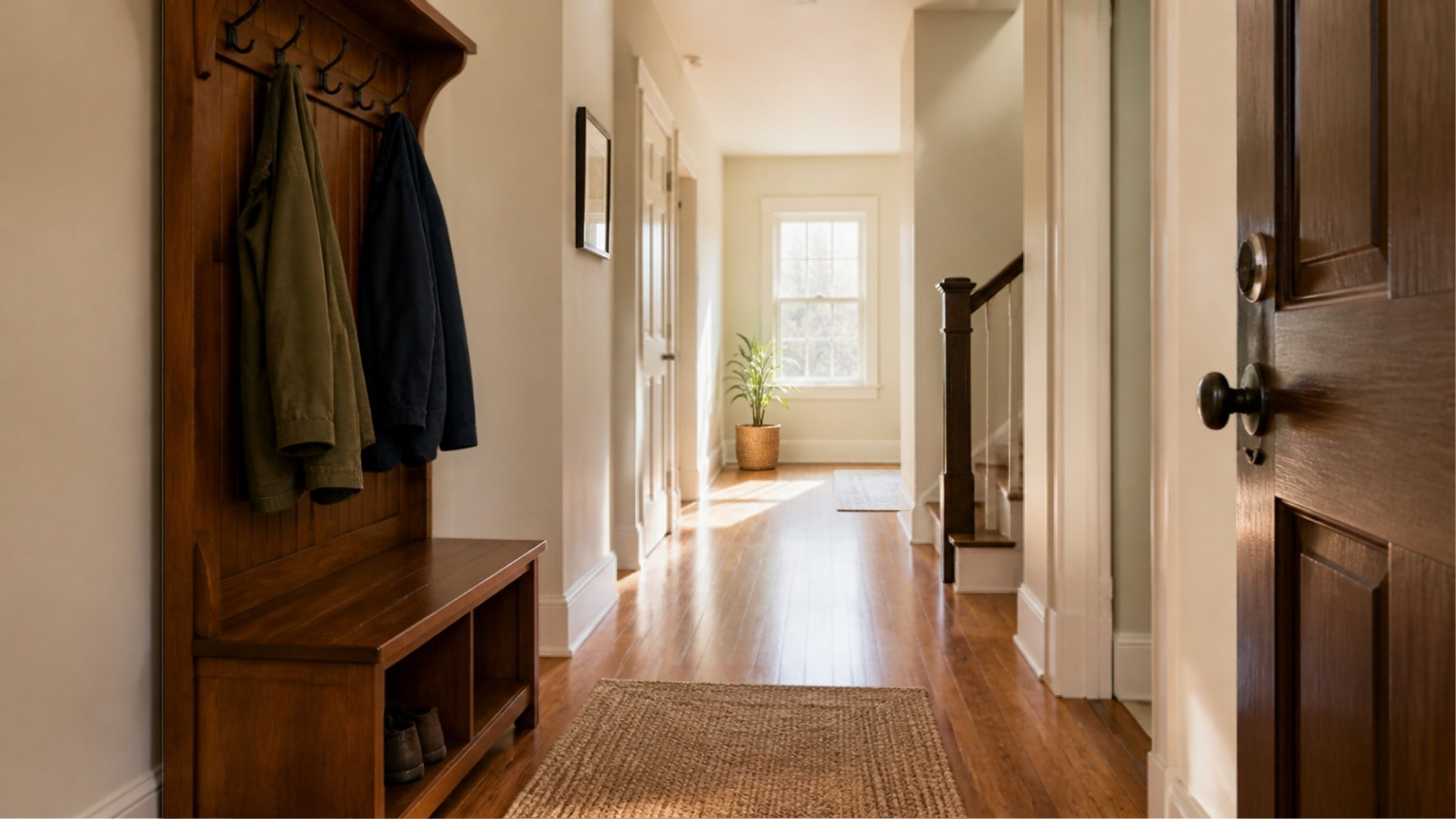
Four things decide which mudroom storage solutions you can put by your door, and the price is not one of them.
How many people it has to serve. How much free wall you have. How deep you can go before the hallway stops working. And what the seller says each hook will carry. Write those four down before you open a single product page, because the shape of the furniture follows from them.
- PeopleIt decides one piece or a column each
- Free wallThe wall you have, not the wall on the plan
- Assembled depthWhat the passage gives up. It rules pieces out first
- Per hookThe figure the seller publishes, not a guess
On the Woodbury hall tree, a seller answer in the questions section says: “We recommend not exceeding 5 pounds per hook.” That is the seller answering a buyer, not a line in the specification table, and it should be read that way. The same page lists 3 hooks in its specification table. Five pounds is not much. A dry raincoat is fine. A wet winter coat is a different proposition, and it can pass 5 pounds on its own.
So: one heavy item per hook, not a coat plus a bag plus a scarf on the same one. If you do not know what your winter coat weighs, put it on a kitchen scale once. It takes a minute and it settles the question for that coat. If your coat comes in over the figure the seller gives, it does not go on that hook. It goes on a separate hook bought with its own weight figure published by the maker, or on a hanger somewhere else. A hook is not made safer by hoping. And if the hooks on the piece you like carry no published rating at all, ask the seller before you buy rather than finding out in February.
Notice the gap on the same piece of furniture. The same page publishes 20 pounds per shelf and cubby, and a bench seat rated at 200 lbs. The bench carries a published figure of 200 lbs, the hooks a suggested 5 pounds each. Before you sit on one to pull your boots off, compare your own weight to the figure the page publishes, and remember that sitting down lands harder than sitting still.
And one rule in plain words. Anything tall that stands on the floor gets fixed to the wall. That applies whatever it weighs and whoever lives in the house. What hooks and wall shelves have to be fixed into is named in the instructions that come with them, and that is the line to read before you drill. If you cannot confirm a stud is where you need it, have that part done by someone who can. The Anchor It campaign from the Consumer Product Safety Commission is where to read what their own pages publish about tip-over.
Take the four numbers first. Our free Entryway Fit Planner is the printable for this door. Page 2 is the depth, page 3 is the free wall, page 4 counts the people. Get the free planner
Mudroom storage solutions: the depth number that surprises people
13.38 in
Dimensions.com gives a typical bench depth of 15 to 20 inches, and adds that past 20 the seat gets uncomfortable for an average person. It presents that as a typical range rather than a standard. Now look at a real product: the RiverRidge Woodbury hall tree lists an assembled depth of 13.38 in, and its bench seat measures 12.75 inches deep. The furniture actually sold for a narrow entry sits under the typical seat range.
Here is the test, and it uses the right number. Stand where you walk. Have someone hold a tape against the wall at 13.38 inches, the assembled depth of the Woodbury. You will feel straight away whether the passage still works. Whatever piece you are looking at, run the test at the assembled depth its own page lists. Assembled depth means the depth once it is built and standing against your wall.
What to measure, in order
Step 1
How many people
Write the number down first. It decides whether you are buying one piece or a column each, and nothing else in the list can tell you that.
Step 2
The free wall, end to end
At the height the piece will sit. Not the wall on the plan. The wall you actually have once the door trim and the light switch are accounted for.
Step 3
The depth you can give up
Use the tape test above, at the assembled depth your chosen piece lists. Depth rules a piece out before width does, which is the same thing we found in reach-in closets.
Step 4
The figure the seller gives per hook
It may be in the specifications or in the questions on the listing. If it is in neither, ask the seller before you buy.
Then two checks
The door arc, and the ceiling
Open your front door fully and mark where it stops. Nothing goes in that arc. And if you are looking at a tall unit, measure your ceiling and note any bulkhead, the boxed-in section that drops lower to hide pipes or ducts. The Royce gives 81.5 in of height in its product title, and the page I read does not say whether that is the assembled figure. Measure your own hallway rather than assuming it clears.
What fits by your door
Three numbers in, a plan out. Nothing is sent anywhere, this runs in your browser.
Measure the wall you actually have, once the door trim and the light switch are accounted for.
Stand where you walk and have someone hold a tape out from the wall. That feeling is the real limit.
Mudroom storage comes in three formsand your wall and floor choose, not your taste
A mudroom is rarely a room. Often it is a stretch of wall between the door and the rest of the house. People walk through it carrying things. The advice that works in a magazine photo rarely works at your door: the photo has a room, you have a passage. So the first question is not what you want. It is what the passage can give up without becoming a squeeze.
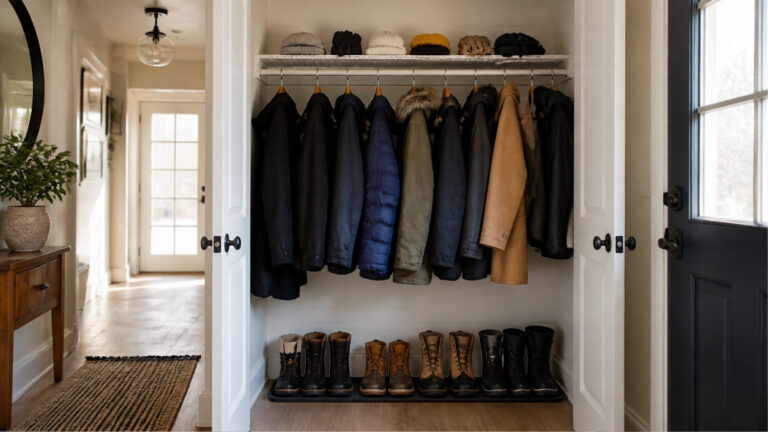
Entry storage takes three forms: a single unit standing on the floor, a run of lockers with a column per person, or hooks and shelves on the wall with nothing on the floor at all. You do not choose between them on looks. Answer these in order.
Is your free wall narrower than the piece you like? Then you are down to one narrow unit, or to the wall-only option. Either way, I would plan it as one person’s worth of storage.
Do you have a long run of wall but a narrow floor? Then go up and stay shallow. Hooks and shelves on the wall, and a bench only if the depth still works.
Do you have both wall and floor? Then a full hall tree or a run of lockers becomes possible, and you can give each person a column.
| What you are deciding | The number to take | What it rules out |
|---|---|---|
| How many people it serves | Count of people, and the width of your free wall | A shared bench where you needed a column each |
| Will the passage still work | Assembled depth of the piece | Anything deeper than the gap you will give up |
| Whether the hooks hold a winter coat | The figure the seller gives per hook | Heavy coats on a piece rated for light ones |
Shoes at the door are a different problem from shoes in a bedroom closet, which we cover in closet shoe organizers.
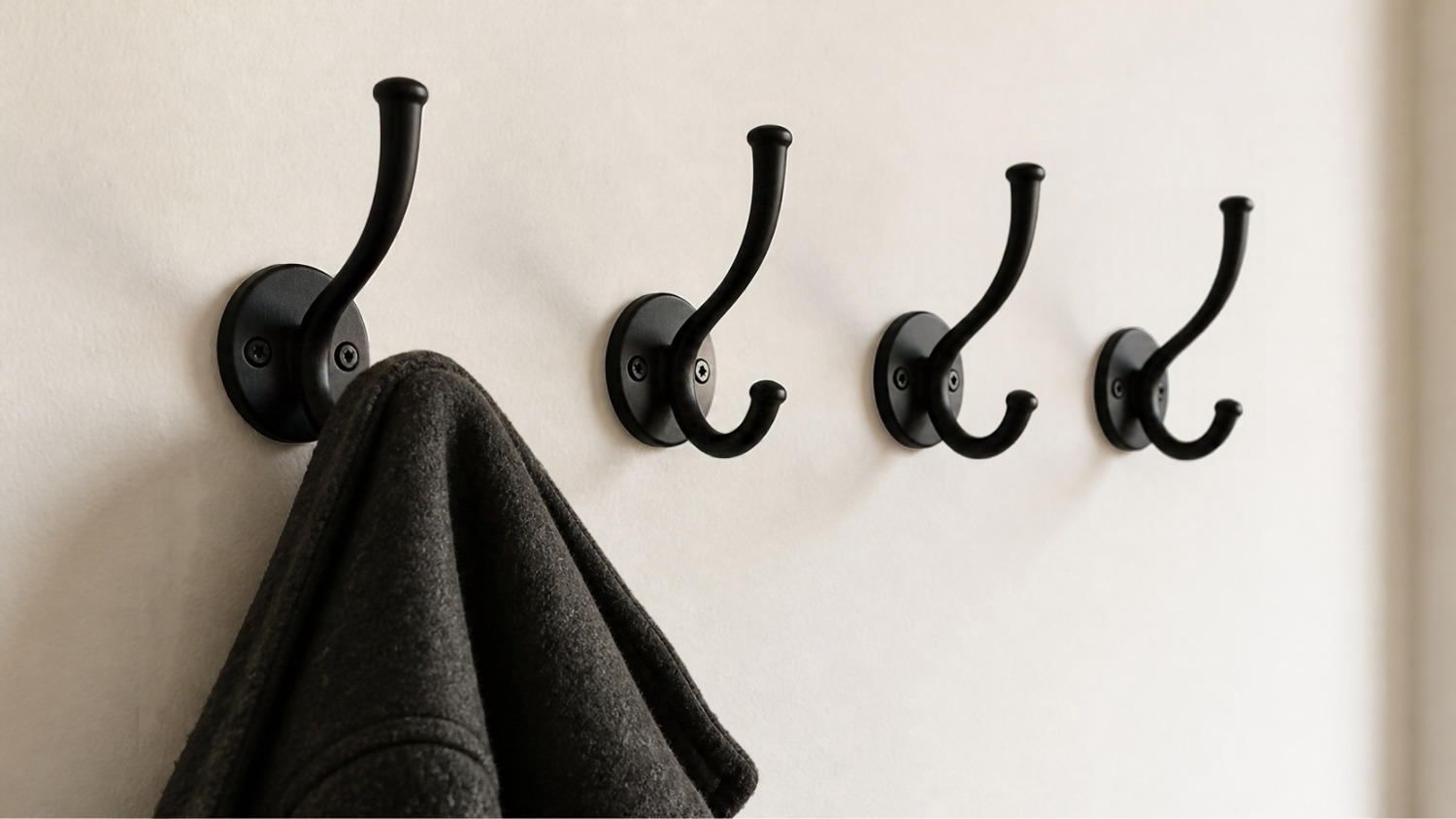
Why you might not want one of these at allfour reasons to walk away from a hall tree
A hall tree is one piece that does four jobs: it hangs coats, seats you, holds shoes underneath, and puts a shelf overhead. That is both its appeal and its limit.
Do not buy one if your free wall is shorter than the piece. They do not shrink. The Home Decorators Royce gives 79.25 in of width in its product title, and needs that much wall plus room for your front door to swing past it. The page I read does not say whether that is the assembled figure, so ask.
Do not buy one if more than one person has to use it. The Woodbury is 23.63 in wide in total, and it lists 3 hooks. I read those two numbers as one person’s worth of space rather than two. One hall tree holds one person’s coat and one person’s shoes well. Two people share it badly, so plan on a second narrow unit rather than a wider one, if the wall allows it. Past two, you need a column each. That means lockers.
Do not buy one if you cannot spare the assembled depth its page lists. When the depth does not fit, you are better off with hooks and a shallow shelf on the wall, and nothing standing on the floor. The floor is what makes a corridor feel narrow.
Whether you can anchor it is part of the choice, so read what the instructions that come with it call for before you buy. A tall unit standing on the floor has to be fixed to the wall. If you cannot confirm there is a wall stud where the bracket needs to go, have that part done by someone who can.
What I could not verifytwo gaps that shape what this article does not tell you
I looked for a published width per person for entry cubbies and lockers. On the 9 search results I examined, I found no source published by a manufacturer or a standards body. What I found were editorial pages giving a figure without saying where it came from. So this article gives you no cubby width, and I would treat any number you see elsewhere with the same question: who published it, and from what.
On the Home Decorators Royce hall tree, the page as I read it gives width and height in the product title. It does not list depth, seat height, cubby sizes or weight capacity. Depth was not there. Ask before you order rather than assuming it matches another unit.
Questions people ask4 questions, including what to do in a rental
Is a hall tree deep enough to sit on properly?
Often not. Dimensions.com puts a typical bench depth at 15 to 20 inches, while the Woodbury seat measures 12.75 inches deep. The seat is shallower and the passage stays walkable. If you want to sit rather than perch, you need the deeper piece and the floor to put it on.
How much weight can the hooks take?
It depends on the piece, and you have to look it up rather than assume. On the Woodbury, the seller answers 5 pounds per hook in the questions section of the listing. Other pieces will differ. If the rating is not published anywhere on the page, ask the seller before you load it with winter coats.
Can I put a hall tree against a wall I cannot drill?
Not unanchored, no. Anything tall that stands on the floor is a tip-over question, and the Anchor It campaign from the Consumer Product Safety Commission is where to read what their pages publish about it.
There are two reasons you might not be able to drill, and they lead to different answers. If a landlord forbids it, ask before you give up, and check what your own lease says.
If you truly cannot put a screw in that wall, then hooks are out too. A hook carrying winter coats needs the same fixing a bracket does. What is left is low and wide: a low bench, a shoe cabinet wider than it is tall, baskets on the floor. Nothing tall, because a tall piece brings the anchoring question with it, and the Anchor It campaign from the Consumer Product Safety Commission is where to read what their pages publish about it. You will store less that way, and I would rather say so. Our guide to small space storage covers the rest of a rented place.
Do I need one unit or several?
Count the people first. One hall tree holds one person’s coat and shoes well. Two people share it badly, so plan on a second narrow unit rather than a wider one, if the wall allows it. Past two, you need a column each, which is a different purchase and usually a different budget.
Taking the tape to the wall this weekend?
Print the Entryway Fit Planner first. It gives you a box for each of the four numbers above, so you arrive at the listing with figures instead of impressions. Four steps, five pages, filled in where you actually walk.
Saved in this browser, on this device. No account, nothing sent to us, and it goes if you clear your browsing data. See what you saved