Closet Systems: The Four Families, and How to Tell Them Apart

Most closet systems fall into one of four families, and the family decides more than the price does.
It decides what you can change later, what you have to drill, and what happens when you move. Wire shelving sits in brackets and gets cut to your width. Melamine and wood are vertical panels, one pegged and one screwed. Freestanding stands on its own frame. Pick the family first, then the product.
- WireCut to your width. Visible brackets
- MelaminePegged panels. Rods and shelves move
- WoodScrewed panels. Changing it later means tools
- FreestandingIts own frame, plus one anti-tip strap
A freestanding unit needs no wall track, which is the whole reason people choose it. It still needs one fixing. The CPSC “recommends that consumers anchor furniture, including dressers, securely to the wall,” and its tip-over standard ASTM F2057-23 covers “dressers, armoires, wardrobes, and other clothing storage units.”
So the gain is not zero holes. It is one strap hole instead of a wall track. Check the box for the restraint, and fit it.
Measure before you choose a family. The free Closet Layout Planner is a measuring sheet plus three layouts, five printable pages. Get the free planner
How to choose between the four closet systems
3
Start with the questions that eliminate families rather than the one that picks a winner. Three of them do almost all the work, and in most closets they leave you with one or two candidates rather than four.
The four families, one at a time
Wire
Shelving in brackets
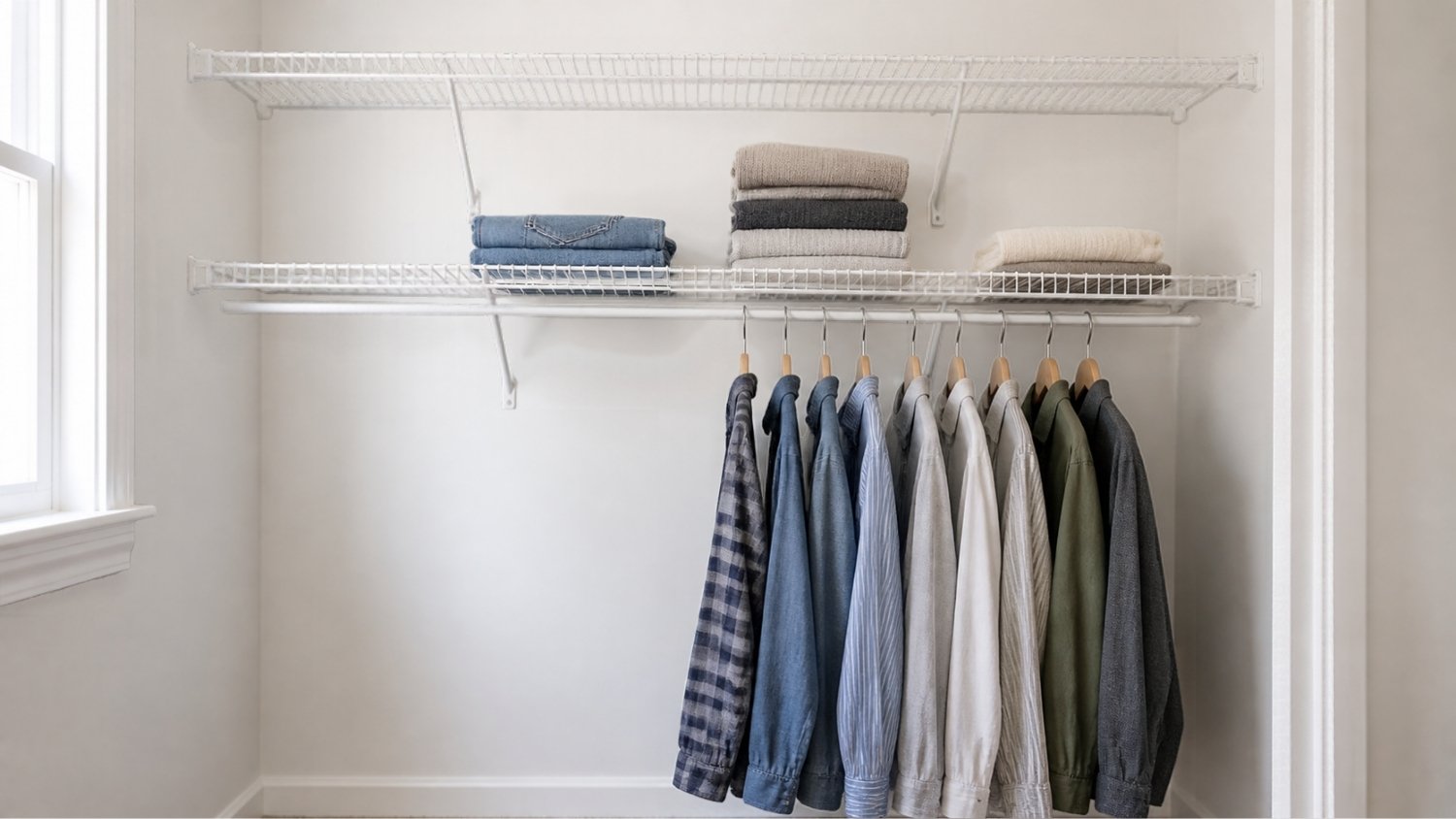
Shelves sit in brackets. On some ranges the brackets hang on a track screwed to the wall, which lets them slide along it. On others they screw straight into the wall, which fixes them where you put them. ClosetMaid, one of the makers, says “All shelving can be cut to your closet measurements, usually right at the store.” That applies to the length of the shelf; depth comes in the sizes the range is sold in. That is the whole argument for this family: the shelf becomes your width rather than a stock width. What you accept: visible brackets, and folded knitwear that marks where the wires sit unless you put a liner down.
Melamine
Pegged panels
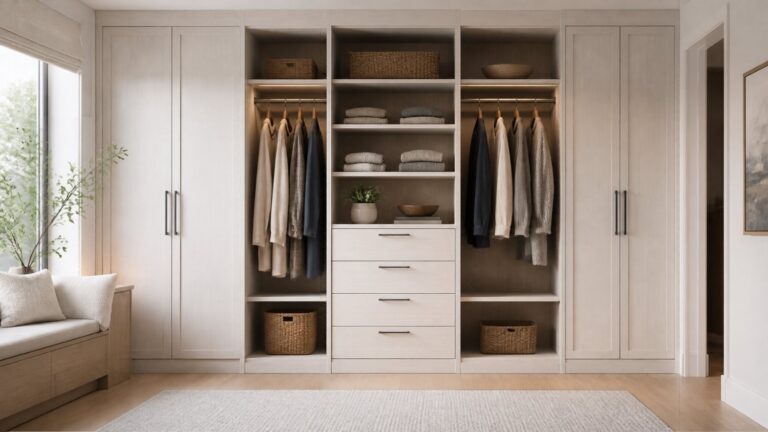
Vertical panels run floor to shelf, with holes drilled along them for pegs. Rods and shelves move between those holes. What you accept: each range offers a set of panel depths and heights, so you choose from that set rather than naming your own.
Wood
Screwed panels
Same idea as melamine, in solid or veneered wood, usually screwed rather than pegged. What you accept: changing it later means tools. Choosing it means choosing your layout once.
Freestanding
Its own frame
A frame that stands on the floor. Rails on legs, cube shelving, an armoire. What you accept: it eats floor space, which a reach-in has very little of, so a unit standing inside a shallow closet leaves you nowhere to stand. And it still needs the one fixing above.
Take your own numbers to the store. Print the measuring sheet, and order from your closet instead of from an average one. Get the free planner
The four families as a tablehow each holds up, and what it takes to change it
| Family | How it holds up | What it takes to change it |
|---|---|---|
| Wire shelving | Brackets, sometimes on a wall track | Cut a shelf, move a bracket |
| Melamine panels | Vertical panels, wall anchored | Reorder a panel |
| Wood systems | Panels and cleats, often screwed | Carpentry |
| Freestanding units | Its own frame, on the floor, plus an anti-tip strap | Unstrap it and lift it out |
Where this sits in the closet guideswhat to read before, and what to read next
Once you have picked a family, which systems fit a reach-in narrows it further, and what you give up going down a grade covers the price side. If you are taking the door off instead, see open closets.
For the figures, see reach-in closet dimensions, and start from how to measure a closet. The two heights every family has to place are on closet rod height and standard closet shelf height.
Questions people ask3 questions
Which closet system is easiest to install?
Wire shelving, on the strength of one thing ClosetMaid publishes: shelving “can be cut to your closet measurements, usually right at the store,” so the width is handled before you get home.
Can I put in a closet system without drilling?
The freestanding family needs no wall track, but the CPSC recommends anchoring clothing storage units to the wall, so expect one strap fixing. Wire, melamine and wood all fix to the wall.
Can I change a closet system later?
Wire and melamine are the two families built to move. Wood systems are usually screwed in place.
Measure before you choose
Five printable pages: a measuring sheet for your own numbers, the standard rod heights and shelf depths, three layouts that work, and a shopping checklist.
More closet fixes, one problem at a time, in our closet organization guide.
Saved in this browser, on this device. No account, nothing sent to us, and it goes if you clear your browsing data. See what you saved