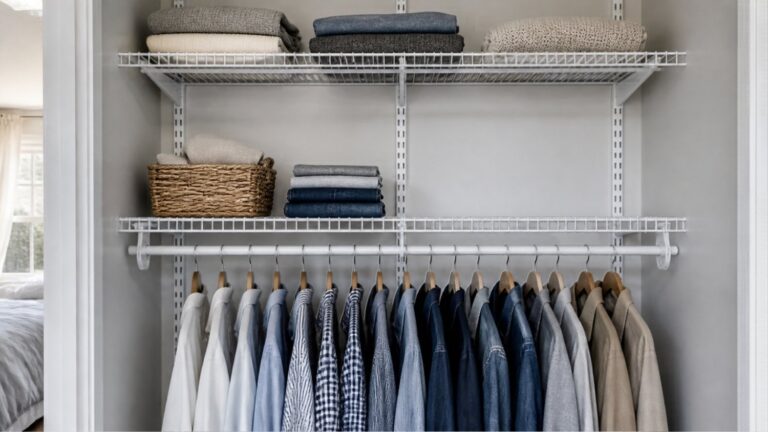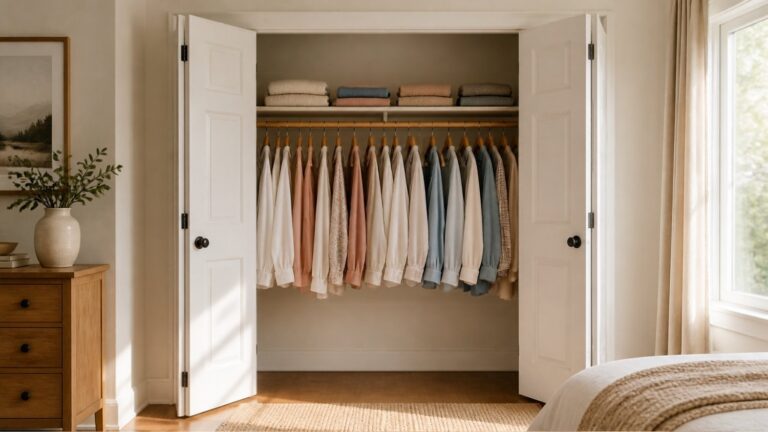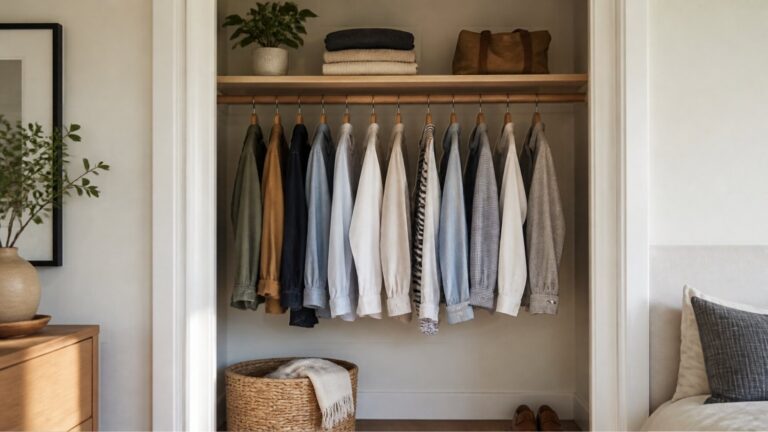
Closet Built-Ins: What They Really Cost and When They Pay Off
When you buy through a link on Cozy & Tidy, we may earn a commission. It does not change the price you pay, and it does not decide what we recommend. How it works
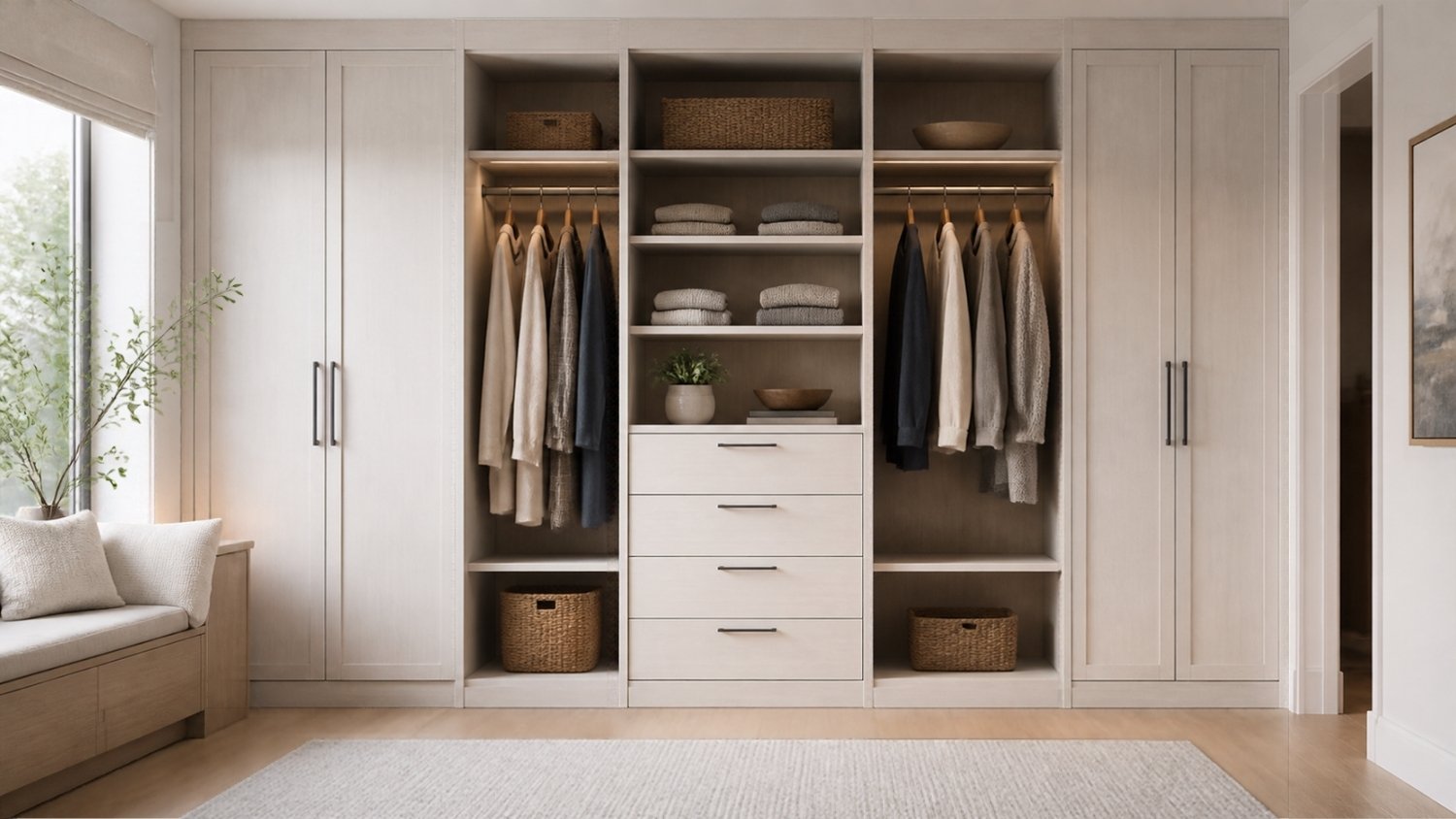
Closet built-ins cost $2,128 on average, and most projects land between $1,046 and $3,210.
That average hides four very different jobs. A basic refresh, meaning rods or shelving and paint, is $150 to $500. A ready-made system fitted for you is $400 to $2,200. Before you compare a single quote, find out how the company counts linear feet, because counting the width alone puts your budget at a third to two thirds of the real number.
- $150 to $500A basic refresh. Rods or shelving, and paint
- $400 to $2,200A ready-made system, fitted for you
- $2,128Angi’s average for a custom closet, from 832 projects
- 83%Of the cost recovered at resale, per NAR 2025
The part to take seriously is what you screw into. Anything carrying the weight of clothes should go into a stud, meaning one of the wooden uprights hidden inside the wall, and an inexpensive stud finder shows you where they are.
On the weight it will carry, look up the limit for the exact product you bought, on the maker’s own page, and read the whole sentence around the figure rather than the figure alone. The capacities I read came with conditions attached: which exact product they cover, what the hardware goes into, and how far apart the fasteners sit. A figure quoted for one system tells you nothing about yours. If your shelf dips in the middle, that is a sign to stop filling it and to go back to the figure its maker publishes.
Measure before you get a quote. The free Closet Layout Planner gives you the five numbers a designer will ask for. Four steps, five printable pages. Walking in with your own measurements changes the whole conversation. Send it to me
The trap that decides what closet built-ins cost you
10 ft
Closet quotes normally arrive priced by the linear foot, and the feet are not the width of the closet. HomeGuide adds the side walls to the back wall. So an ordinary 2 by 6 foot reach-in is 10 linear feet, not 6, and a 6 by 8 foot walk-in is 20, not 8.
Three questions that make two quotes comparable
Step 1
How many linear feet am I being charged for?
Get it in writing. Some companies price by square footage instead, so check which one you have been handed before you compare anything. A quote counted one way and a quote counted the other are not two prices for the same job.
Step 2
Does this rate include the fitting?
A rate that quietly leaves labor out looks like a bargain next to one that includes it. Angi lists laminate at $125 to $150 a linear foot and cedar at $200 to $500, in a table about materials, and it does not say whether fitting is included. HomeGuide’s $70 to $270 a linear foot is a cost to build, which is a different animal from a material price.
Step 3
Can I have a flat project price?
Labor by itself runs $40 to $120 an hour, per Angi, covering designers, carpenters and closet installers. Ask for a flat price where you can, because an hourly rate on a job nobody has measured is how a budget drifts.
A rate means nothing until you know what it includes and how the feet were counted.
Before you book anybody, it is worth spending one Saturday on the cheap version. Start with the five dimensions that decide what fits, or with the step-by-step for laying out a narrow closet.
The four routes, cheapest firstwhat each one buys, and which prices include the fitting
Built-ins are the closet upgrade everyone wants and nobody prices out first. You see the photo, you picture your clothes in it, and then the quote arrives. So let us do the unglamorous part first.
Angi’s national average for a custom closet installation is $2,128, from 832 verified projects, and most homeowners pay between $1,046 and $3,210. That average hides four very different jobs.
| What you buy | What it costs | What you get |
|---|---|---|
| A basic refresh | $150 to $500 | New rods or shelving, and paint. No panels, no drawers. |
| A ready-made system, fitted | $400 to $2,200 | A prefab system: panels, shelves, hanging sections, drawers as an option. |
| A custom reach-in, fitted | $500 to $3,000 | Cut to your walls, with drawers and a chosen finish. |
| A custom walk-in, fitted | $1,000 to $8,000 | A full build-out. Lighting and an island at the top end. |
The first two rows are HomeGuide’s figures, the last two are Angi’s, and both sites give the same $1,000 to $8,000 for a walk-in.
Three of those four rows are fitted prices. HomeGuide labels its prefab costs as total cost installed, and Angi’s figures are for custom closet installation. The basic refresh row is the odd one out: HomeGuide does not say whether it includes labor, and at $150 it plainly does not. Treat that one as a shopping list, not a quote.
If you plan to do the fitting yourself, Angi puts the materials and tools for a basic DIY closet at $500 to $2,000. That is a useful reality check against the $400 sitting at the bottom of the prefab row.
What pushes the price upfour things, and only one of them is the closet itself
- The material. Of the four Angi prices, laminate is the cheapest at $125 to $150 a linear foot. Cedar is $200 to $500 for the same width of wall.
- The size, since a rate per foot means a wider closet costs more even with nothing added to it.
- The small extras, which add up quietly. Angi prices shoe racks and cubbies at $50 to $200 each, and jewelry organizers or pull-out trays at $75 to $200 each.
- The big extras, which are a different order of money. LED lighting is $200 to $800, and a closet island or built-in dresser is $1,000 to $3,000 on its own.
Does a built-in closet add value when you sell?83 percent, and how to read that figure
It is one of the best returns in the report. In the National Association of Realtors 2025 Remodeling Impact Report, a closet renovation recovers an estimated 83 percent of its cost. Of the twelve projects that report ranks, only a new steel front door does better, at 100 percent.
Read that 83 percent carefully. It is an estimate from within the industry, not a measured sale price, and the report attaches no dollar figure to it. Treat it as a strong sign the money is not wasted, not as a number to borrow against.
When it is worth it, and when it is notseven honest tests, before you book a designer
Worth it
- You own the home and you are staying.
- Your walls are out of square, sloped or interrupted. This is exactly where a kit fails and a custom build earns its money.
- You need drawers, and there is no room for a dresser in the bedroom.
- This closet is the only storage in the room, so it has to do several jobs at once.
Not worth it
- You rent. A second rod, some bins and an over-the-door organizer cost a fraction of this and move house with you.
- The closet is very shallow. Below about 20 inches deep, clothes press on the door. Hang one garment and see whether the hanger sits square without touching the door: if it does not, no fitted system changes that, because spending more does not buy you depth you do not have.
- You have not counted your clothes yet. It is easy to pay for capacity you never fill.
Try the cheap version firstone Saturday, and both outcomes are useful
Before you book a designer, spend one Saturday on the basic version. HomeGuide puts a budget closet remodel at $150 to $500, and what it covers is basic rods or shelving and paint. Add matching bins, shelf dividers and an over-the-door shoe organizer on top of that, and you are still a long way short of a built-in.
Then live with it for a month.
Two things can happen, and both are useful. Sometimes the closet is simply fixed, and against that $2,128 average you have saved well over a thousand dollars. And when it is not fixed, you now know exactly which part was missing, so the quote you ask for is smaller and far more precise.
The figures a quote is built on
Before you compare quotes, it helps to know what the published figures are: reach-in closet dimensions for depth, width and the rod heights, and double hang closet heights for the layout that doubles the hanging space.
Questions people ask5 questions
How much does a custom closet cost for an ordinary reach-in?
Angi puts a reach-in at $500 to $3,000 fitted, and HomeGuide gives $500 to $3,800. Where you land inside that depends mostly on how wide the closet is and how many drawers you ask for. Worth knowing: the two sites put the overall average in different places. Angi says $2,128, HomeGuide says $3,000 with a typical range of $1,500 to $4,500. Angi’s figure sits inside HomeGuide’s range, so read the whole span rather than either single number.
Is a ready-made system cheaper than a custom build?
Usually, but the two ranges overlap far more than people expect. HomeGuide puts a prefab system at $400 to $2,200 fitted. Angi’s average for a full custom closet is $2,128. So the cheap end of prefab is under a fifth of the average custom job, while the expensive end of prefab sits right on top of it. What you give up is the cutting: a custom system is made to your walls, which matters in an older house where nothing is square.
Do built-in closets add resale value?
A closet renovation recovers an estimated 83 percent of its cost, according to the National Association of Realtors 2025 Remodeling Impact Report. Of the projects that report highlights, only a new steel front door does better, at 100 percent. That figure is an estimate from remodeling professionals rather than a measured sale price, so read it as a strong indicator and not a guarantee.
Can I fit a closet kit myself?
Wire and prefab kits are designed for it, and most are a Saturday’s work with a drill, a level and a stud finder. The part to take seriously is what you screw into. Anything carrying the weight of clothes should go into a stud, meaning one of the wooden uprights hidden inside the wall, and an inexpensive stud finder shows you where they are. Look up the weight limit for the exact product you bought, on the maker’s own page, rather than working from a general rule.
What is the cheapest way to get the built-in look?
Buy a prefab kit, paint the inside of the closet the same color as the panels, and add a slim trim board where the unit meets the wall. Most of the visual difference between a kit and a built-in is finish details rather than structure.
Sourceswhat was read, and when
From Angi’s custom closet cost page: the $2,128 average and the 832 verified projects behind it, the $1,046 to $3,210 band, the $500 to $3,000 reach-in, the $1,000 to $8,000 walk-in, the per linear foot prices for laminate and cedar, the $40 to $120 hourly labor rate, the $500 to $2,000 for DIY materials and tools, and the prices for shoe racks, jewelry organizers, LED lighting and islands. Angi’s per linear foot prices sit in a table about materials and it does not state whether fitting is included, which is why this article does not treat them as a finished price. From HomeGuide: the $150 to $500 budget remodel and what it covers, the $400 to $2,200 prefab system, the $500 to $3,800 reach-in, the $1,000 to $8,000 walk-in, the $3,000 national average with its $1,500 to $4,500 typical range, the $70 to $270 per linear foot rate that HomeGuide gives for building a walk-in, and the linear foot method, which adds the side walls to the back wall. The 2 by 6 foot reach-in at 10 linear feet and the 6 by 8 foot walk-in at 20 are HomeGuide’s own size tables. HomeGuide labels its prefab figures as total cost installed; it does not say either way for the budget remodel row. The third to two thirds comparison is my own arithmetic across all eight rows of those two size tables, not a figure HomeGuide publishes. Neither site is a quote for your closet: read both as the range to negotiate inside. The 83 percent cost recovery and the 100 percent for a steel front door come from the National Association of Realtors 2025 Remodeling Impact Report, which ranks twelve projects and gives no dollar amount for any of them. The 20 inch depth below which clothes press on the door is my own working figure, not a published spec. Checked September 28, 2026.
More closet fixes, one problem at a time, in our closet organization guide.
Walk into the appointment with numbers
The free Closet Layout Planner gives you the five measurements a designer will ask for, the standard dimensions, three layouts that work, and a shopping checklist. Bringing your own numbers changes the whole conversation.
Saved in this browser, on this device. No account, nothing sent to us, and it goes if you clear your browsing data. See what you saved