Closet Storage Bins and Baskets: The Sizes That Actually Fit
When you buy through a link on Cozy & Tidy, we may earn a commission. It does not change the price you pay, and it does not decide what we recommend. How it works
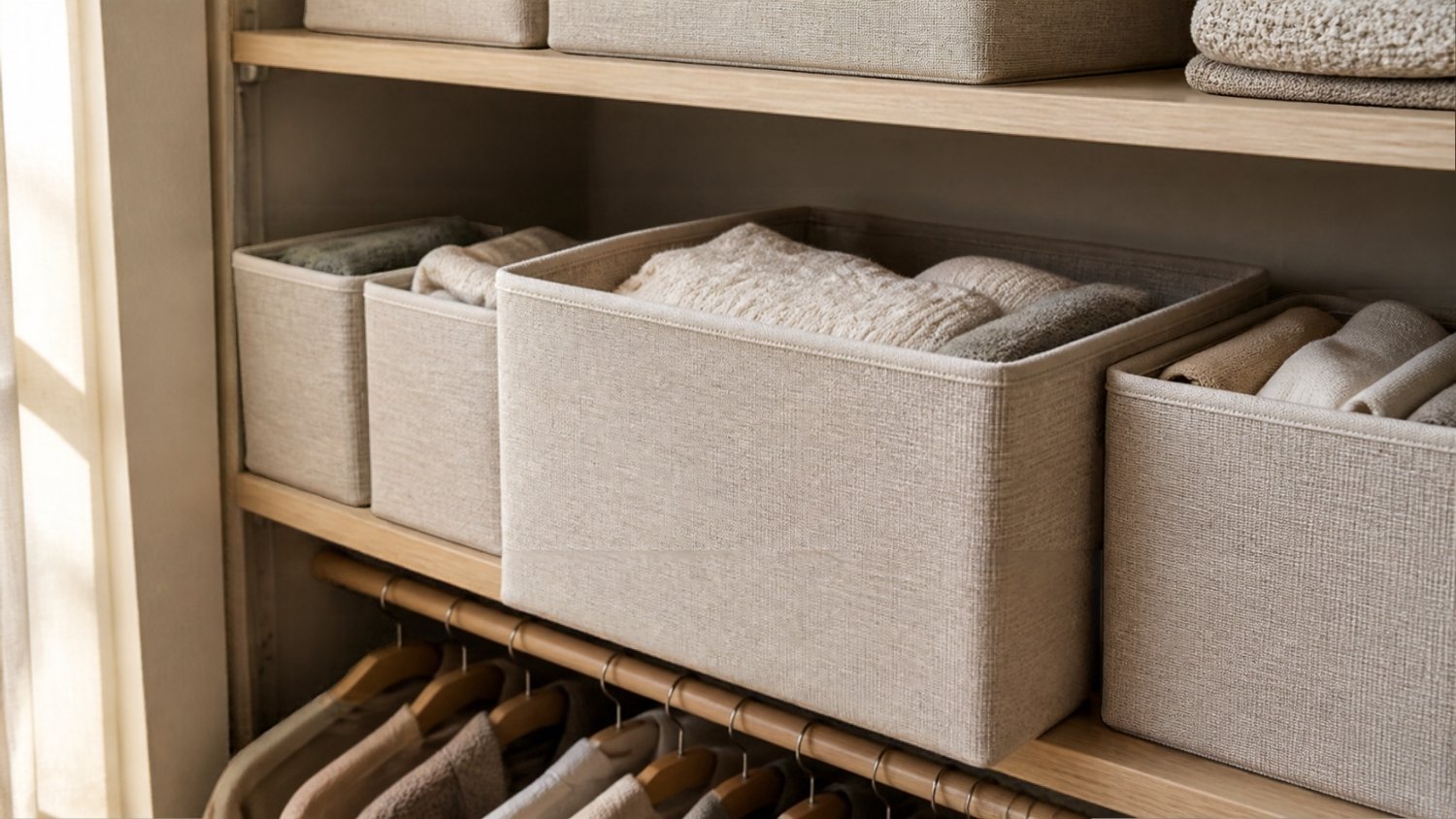
I found no published size standard for closet storage bins.
That is the whole problem. The 13 inch cube is the closest thing to one, and it still overhangs a 12 inch shelf by about an inch. Measure your shelf depth, your clear width and your headroom first, then check which axis of the listing runs front to back, because sellers do not agree on the order.
- 12 inThe shelf depth in most reach-in closets
- 13 inThe cube everyone buys. It overhangs by about an inch
- 15 inIKEA’s DRONA, which overhangs by three
- 10.5 inClosetMaid Cubeicals, which leaves a gap instead
A shelf of full bins is much heavier than a shelf of sweaters, and that is why it sags. On the shelving pages I read, a published capacity came with conditions attached: which exact product it covers, what the hardware goes into, and how far apart the fasteners sit. A figure quoted for one shelf tells you nothing about yours.
So find the capacity for the shelf you actually own, on the maker’s own page, and read the whole sentence around the figure rather than the figure alone. Two things are safe to say without a number. The two ranges I read publish very different figures, so the range name on the box matters as much as the number. And if your shelf dips in the middle, that is a sign to stop filling it and to go back to the figure its maker publishes.
Measure it properly, once. The free Closet Layout Planner has the measuring sheet, the standard dimensions on one page, three layouts that work, and a shopping checklist that tells you which measurement to verify for each item before you order it. Send it to me
What closet storage bins actually measure
Yours
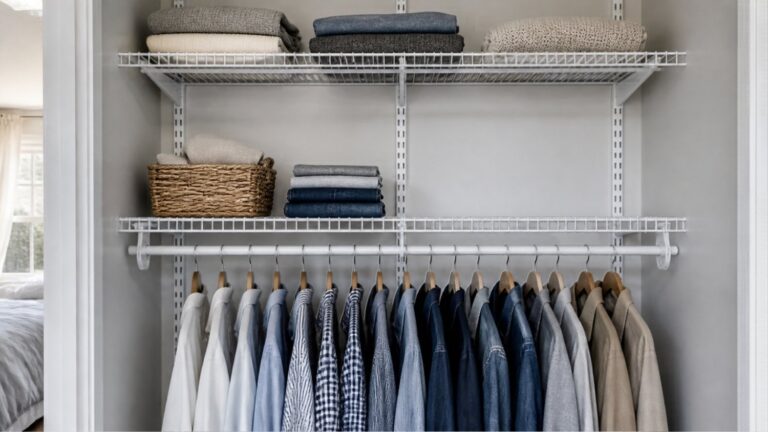
Wire closet shelving is manufactured in 6, 9, 10, 12, 16 and 20 inch depths, and reach-in closets usually have the 12. This is the number that decides almost everything, and it is the one nobody checks before ordering.
Three measurements, before you buy a single bin
Step 1
Shelf depth, front to back
Wire shelving comes in 6, 9, 10, 12, 16 and 20 inch depths. A reach-in usually has the 12, and that single number rules out more bins than anything else.
Step 2
Usable width between the walls
The actual clear span, not the closet width. A 13 inch cube is really 12.75 to 13 inches wide, so two of them need a full 26 inches. One cube fits a 24 inch shelf, two a 36, three a 48 and five a 72.
Step 3
Headroom above the shelf
Shelf surface to the ceiling, or to the next shelf. Top shelves commonly sit around 84 inches from the floor, so under an 8 foot ceiling you have roughly a foot. A bin two inches too tall is a bin you will never put back.
Will it fit? Enter the depth you measured and the depth the listing publishes, and the tool tells you whether it goes in, or that it cannot tell you yet. Try it
If you want the full routine, here is how to measure a closet step by step, with a sheet for every number.
The sizes closet storage bins actually come ineleven real footprints, and what each does on a 12 in shelf
Bins are the most satisfying purchase in the whole organizing world and the one most likely to come back out of the car still in its bag. Not because you chose badly, but because the three numbers that decide the answer are almost never printed where you can see them.
Retailers invent names freely, and no two brands agree on a cube. These are the real footprints you will meet, with the dimensions as the sellers state them. Watch the axis order: The Container Store lists length, width then height, IKEA lists width, depth then height, so the same number can mean two different things.
| Bin | Actual dimensions | On a 12 in shelf |
|---|---|---|
| 13 in fabric cube | 13 x 13 x 13 in exterior; I found no brand publishing an interior | Overhangs by about 1 in |
| Half cube with lid | 12.75 x 12.75 x 6.5 in | Overhangs slightly, but fits a low ceiling |
| IKEA DRONA | 13 x 15 x 13 in | No, overhangs by 3 in |
| IKEA KNIPSA seagrass | 12.5 w x 13 d x 12.5 h in | Overhangs by about 1 in |
| IKEA BRANAS rattan | 12.5 w x 13.5 d x 12.5 h in | Overhangs by about 1.5 in |
| ClosetMaid Cubeicals bin | 10.5 x 10.5 x 11 in | Yes, but leaves a gap in a 13 in cube opening |
| Clear shoe box | 7.5 L x 13 W x 4.25 H in | Only sideways, with the 7.5 in side front to back. Turned long-ways it overhangs by 1 in |
| Clear sweater box | 13.1 in deep, 15.6 wide, 6.75 high | Yes. Overhangs by about 1 in, the same as a cube, but needs 15.6 in of width |
| Deep sweater box | 13.1 in deep, 15.6 wide, 13.25 high | Depth is fine. Too tall for a top shelf under an 8 ft ceiling |
| Narrow bin | About 5 to 7 w x 12 to 14 d x 5 h in | Yes at 12 in deep. Check the depth: some run to 14 and overhang by 2 |
| Jumbo box | 16 x 27 x 12.4 in | No, this is a floor or garage box |
The 13 inch cube exists because of cube shelving units, not because of closets, and the fit is not guaranteed even inside one brand. The retailer listing for ClosetMaid’s own decorative fabric bin, at Walmart, carries this warning in capitals: these bins will not fit into ClosetMaid Cubeicals cubes. Same brand, both products. So measure the opening you are filling and ignore the name on the bin.
One more trap: collapsible cubes sold cheaply in packs of four are often 10.5 inches, not 13. They look identical in a photo, and in a 13 inch cube opening they leave a gap of two and a half inches.
Three baskets need 39 inches of clear span. On a 36 inch shelf only two fit, and that is how a shelf ends up with one basket turned sideways. Ventilated shelving is sold in 2, 3, 4, 6, 8 and 12 foot lengths.
Fabric, woven, clear or wireonly what is documented, which is less than you would think
Something you will not read on a product page: I could not find any comparative testing of these materials against each other for dust, sagging or cleanability. The internet is full of confident comparisons and I could not trace a source under any of them. So here is only what is actually documented.
- Clear polypropylene is what conservation guidance accepts for storage, alongside polyethylene and acid-free cardboard. It is also the cheapest transparent option, and being able to see what is inside is the real reason those boxes work.
- Fabric bins are fine for towels and t-shirts. The documented caution is about contact rather than the bin itself: textile guidance is to keep fabric from sitting directly against bare wood, newspaper or plain boxes, because it turns acidic over time. Line the bin with a cotton sheet or acid-free tissue if something good is going in it for years.
- Woven natural fiber, rattan, seagrass or water hyacinth, is beautiful, and none of it is washable. IKEA’s care line for its rattan basket is to wipe clean with a dry cloth. For seagrass it is a different warning entirely: the material dries out and deteriorates near a heat source. Plan for that before you put anything that can leak or shed inside one.
- Wire baskets were, of the types I read, the only ones whose listing published a load figure. One warning worth more than any number: a system’s headline capacity is often per bracket, not per basket. Those are very different things, and the figure that applies to yours is the one its own listing publishes. Read which one your product page is quoting before you fill it.
And a buying rule that matters more than material: on anything going above eye level, insist on cut-out handles. Plenty of the prettiest bins have none, which is fine at waist height and miserable at 84 inches.
Storing clothes in bins without wrecking themfour rules from textile conservators
If the bin is holding off-season clothes for six months, the rules change, and textile conservators have already done this work for us.
- Keep it dry. Damp is the thing that actually ruins stored clothes. A heated room inside the house is fine; a basement, a garage or an unheated attic is not, and that is exactly where most of us put the off-season bin.
- Clean first, every time. Perspiration, food stains and body oils are what make wool attractive to moths and carpet beetles. Dry cleaning kills every life stage, and so does laundering for 20 to 30 minutes in water at 120 degrees Fahrenheit or hotter, which is the figure University of California guidance gives. The duration is not optional: a short or cool cycle does not do it.
- Fold as little as possible, and pad the folds with unbuffered acid-free tissue. Textiles break along fold lines over years. Not newspaper, which makes fabric acidic wherever it touches.
- Rigid plastic boxes yes, dry cleaner bags no. This looks contradictory until you read both sides. Entomologists want tight-fitting containers to keep pests out. Conservators warn against thin plastic garment bags, because there is no air circulation and moisture builds up. A rigid polyethylene or polypropylene box over clean, dry clothes satisfies both.
Cedar will not save your sweatersfive extension services, and what they actually found
This one is worth the price of the article, because everybody repeats it and the people who study it do not agree. Cedar heartwood oil does kill small clothes moth larvae, but only at a concentration a closet or a chest never sustains, and University of California guidance adds that it does not affect large ones at all. North Carolina State puts it bluntly: cedar chests and closets do not keep woolens safe from clothes moths and carpet beetles for long periods, and the mothproofing value disappears after about two years. Kentucky says cedar closets and chests are seldom effective, because the seal is usually insufficient to hold a lethal concentration. Colorado State adds that the oils do not repel adult moths and do nothing at all to carpet beetles, and cites a study suggesting a chest more than three years old is practically useless for killing larvae. The Canadian Conservation Institute simply advises avoiding cedar chests, because the vapor it gives off has limited effectiveness.
What a good cedar chest does do is seal tightly, which physically keeps moths out. That is carpentry, not chemistry, and a plastic box with a lid does it for a fraction of the price. One warning from Colorado State worth repeating: an infestation already inside an old cedar chest will carry on developing quite happily.
Herbal sachets are in the same territory. University of California guidance says you can put herbal oils in the container, but little is known about how well they work. Colorado State notes that lavandin oil is registered for use on clothes after dry cleaning and is lethal to clothes moths, but that information is not available on its effect against other woolen pests such as carpet beetles. So keep them because they smell lovely, and do not count on them.
About labels, and what to put whereno study exists, and the reach figure people misuse
Honest answer: I could not find a single study either way on whether labeling household containers makes you use them better. It is a convention, and the only material on it comes from people selling label makers. Which does not mean skip it, only that nobody has earned the right to tell you how.
What is documented is a reach figure, though not the one people think. The ADA sets an unobstructed forward reach range of 15 to 48 inches, but that is an accessibility requirement for reaching operable parts, not a comfort guideline for a standing adult at a closet. I found no published comfortable reach figure for a standing person at a closet shelf. What is safe to say is that an 84 inch top shelf is above eye level for most adults, so you are working blind up there. A more useful rule than labeling everything: keep what you use weekly where you can see into it, use clear boxes at eye level and above, and save the pretty opaque baskets for the shelves you can actually look into.
The shelf under the bin
A bin deeper than the board it sits on overhangs the edge. The depths actually sold, and what each one holds, are on closet shelf depth. If you are planning the whole closet rather than one shelf, reach-in closet dimensions gathers every published figure with its source.
Once you know your three numbers, the rest of the closet follows. Our guide to closet layout dimensions has the full set, planning a narrow reach-in covers closets under four feet, and if bins are never going to be enough, what closet built-ins really cost has the numbers. For shoes specifically, see which shoe organizers actually fit.
Questions people ask5 questions
What size storage bin fits a closet shelf?
Reach-in closet shelves are usually 12 inches deep, and a 13 inch cube overhangs that by about an inch, which most people accept. What does not work is anything 15 inches or deeper front to back, such as IKEA’s DRONA at 15. Watch the axis labels here: the standard clear sweater box reads 15.6 inches, but that is its width, and its depth is 13.1, so it sits on a 12 inch shelf with about the same overhang as a cube. For a true 12 inch shelf with no overhang at all, look at narrow bins 12 inches deep or less, or clear shoe boxes turned sideways so the 7.5 inch side runs front to back.
How many 13 inch cubes fit on a closet shelf?
One on a 24 inch shelf, two on a 36, three on a 48. A 13 inch cube measures 12.75 to 13 inches wide, so two need a full 26 inches of clear span. Measure between the side walls rather than trusting the closet’s nominal width.
How much weight can a closet shelf hold?
Look it up for the shelf you own, on the maker’s own page. Each page I read publishes its own conditions alongside its own figure, so a number quoted for one shelf does not carry to another. What is safe to say: a shelf of full bins weighs far more than a shelf of folded clothes, and fixed-mount ventilated shelving carries much less than a heavy duty track system fixed into studs. If a shelf dips, stop filling it and read the figure its maker publishes.
Do cedar blocks or lavender keep moths away?
Not reliably. Cedar oil kills clothes moth larvae only at concentrations a closet never holds, it does not repel adult moths, and extension entomologists say the effect fades within a couple of years. On herbal oils, University of California guidance is that little is known about their effectiveness. What does work is cleaning garments before storage and sealing them in a tight-fitting container.
Is it bad to store clothes in plastic bins?
No, provided the clothes are clean and dry and the box is rigid. Conservation guidance accepts polyethylene and polypropylene boxes and rejects thin dry cleaner garment bags, where moisture gets trapped with no air circulation. Keep the bins in a dry, heated part of the house rather than a basement or garage, and off concrete floors.
Sourceswhat was read, and when
Dimensions checked on September 25, 2026 and re-checked on October 10. IKEA, The Container Store and ClosetMaid figures come from those brands’ own pages, specification sheets and brochures; where the figure or the warning sits on a retailer listing instead, at Walmart or Home Depot, the text says so. This article publishes no shelf weight rating on purpose: capacities depend on the exact product, on whether the hardware went into studs and on the spacing of the fasteners, so look yours up on the maker’s page. Storage conditions are from the Canadian Conservation Institute, the National Park Service and the Smithsonian, and pest guidance from the North Carolina State, Kentucky, Colorado State and University of California extension services. More closet fixes are in our closet organization guide.
Take the three numbers with you. Print the measuring sheet, fill it in at the closet, and order once instead of twice. Get the free planner
Saved in this browser, on this device. No account, nothing sent to us, and it goes if you clear your browsing data. See what you saved